

Table of Contents
- 1. Why Mobile Training Has Become a Strategic Priority for SMEs
- 2. The Real Training Challenges SMEs Face Today
- 3. Why Mobile Training Solutions Are Transforming SME Learning
- 4. Business Impact: How Mobile Training Drives ROI for SMEs
- 5. Compliance & Risk Mitigation Through Mobile-First Learning
- 6. How SMEs Can Implement Mobile Training With Minimal Complexity
- 7. Case-Driven Value: Measurable Outcomes Achieved With Modern LMS Tools
- 8. Competitive Advantage: Why Early Movers Benefit From Mobile Training
- 9. Choosing the Right Mobile Training Solution for Your SME
1. Why Mobile Training Has Become a Strategic Priority for SMEs
Small and mid-sized businesses are operating in an environment where talent agility, regulatory pressure, and operational efficiency directly influence competitiveness. As a result, mobile training solutions for SMEs have moved from being a “nice-to-have” to a practical, strategic requirement. Modern HR teams need training systems that are fast to deploy, easy to scale, and capable of supporting distributed workforces without adding administrative overhead. Mobile learning fits this reality by giving employees immediate access to bite-sized training while giving HR leaders real-time visibility into progress, compliance, and skill readiness.
1.1 The Shift Toward Digital, Distributed, and Skills-Focused Workforces
SMEs are increasingly hybrid, multi-location, and dependent on frontline employees who cannot attend long training sessions. Traditional methods-manual checklists, classroom sessions, and scattered documents-cannot keep pace with today’s speed of operations.
<div style="padding: 0 20px 12px 20px; border-radius: 10px; border: 2px solid #F6D9FF; background: #FAF8FF; font-family: 'Inter', sans-serif; font-size: 14px; margin-bottom: 25px;">
	<h2 style="margin: 0 0 12px 0; text-align: left;">
		<span id="Mobile-First-Learning-Overview">
			<span id="toc" style="display:inline-block; background:linear-gradient(219.84deg, #9A54DB 39.82%, #2B4FD8 126.01%); color: #fff; padding:6px 14px; border-radius:0 0 10px 10px; font-size:18px; font-weight:600;">
				Mobile-First Learning – Key Benefits
			</span>
		</span>
	</h2>
	<ul class="wp-block-list" style="margin:0; padding-left:18px; list-style:disc;">
		<li>
			Instant access to training materials regardless of shift, location, or device
		</li>
		<li>
			Short, focused learning paths that reduce downtime and boost retention
		</li>
		<li>
			Consistent training delivery across teams with varied schedules
		</li>
	</ul>
</div>
With labor productivity under pressure and role expectations expanding, leaders need tools that keep employees competent without disrupting daily operations. This is where mobile training solutions for SMEs offer clear operational value.
1.2 Rising Compliance Expectations and Risk Exposure
Regulatory requirements for safety, data handling, industry certifications, and HR documentation are becoming more complex-especially for SMEs operating in manufacturing, logistics, retail, healthcare, and services. Missed training directly translates into measurable business risk.
Mobile-based training helps SMEs:
- Maintain audit-ready documentation
- Track certifications and mandatory modules in real time
- Automate reminders to prevent lapses
- Ensure every employee receives the same standardized content
Instead of chasing paperwork, HR teams can focus on strategic workforce development. Effective mobile training solutions for SMEs strengthen compliance resilience while keeping training costs manageable.
1.3 The Cost of Outdated Training Methods for Growing Teams
Relying on in-person workshops, long PDFs, or disconnected digital tools slows learning and increases administrative burden. Common consequences include:
- Longer onboarding cycles
- Lower training completion rates
- Increased rework due to inconsistent instruction
- Higher dependence on supervisors for on-the-job explanations
These inefficiencies accumulate as SMEs scale. By contrast, mobile training solutions for SMEs enable faster rollout of content, more accurate skill tracking, and measurable performance improvements, turning training into a strategic driver of efficiency rather than a recurring operational bottleneck.
2. The Real Training Challenges SMEs Face Today
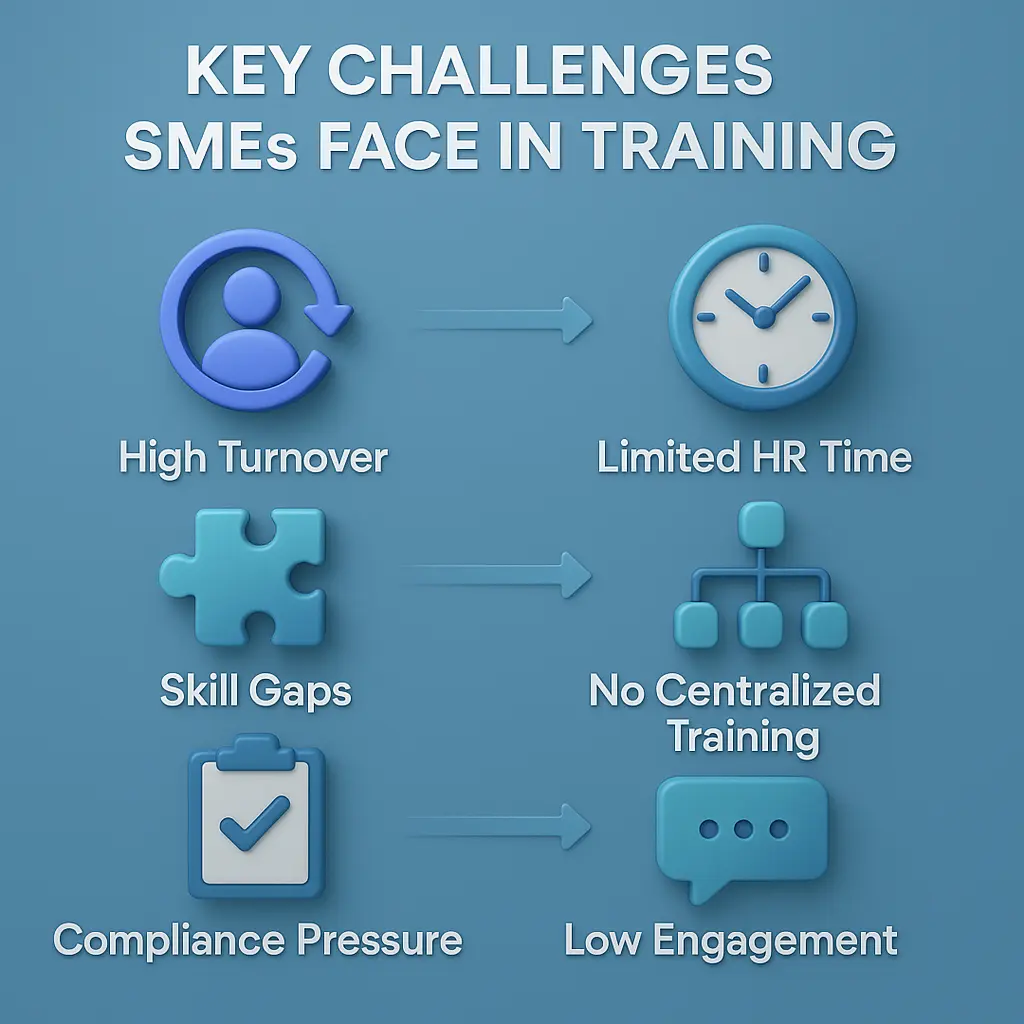
Small and mid-sized businesses operate under intense operational pressure. They must train employees quickly, maintain compliance, and support day-to-day productivity-often without a dedicated L&D function. Before leaders even consider mobile training solutions for SMEs, it’s essential to understand the underlying challenges that create friction, cost, and risk. These issues compound as teams grow, making training one of the most resource-draining responsibilities for HR and operations.
2.1 Limited Budgets, Minimal L&D Capacity, and Fragmented Processes
Most SMEs run lean teams where HR manages recruitment, onboarding, compliance, and training simultaneously. This creates several structural barriers:
- No dedicated L&D specialists, leading to ad-hoc training documentation and inconsistent delivery
- Budget limitations that make frequent workshops and instructor-led programs unsustainable
- High opportunity cost, as employees spend more time coordinating training than performing core tasks
- Siloed tools-PDFs, WhatsApp groups, spreadsheets, email-all used simultaneously to track training
These disconnected efforts reduce clarity, increase workload, and make training difficult to scale as the business grows.
2.2 Compliance Tracking Gaps That Increase Operational Risk
SMEs face rising compliance expectations across safety, role-based training, workplace policies, and industry-specific regulations. Yet most still use manual tracking or scattered systems, which creates high exposure.
Key risk factors include:
- Unverifiable completion records during audits
- Missed certifications that go unnoticed until an incident occurs
- Inconsistent delivery of mandatory content across shifts or branches
- Lack of standardized refreshers, making skills outdated over time
These gaps can directly impact customer trust, insurance obligations, and legal accountability. Even before adopting mobile training solutions for SMEs, leaders must acknowledge how unmanaged compliance processes weaken operational resilience.
2.3 Engagement and Adoption Failures With Traditional Training Formats
Employees-especially frontline staff-struggle with long workshops, dense documents, and static training formats. Engagement drops quickly when learning feels time-consuming or disconnected from daily work.
Common symptoms include:
- Low completion rates, particularly for non-mandatory modules
- Poor knowledge retention, leading to repeated mistakes
- Training fatigue, where employees view learning as a burden
- High dependency on supervisors, slowing down productivity
These challenges reveal why many SMEs struggle to create a workforce that is consistently skilled, compliant, and performance-ready.
3. Why Mobile Training Solutions Are Transforming SME Learning
The limitations of traditional training methods make clear the strategic value of modern, mobile-first approaches. Mobile training solutions for SMEs are reshaping how small and mid-sized businesses build skills, maintain compliance, and boost productivity. By delivering learning where employees work, these systems convert training from a static obligation into a measurable performance driver, supporting both operational efficiency and business growth.
3.1 Anytime, Anywhere Access for Modern Workforces
SMEs increasingly rely on distributed teams, shift-based roles, and remote or hybrid employees. Traditional classroom sessions cannot accommodate this flexibility, creating skill gaps and inconsistent compliance.
Mobile training solutions for SMEs solve this by:
- Providing on-demand access to learning resources on smartphones or tablets
- Allowing employees to complete modules during downtime, travel, or between tasks
- Reducing training bottlenecks, so learning aligns with operational schedules
- Ensuring uniform skill development across locations without requiring additional instructor time
The result is faster knowledge transfer and measurable reductions in ramp-up time for new hires.
3.2 Microlearning and Real-Time Content Updates
Complex procedures and industry regulations evolve rapidly, and SMEs cannot afford static training materials that quickly become obsolete. Modern mobile training platforms support:
- Bite-sized modules that improve comprehension and retention
- Rapid content updates, ensuring employees always work with the latest standards
- Push notifications and reminders, keeping learners engaged without manual follow-ups
This approach allows SMEs to respond to regulatory changes, product updates, or operational shifts almost instantly, reducing errors and compliance risks while maintaining workforce readiness.
3.3 Measurable Performance Uplift and ROI
Beyond access and engagement, the true business value lies in measurable improvements. Mobile training solutions for SMEs deliver:
- Higher completion rates and knowledge retention compared with traditional methods
- Data-driven insights on employee progress, skill gaps, and training ROI
- Faster onboarding, translating into quicker contribution from new hires
- Enhanced productivity, as employees spend less time retraining or correcting mistakes
By connecting training outcomes to operational performance, these solutions make learning a strategic lever rather than a cost center. For SMEs aiming to optimize workforce efficiency and reduce operational risk, mobile training solutions for SMEs are no longer optional-they are a vital investment that drives tangible business results.
The next sections explore how these solutions further strengthen compliance and risk management, translating learning into measurable organizational impact.
4. Business Impact: How Mobile Training Drives ROI for SMEs
For SMEs, training is not just an HR function-it is a measurable business driver. Investing in mobile training solutions for SMEs translates directly into reduced costs, faster onboarding, higher productivity, and smarter, data-driven decision-making. Unlike traditional training methods, mobile learning platforms provide actionable insights and operational flexibility, enabling SMEs to maximize the return on every training dollar.
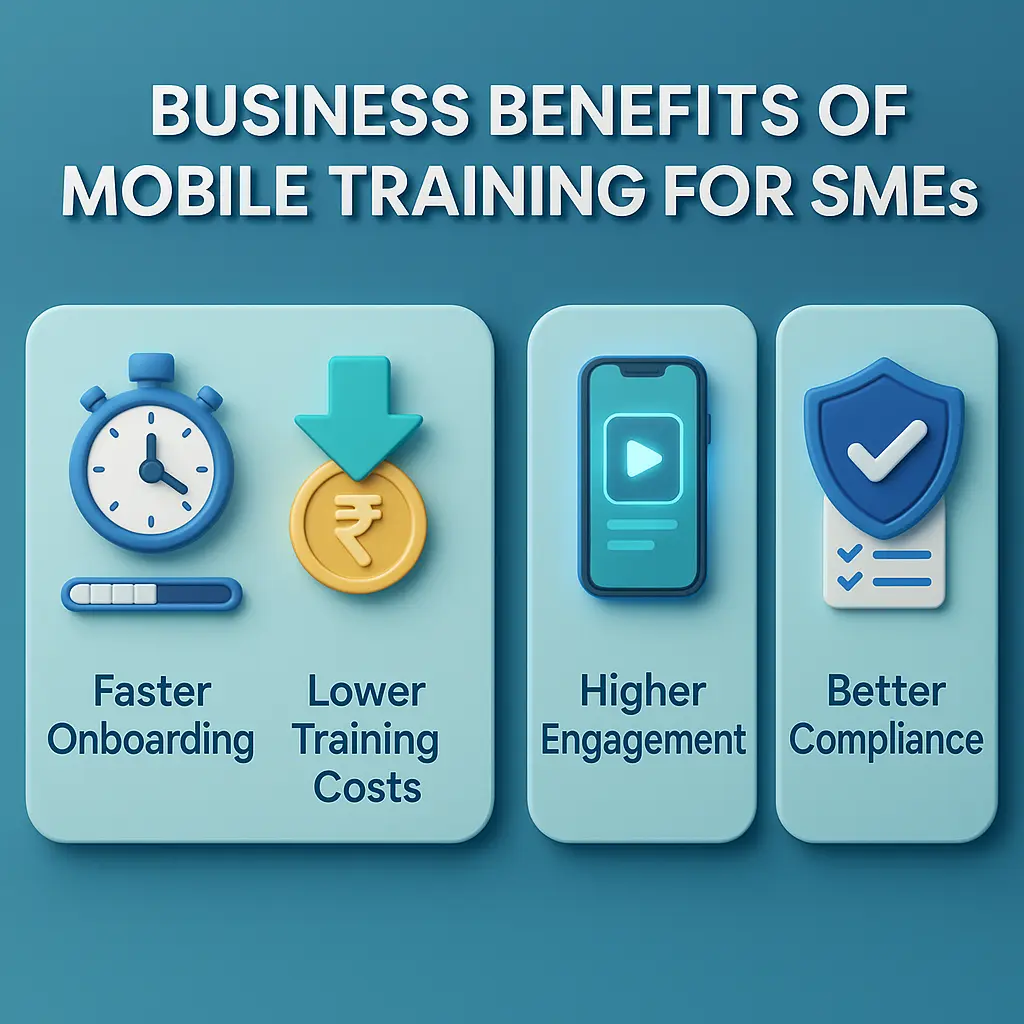
4.1 Faster Onboarding Cycles and Reduced Ramp-Up Time
New hires in SMEs often juggle multiple responsibilities from day one, making speed-to-competency critical. Mobile training accelerates onboarding by:
- Delivering role-specific modules that employees can complete at their own pace
- Allowing access to essential procedures, compliance guidelines, and best practices instantly
- Reducing average ramp-up time by 30–50%, compared to instructor-led sessions
This rapid upskilling ensures employees contribute meaningfully faster, mitigating lost productivity and avoiding operational bottlenecks that typically occur during the first 90 days.
4.2 Direct Cost Savings vs. Traditional Training Formats
Traditional training consumes budget through venues, instructors, travel, and printed materials. Mobile training consolidates these costs while maintaining learning quality.
<div class="custom-table-wrapper">
	<table class="custom-table">
		<thead>
			<tr>
				<th style="color:#FFFFFF; font-weight:600;">Metric</th>
				<th>Traditional Training</th>
				<th>Mobile Training Solutions</th>
			</tr>
		</thead>
		<tbody>
			<tr>
				<td style="color:#440385; font-weight:500;">Onboarding time</td>
				<td>6–8 weeks</td>
				<td>3–4 weeks</td>
			</tr>
			<tr>
				<td style="color:#440385; font-weight:500;">Training delivery cost per employee</td>
				<td>$800–$1,200</td>
				<td>$250–$400</td>
			</tr>
			<tr>
				<td style="color:#440385; font-weight:500;">Administrative overhead</td>
				<td>High</td>
				<td>Low</td>
			</tr>
			<tr>
				<td style="color:#440385; font-weight:500;">Compliance tracking</td>
				<td>Manual, error-prone</td>
				<td>Automated, real-time</td>
			</tr>
		</tbody>
	</table>
</div>
By digitizing and centralizing learning, SMEs can reduce annual training expenditures by 40–60% without compromising outcomes, freeing resources for strategic initiatives.
4.3 Data-Driven Productivity and Decision-Making
Mobile platforms provide analytics dashboards that track progress, completion rates, assessment scores, and skill gaps in real time. This enables:
- Targeted interventions for employees who need additional support
- Performance benchmarking across teams, roles, and locations
- Strategic workforce planning, allowing leaders to allocate talent where impact is highest
Companies leveraging mobile learning report 15–25% improvement in overall employee productivity within six months, while decision-makers gain visibility into training ROI that was previously inaccessible through fragmented spreadsheets and manual logs.
Investing in mobile training solutions for SMEs converts training from a reactive HR process into a measurable growth lever, enhancing compliance, operational efficiency, and employee performance simultaneously. This quantifiable impact positions mobile learning as a strategic asset rather than a peripheral cost.
5. Compliance & Risk Mitigation Through Mobile-First Learning
For SMEs, regulatory compliance and risk management are critical yet often resource-intensive. Non-compliance can result in fines, reputational damage, and operational disruptions. Mobile training solutions for SMEs provide a strategic approach to reduce these risks, streamline certification tracking, and ensure employees remain aligned with evolving regulatory requirements.
5.1 Real-Time Certification Tracking
Maintaining up-to-date certifications is essential for safety, legal, and operational compliance. Mobile-first learning systems enable SMEs to:
- Track certification status for every employee in real time
- Monitor renewal dates and skill expirations to prevent lapses
- Identify compliance gaps proactively before audits or inspections
- Generate detailed reports to verify competency across roles and locations
This visibility ensures organizations can confidently demonstrate workforce readiness and reduce exposure to regulatory penalties.
5.2 Audit-Ready Training Records and Automated Alerts
Manual record-keeping for compliance is time-consuming and prone to error. Mobile training solutions for SMEs replace fragmented systems with centralized, audit-ready documentation:
- Digital logs of course completion, assessment scores, and participation history
- Automated reminders for employees to complete mandatory training
- Easy extraction of reports for internal reviews or external audits
- Reduced administrative burden for HR teams, allowing focus on strategic workforce initiatives
Automating these processes minimizes the risk of missed deadlines and non-compliance, ensuring audits proceed smoothly and efficiently.
5.3 Reducing Regulatory Exposure and HR Risk
Beyond compliance, mobile learning mitigates broader HR risks by embedding consistent, standardized training across the workforce:
- Ensures all employees receive the same critical training, regardless of location or shift
- Reduces the likelihood of incidents due to outdated procedures or miscommunication
- Provides HR and leadership with actionable insights for targeted interventions
- Supports a proactive compliance culture, which strengthens employee accountability and organizational resilience
By integrating structured learning with automated tracking, mobile training solutions for SMEs transform compliance from a reactive task into a continuous, data-driven process. This approach not only reduces regulatory exposure but also enhances operational efficiency, workforce reliability, and long-term organizational stability.
Adopting mobile-first learning positions SMEs to meet compliance obligations efficiently while freeing HR teams to focus on strategic growth initiatives.
6. How SMEs Can Implement Mobile Training With Minimal Complexity
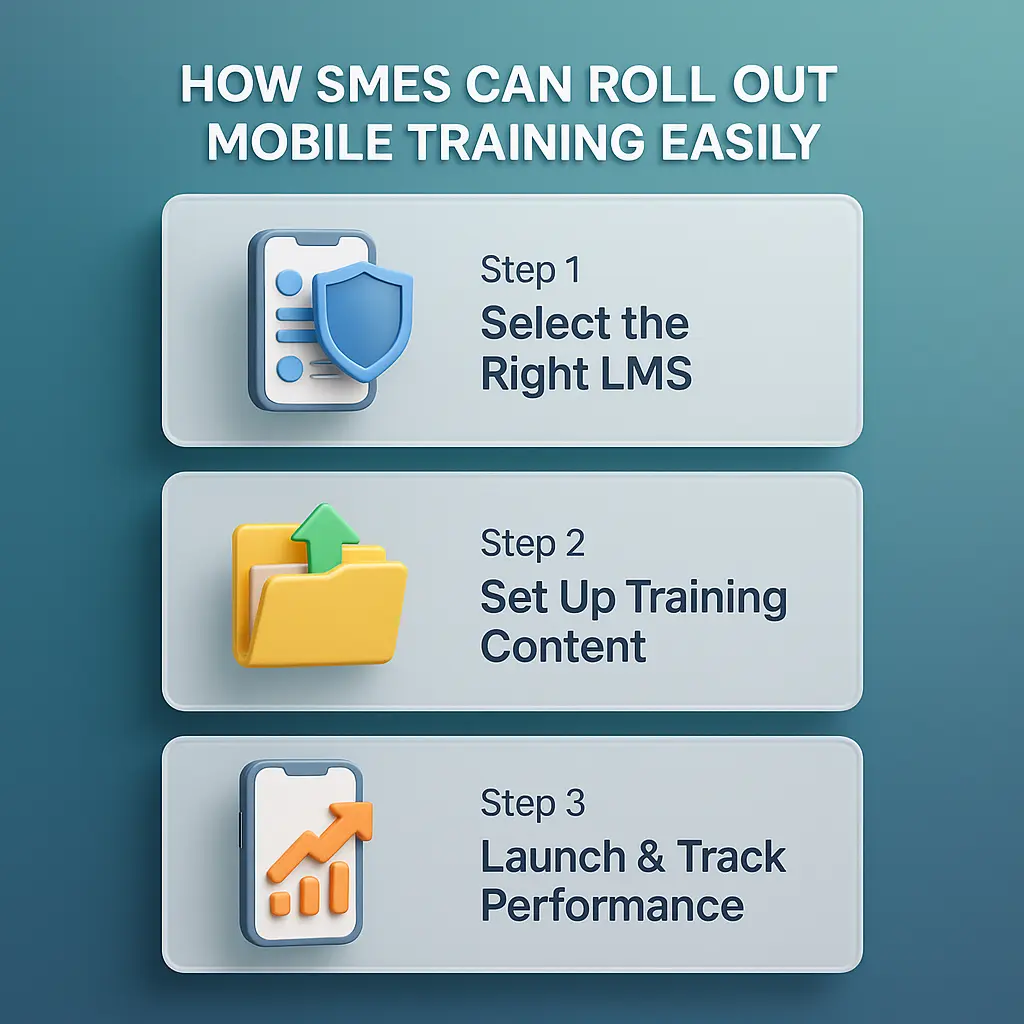
Deploying mobile training in SMEs does not have to be complicated or resource-intensive. By carefully selecting the right learning management system (LMS) and leveraging user-friendly features, SMEs can deliver high-impact training programs efficiently. The goal is to maximize adoption, control costs, and ensure scalability as the workforce grows. Mobile training solutions for SMEs are most effective when designed to minimize administrative burden while providing measurable business outcomes.
6.1 Choosing an LMS Designed for Small and Mid-Sized Teams
Selecting an LMS is the foundation of a successful mobile training initiative. SMEs should prioritize:
- Ease of setup with minimal IT dependency
- Scalable architecture that grows with team size without recurring complexity
- Flexible content management to accommodate compliance modules, product updates, and role-specific training
- Robust analytics to track completion rates, skill gaps, and ROI
By focusing on an LMS tailored to SME needs, organizations can implement mobile training solutions for SMEs without over-investing in enterprise-grade features that remain unused.
6.2 The Importance of Intuitive UX, Automation, and Templates
User adoption is critical for success. A well-designed interface encourages completion, reduces errors, and accelerates onboarding. Key elements include:
- Mobile-optimized dashboards for employees and managers
- Automated reminders and progress tracking to reduce manual follow-ups
- Pre-built templates and learning paths that simplify course creation and reduce content development costs
- Seamless integration with existing HR systems to maintain operational consistency
These features ensure training is frictionless, engaging, and repeatable, supporting both cost control and workforce productivity.
6.3 Simple Rollout and Deployment Examples
Effective deployment focuses on rapid time-to-value and minimal disruption. SMEs should:
- Launch pilot programs for high-impact modules before full rollout
- Leverage templates and automated workflows to scale training quickly
- Monitor analytics from day one to adjust content and schedules
For instance, platforms like Advance The Team allow SMEs to deploy training modules with minimal setup, automated tracking, and ready-to-use templates-demonstrating that mobile training solutions for SMEs can be implemented efficiently even in resource-constrained environments.
By combining thoughtful LMS selection, intuitive UX, and streamlined deployment strategies, SMEs can adopt mobile training with confidence, achieving measurable productivity and compliance benefits while keeping costs under control.
7. Case-Driven Value: Measurable Outcomes Achieved With Modern LMS Tools
Modern LMS platforms are not theoretical investments-they deliver tangible, quantifiable results for SMEs across industries. Mobile training solutions for SMEs provide clear visibility into learning effectiveness, cost efficiency, and workforce performance, enabling leaders to make data-driven decisions. The following examples illustrate realistic outcomes that demonstrate the strategic value of mobile-first training.
7.1 Accelerating Onboarding and Reducing Ramp-Up Time
A mid-sized logistics firm with 120 employees implemented mobile-first training to accelerate onboarding for warehouse staff and drivers. Prior to deployment, onboarding averaged 6 weeks with inconsistent performance. After introducing mobile training solutions for SMEs:
- Average onboarding time dropped to 3.5 weeks, a 42% reduction
- Early-stage task accuracy improved by 35%, reducing errors in shipment processing
- Employee satisfaction scores for initial training rose by 20%, indicating higher engagement and confidence
The faster ramp-up translated directly into operational efficiency, as new hires contributed fully sooner and reduced the dependency on supervisors for hands-on instruction.
7.2 Compliance and Certification Tracking
A small healthcare services SME struggled to keep track of mandatory certifications for 85 clinical staff, risking regulatory fines. Using mobile training platforms with automated tracking:
- Certification completion rates reached 98% on schedule, up from 65% in manual tracking
- Automated reminders cut overdue certifications by 75%, eliminating audit penalties
- Time spent by HR managing compliance dropped by 60%, freeing resources for strategic initiatives
These measurable improvements highlight how mobile training solutions for SMEs can reduce regulatory risk while minimizing administrative load.
7.3 Performance Insights and Skill Development
A growing retail chain leveraged an LMS to standardize product knowledge and customer service training across 200 employees. The platform provided real-time analytics, allowing managers to intervene where skill gaps appeared. Outcomes included:
- Average employee assessment scores increased by 28% within three months
- Sales conversion rates in trained teams improved by 15%, showing direct business impact
- Insights from tools like Advance The Team enabled managers to target coaching interventions effectively, identifying top performers and areas needing reinforcement
These results illustrate that mobile training solutions for SMEs not only streamline learning but also create a culture of measurable performance improvement. By combining data-driven insights with flexible delivery, SMEs gain operational efficiency, compliance assurance, and demonstrable workforce productivity gains, turning training into a strategic growth lever.
8. Competitive Advantage: Why Early Movers Benefit From Mobile Training
Adopting mobile-first learning early provides SMEs with a distinct edge over competitors. By integrating mobile training solutions for SMEs into workforce development strategies, leaders not only enhance employee capabilities but also position their organizations as agile, forward-looking, and talent-centric. Early movers capture advantages that extend beyond operational efficiency, influencing culture, retention, and market responsiveness.
8.1 Strengthening Employer Branding and Talent Retention
Top talent increasingly evaluates employers on learning opportunities and professional development. SMEs that implement mobile training solutions for SMEs:
- Signal a commitment to continuous skill growth, enhancing employer brand perception
- Offer flexible, self-paced learning that aligns with modern workstyles, increasing satisfaction
- Reduce turnover by 20–30% on average, as employees feel supported and empowered
A strong learning environment attracts candidates who value growth, positioning SMEs competitively against larger companies with more established L&D departments.
8.2 Enhancing Market Agility and Operational Responsiveness
Mobile training accelerates knowledge transfer across teams, enabling SMEs to respond faster to market changes:
- Rapid deployment of new processes or product knowledge ensures minimal disruption
- Teams adapt quickly to regulatory updates, seasonal demands, or client requirements
- Decision-makers gain confidence in workforce readiness, enabling strategic pivots without costly delays
By staying ahead in employee competence, SMEs maintain operational agility that early adoption of mobile training solutions for SMEs uniquely provides.
8.3 Cultivating a Future-Ready Learning Culture
Beyond immediate outcomes, early adoption fosters a culture of continuous improvement:
- Employees internalize learning as a routine, reducing dependency on ad-hoc interventions
- Knowledge sharing becomes systematic, enhancing collective organizational intelligence
- Leaders can leverage skill analytics to plan growth, succession, and innovation initiatives
By prioritizing mobile training solutions for SMEs, early movers embed learning into the organizational DNA, turning workforce development into a sustained competitive advantage. This strategic positioning ensures SMEs remain resilient, adaptive, and ready for long-term growth.
9. Choosing the Right Mobile Training Solution for Your SME
Selecting the right platform is critical for turning training from a compliance task into a strategic growth lever. Mobile training solutions for SMEs vary widely in features, scalability, and analytics capabilities. Decision-makers must assess tools not only for ease of use but also for their ability to deliver measurable business impact, maintain security, and integrate seamlessly with existing operations.
9.1 Essential Features for Scalable, Secure, and Insightful Training
When evaluating mobile training solutions for SMEs, focus on features that support growth, compliance, and operational efficiency:
- Scalability: Platform should support additional users, locations, and learning modules without significant IT overhead
- Analytics and Reporting: Track completion rates, assessment scores, skill gaps, and ROI in real time
- Integration Capabilities: Seamlessly connect with HRIS, payroll, and performance management systems
- Mobile UX: Intuitive interface, responsive design, offline access, and push notifications for engagement
- Security and Compliance: Data encryption, role-based access, and automated certification tracking
- Automation: Reminders, recurring learning assignments, and audit-ready reporting to reduce administrative burden
A checklist approach ensures no critical functionality is overlooked, helping SMEs select a platform that delivers immediate and long-term value.
9.2 Alignment With Organizational Learning Maturity
Not every SME requires enterprise-grade features. Evaluate the LMS based on your current learning maturity:
<div class="custom-table-wrapper">
	<table class="custom-table">
		<thead>
			<tr>
				<th style="color:#FFFFFF; font-weight:600;">Organization Stage</th>
				<th>Recommended Focus</th>
			</tr>
		</thead>
		<tbody>
			<tr>
				<td style="color:#440385; font-weight:500;">Emerging</td>
				<td>Easy content creation, basic tracking, mobile access</td>
			</tr>
			<tr>
				<td style="color:#440385; font-weight:500;">Growing</td>
				<td>Advanced analytics, automated compliance, integrations</td>
			</tr>
			<tr>
				<td style="color:#440385; font-weight:500;">Established</td>
				<td>Full-scale learning paths, performance insights, predictive skill planning</td>
			</tr>
		</tbody>
	</table>
</div>
This framework helps match investment to actual business needs. Platforms like Advance The Team illustrate how SMEs can align LMS capabilities with learning maturity, enabling staged adoption without overspending.
9.3 Cost-Effective Rollout and Total Value Assessment
Decision-makers should consider ROI beyond license cost:
- Implementation time: Faster deployment reduces lost productivity
- Content reuse and templates: Minimize instructional design costs
- Employee adoption metrics: High engagement translates into measurable performance gains
- Ongoing analytics: Enables continuous optimization and strategic workforce planning
Choosing the right mobile training solutions for SMEs ensures the platform is not just a tool but a strategic partner-driving compliance, skill development, and workforce efficiency while remaining cost-effective and adaptable to future growth.
<div style="border-radius:10px; margin-bottom:24px;">
	<h2 style="font-family: 'Inter', sans-serif; background:linear-gradient(219.84deg, #9a54db 39.82%, #2b4fd8 126.01%); color:white; padding:10px 20px; font-size:18px; font-weight:600; margin:0px; border-radius:10px 10px 0px 0px;">
		<span id="Conclusion">Conclusion</span>
	</h2>
	<div style="font-family: 'Inter', sans-serif; background:linear-gradient(219.84deg, #EAECFF 39.82%, #F6ECFC 126.01%); padding:15px 20px 10px 20px; border-radius:0px 0px 10px 10px; font-size:14px; font-weight:400;">
		<p>In today’s fast-changing business environment, SMEs can no longer rely on traditional, manual, or classroom-only learning methods. Modern teams demand faster onboarding, continuous upskilling, and consistent knowledge delivery across locations.</p>

		<p>Throughout this guide, we explored why structured training is now a business necessity, how skill gaps limit productivity, and how high turnover and compliance demands place growing pressure on HR teams-making the shift to digital learning unavoidable.</p>

		<p>We discussed the core challenges SMEs face, including limited budgets, time constraints, lack of L&D expertise, and the inability to track training outcomes accurately. We also demonstrated how mobile training solutions for SMEs address these issues through flexible microlearning, instant content delivery, real-time tracking, and scalable standardized training.</p>

		<p>We examined how mobile-based learning boosts engagement through interactive formats, supports remote and field teams, reduces HR’s administrative workload, and helps organizations respond rapidly to changing regulations and market demands.</p>

		<p>Key features such as centralized content management, automated progress tracking, assessments, certificates, offline learning, analytics dashboards, and seamless workflow integrations further strengthen digital learning ecosystems.</p>

		<p>Ultimately, future-ready SMEs are investing in digital learning to drive productivity, reduce errors, strengthen compliance, and build a culture of continuous improvement-making mobile training solutions for SMEs not just a training upgrade, but a long-term competitive advantage for organizations ready to modernize their workforce and accelerate growth.</p>
	</div>
</div>