

Table of Contents
- 1. Introduction: Why Remote Employee Training Has Become a Strategic Priority
- 2. The New Reality of Remote Work: Key Challenges HR & L&D Must Address
- 3. What Makes Remote Employees Engaged? The Behavioral Science Behind Motivation
- 4. Designing an Effective Remote Training Strategy: Frameworks HR Teams Can Use
- 4-Pillar Learning Experience Framework: Designing Engaging and Retainable Learning
- 5. Core Components of High-Impact Remote Training Programs
- 6. Training Modalities: What Works Best for Remote Employees?
- 7. Technology Backbone: How Modern LMS Platforms Enable Effective Remote Training
- Key LMS Capabilities for Remote Training Success
- 8. Where Advance The Team Fits In: A Practical Look at LMS Capabilities for Remote Teams
- 9. Implementation Blueprint: How to Train Remote Employees Effectively (Step-by-Step)
- 10. Creating Engaging Learning Experiences for Remote Employees
- 11. Measuring ROI: KPIs and Analytics That Show Training Impact on Remote Teams
- 12. Common Mistakes Companies Make When Training Remote Teams (and How to Avoid Them)
- 13. Building a Culture of Continuous Learning in Remote Organizations
- 14. Case-Driven Insights: What High-Performing Remote Organizations Do Differently
- 15. Selecting the Right LMS for Remote Training: Comparison Criteria HR Leaders Should Use
- 16. Future of Remote Employee Training: AI, Automation, and Data-Driven Learning
- 17. Conclusion
1. Introduction: Why Remote Employee Training Has Become a Strategic Priority
The rise of distributed work has redefined how organizations develop talent, maintain productivity, and ensure consistent performance across teams. What began as a temporary shift has matured into a long-term operating model-one where nearly 60–70% of global knowledge workers now spend at least part of their week working remotely, according to multiple workforce surveys. This transition has introduced both opportunity and complexity, placing remote employee training at the center of modern HR and L&D strategies.
As remote and hybrid structures expand, companies are confronting critical capability gaps that cannot be solved with ad-hoc training or legacy classroom-based models. Skill requirements are evolving faster than traditional learning cycles, and employees working across time zones lack the peer learning, informal coaching, and on-the-job visibility that once occurred naturally in physical offices. The result is a widening chasm between required competencies and day-to-day performance.
Multiple market studies show that organizations with structured remote learning frameworks experience:
- Higher productivity from employees who receive targeted upskilling
- Faster onboarding cycles due to standardized learning paths
- Lower turnover, especially among younger, distributed teams
- Improved collaboration and alignment, even in asynchronous environments
These outcomes highlight a fundamental shift-training is no longer a support function but a strategic enabler of workforce effectiveness. Without a clear approach to developing remote talent, companies face measurable performance risks: inconsistent service delivery, slower project execution, reduced engagement, and rising operational costs tied to errors and rework.
The urgency is amplified by the global skills shortage. Research shows that over 40% of enterprise roles require new or updated skills every 12–18 months, leaving remote employees especially vulnerable to falling behind. In distributed teams, even small competency gaps magnify quickly because managers have fewer opportunities to intervene early, coach directly, or observe real-time performance challenges.
This is why leaders are turning to structured, technology-enabled training ecosystems. Modern digital learning frameworks offer consistency, visibility, and scale-three elements that remote teams depend on to perform effectively. They allow HR and L&D teams to:
- Deliver role-aligned content without geographic constraints
- Track progress, completion, and skill development at individual and team levels
- Reinforce learning through automation, nudges, and feedback
- Build a culture of continuous improvement supported by data
In today’s distributed work environment, remote employee training is no longer optional. It has become a core driver of productivity, resilience, and competitive advantage. Companies that treat remote training as a strategic asset-not a compliance requirement-are the ones building agile, future-ready workforces capable of meeting the demands of a rapidly changing market.
2. The New Reality of Remote Work: Key Challenges HR & L&D Must Address
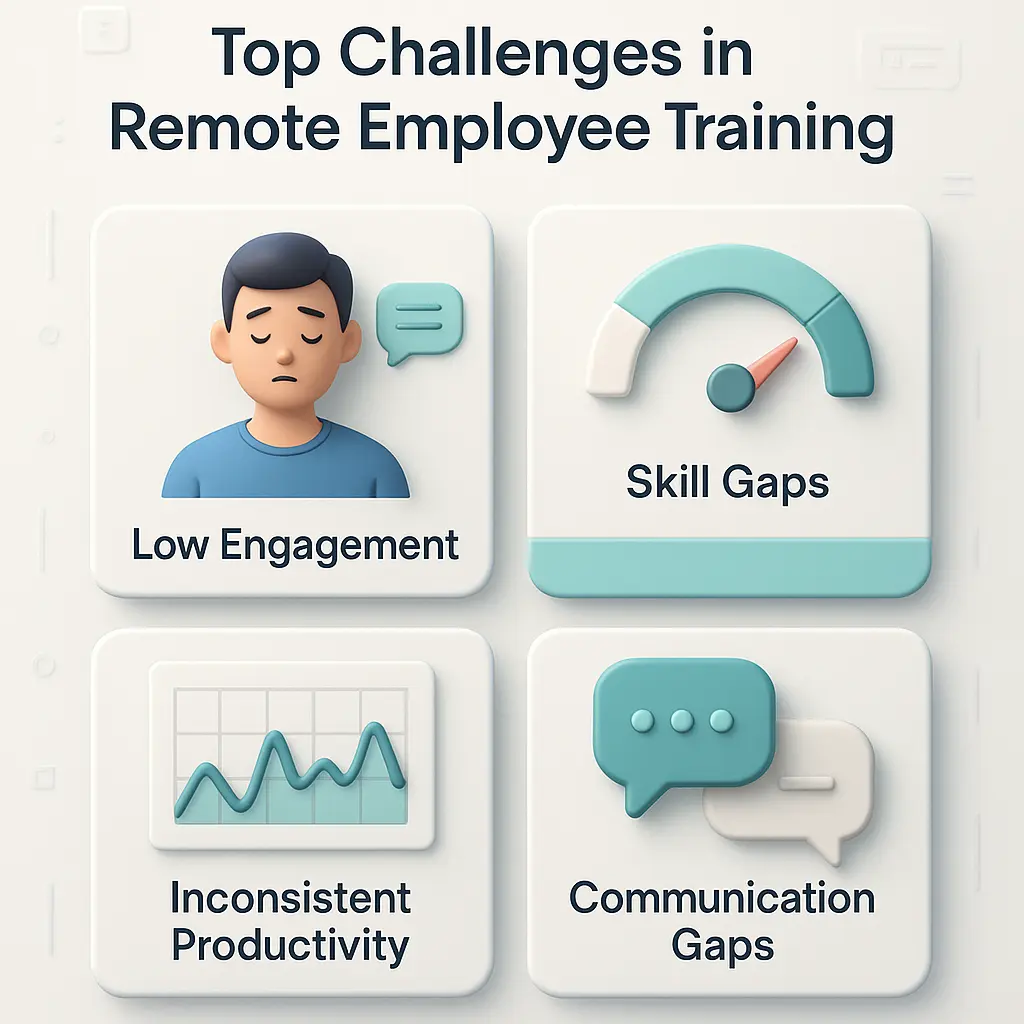
Remote work has moved far beyond an operational shift-it has fundamentally changed how organizations build capability, maintain alignment, and manage employee performance. While distributed teams offer access to wider talent pools and increased flexibility, they also expose structural weaknesses in communication, skill development, and managerial oversight. As these gaps grow, remote employee training becomes essential not just for skill-building, but for ensuring consistency, productivity, and long-term workforce readiness. HR leaders and L&D teams now face challenges that traditional training methods were never designed to solve.
Below are the most urgent and widespread challenges reshaping how companies approach learning in a distributed environment:
• Declining Day-to-Day Engagement
Without face-to-face interaction, natural learning moments-peer coaching, quick clarifications, informal feedback-disappear. This leads to lower engagement, weaker collaboration, and slower problem-solving across remote teams.
• Fragmented Communication and Information Flow
Employees working across time zones often receive inconsistent messages, outdated content, or lack visibility into updated processes. This creates performance variations that structured digital learning must address.
• Limited Visibility Into Skill Gaps and Performance Issues
Managers cannot easily observe day-to-day work in a remote setting. As a result, competency gaps go unnoticed until productivity drops or errors accumulate, making timely intervention difficult without strong analytics.
• Inconsistent Onboarding for Distributed Teams
Remote onboarding frequently lacks structure, leading to longer ramp-up periods, uncertain expectations, and higher early-stage attrition. A standardized training pathway is essential to maintain quality and speed.
• Rising Training Costs Caused by Disconnected Tools
Using multiple communication platforms, content repositories, and manual tracking systems increases operational overhead. Centralized learning management reduces inefficiencies and brings training under one cohesive ecosystem.
• Overreliance on Live Meetings and Synchronous Sessions
Remote teams suffer when training depends solely on scheduled calls or instructor-led sessions. Time-zone conflicts and calendar overload reduce participation, leading to inconsistent skill development.
• Difficulty Sustaining Learning Momentum
Without structured reinforcement, remote employees often forget or deprioritize what they learn. Continuous, automated follow-ups and microlearning are now essential to support long-term retention.
These challenges illustrate why organizations are reevaluating their L&D strategies for distributed teams. The complexity of remote work demands a deliberate, technology-enabled approach-one where remote employee training is built on systems, analytics, and workflows that ensure consistency at scale. As HR and L&D leaders confront these realities, the need for structured digital learning programs becomes not just important but mission-critical for sustaining performance in the modern workplace.
3. What Makes Remote Employees Engaged? The Behavioral Science Behind Motivation
Engaging remote employees requires more than delivering content or tracking completion rates. In distributed environments, motivation is shaped by psychological drivers that influence how people absorb information, retain new skills, and apply learning to real work scenarios. This is why leading organizations now design remote employee training programs around behavioral science principles rather than traditional instructional design alone. When employees feel autonomy, clarity, relevance, and recognition, they participate more actively-and their performance improves measurably.
Modern research on human motivation, cognitive psychology, and workplace behavior reveals the specific factors that elevate engagement in remote settings. The following elements form the foundation of high-performing learning ecosystems:
• Autonomy and Control Over Learning Pace
Remote employees respond positively when they have flexibility in how and when they learn. Self-paced modules reduce resistance, increase intrinsic motivation, and fit naturally into work cycles without causing cognitive fatigue.
• Clarity of Expectations and Learning Outcomes
Uncertainty is a major friction point for distributed teams. Clearly stated objectives, role-aligned competencies, and transparent learning paths help employees understand why training matters and how it supports their career progression.
• Microlearning and Cognitive Load Management
Behavioral studies show the brain absorbs information more effectively in short, targeted bursts. Microlearning reduces overwhelm, supports better retention, and keeps employees engaged without interrupting their workflow-making it a critical component of any remote training strategy.
• Personalization Based on Role, Skills, and Experience
When learning feels relevant, motivation increases dramatically. Personalized pathways, adaptive modules, and skills-based recommendations ensure that employees receive training tailored to their needs rather than generic content that fails to resonate.
• Continuous Feedback, Recognition, and Small Wins
Consistent reinforcement taps into the brain’s reward systems. Badges, progress indicators, and achievement notifications provide psychological incentives that keep learners emotionally connected to the training journey.
• Social Learning and Peer Interaction
Even in remote environments, people learn best through shared experiences. Discussion boards, cohort-based programs, collaborative assignments, and expert-led forums recreate the social cues and knowledge-sharing mechanisms that naturally occur in physical workplaces.
• Story-Based and Scenario-Driven Learning
Behavioral science confirms that humans learn better through narrative. Real-world scenarios, branching journeys, and case-driven simulations activate emotional memory-boosting engagement and real-world application.
When organizations integrate these behavioral principles into remote employee training, they build learning experiences that feel meaningful, personalized, and psychologically rewarding. The result is not just higher completion rates but a workforce that is more capable, more confident, and more connected-despite operating from different locations and time zones.
4. Designing an Effective Remote Training Strategy: Frameworks HR Teams Can Use
Building an effective strategy for remote employee training requires more than digitizing content or shifting classroom sessions to video calls. Distributed teams operate with different rhythms, distractions, and information flows, meaning HR and L&D leaders must adopt structured frameworks that ensure consistency, clarity, and measurable outcomes. A well-designed remote training strategy should balance scalability with personalization, align with organizational competencies, and provide visibility into how skills translate into performance.
Two strategic frameworks help HR leaders operationalize a modern, high-impact approach to remote learning: the Remote Capability Model (RCM) and the 4-Pillar Learning Experience Framework. Together, they provide a blueprint for designing training that is scalable, role-aligned, and data-driven.
Key Components of a Modern Remote Training Strategy
• Define clear performance outcomes
Training must be tied to specific behavioral and skill-based goals. Clear outcomes reduce ambiguity and make it easier to measure ROI and identify skill gaps.
• Map competencies to job roles and workflows
Remote employees need clarity on what skills matter and why. A structured competency map ensures training content is relevant and aligned with real work.
• Create repeatable learning pathways
Standardized paths for onboarding, upskilling, and leadership development help ensure all employees receive consistent, high-quality learning-regardless of location.
• Build reinforcement and assessment loops
Quizzes, simulations, practice scenarios, and coaching touchpoints help reinforce new knowledge and validate capability development.
• Use automation for scale and consistency
Automated reminders, progress tracking, and learning nudges reduce administrative workload, improve adoption, and help maintain momentum across distributed teams.
Comparing Strategic Frameworks for Remote Training
The two most effective structures for planning, executing, and scaling remote employee training are shown in the table below:
| Framework | Primary Focus | Strengths for Remote Teams | Best For |
|---|---|---|---|
| Remote Capability Model (RCM) | Capability alignment and performance readiness | Clarifies role expectations, identifies skill gaps, supports competency-based training | Onboarding, upskilling, workforce readiness planning |
| 4-Pillar Learning Experience Framework | Learning design and delivery quality | Enhances engagement through content, delivery, feedback, and reinforcement | Designing training experiences, improving adoption, boosting retention |
Remote Capability Model (RCM): Building Skills for Distributed Performance
The RCM helps HR teams identify and strengthen the exact capabilities remote employees need to perform with confidence. It shifts the focus from content volume to capability outcomes.
Key elements include:
- Role clarity: Ensuring employees know what “good performance” looks like.
- Skill mapping: Identifying required competencies for each role.
- Gap identification: Using assessments and analytics to highlight performance risks early.
- Capability progression: Defining how employees advance from foundational to expert-level skills.
This model provides a measurable structure to ensure training directly drives individual and organizational performance-critical in remote environments where visibility is limited.

4-Pillar Learning Experience Framework: Designing Engaging and Retainable Learning
While the RCM focuses on what employees must be able to do, the 4-Pillar Framework focuses on how training is delivered and experienced.
Its pillars ensure a holistic learning journey:
- Content – Clear, relevant, digestible lessons aligned with skills.
- Delivery – Blended formats including microlearning, mobile modules, and VILT.
- Feedback – Assessments, coaching interactions, and actionable insights.
- Reinforcement – Nudges, reminders, and follow-up modules to strengthen retention.
This framework is especially effective for addressing common remote learning challenges such as disengagement, cognitive overload, and lack of structure.
Using Both Frameworks Together
When combined, the RCM and 4-Pillar Framework give HR leaders a complete system:
- RCM defines capabilities
- 4-Pillars define learning experiences
- Together, they support scalable, high-impact remote employee training that improves both engagement and performance.
5. Core Components of High-Impact Remote Training Programs
High-impact remote employee training is built on structure, clarity, and continuous development-not one-off courses or scattered learning resources. For distributed teams, the quality of the training architecture often determines the quality of the workforce. When employees operate across locations and time zones, a well-designed training system becomes the backbone for consistent performance, faster onboarding, and long-term capability building. The most successful organizations rely on a set of core components that ensure training is not only engaging but operationally effective.
Below are the foundational elements every HR and L&D team should embed into their remote learning strategy:
• Structured and Standardized Onboarding
Remote onboarding must compensate for the lack of in-person guidance. High-performing companies use standardized onboarding pathways to ensure every new hire receives consistent information, role clarity, and early-stage support. This reduces ramp-up time, accelerates productivity, and builds early engagement. Effective remote onboarding includes:
- Clear learning sequences for the first 30, 60, and 90 days
- Role-specific competency expectations
- Automated reminders and check-ins
- Access to centralized resources, documents, and SOPs
• Job Role–Based Learning Journeys
Learning must mirror real work. Role-aligned learning journeys give employees a predictable progression path that aligns with required skills and business goals. When employees know exactly what they need to learn-and why-they engage at a higher level. These journeys typically include:
- Skill-based modules tied to job tasks
- Branching pathways for specialization
- Periodic assessments to verify competency
- Integrated milestones that reflect career development
• Continuous Skills Development and Upskilling
Remote teams experience faster skill decay due to limited face-to-face coaching. This makes continuous development essential for maintaining performance. High-impact remote training programs include:
- Monthly or quarterly upskilling modules
- Microlearning to reinforce key competencies
- Access to on-demand content for just-in-time learning
- Regular capability assessments to prevent skill gaps from widening
• Collaborative and Peer-Driven Training Formats
Isolation is a major challenge in remote work. Collaborative learning introduces community, shared insights, and peer accountability-key drivers of engagement and retention. Effective remote programs incorporate:
- Discussion boards and learning forums
- Cohort-based programs with group assignments
- Peer reviews and knowledge-sharing sessions
- Virtual workshops where teams solve real-world scenarios
• Feedback Loops, Coaching, and Performance Support
Skills only translate into performance when employees receive timely feedback and structured coaching. Remote teams benefit from feedback loops that combine data, manager insights, and practical reinforcement. Strong coaching infrastructure includes:
- Regular manager check-ins tied to learning progress
- Skill assessments followed by targeted guidance
- Automated reminders for practice and reinforcement
- Performance dashboards that identify improvement areas
When these components work collectively, remote employee training evolves from a content delivery process into a scalable system for building capability across the organization. This integrated approach ensures that employees not only complete training but apply it confidently-driving productivity, engagement, and measurable business outcomes.
6. Training Modalities: What Works Best for Remote Employees?
Designing effective remote employee training requires selecting the right blend of modalities-formats that not only deliver information but sustain engagement, accommodate diverse work schedules, and support long-term skill retention. In distributed teams, training must be flexible enough to fit into asynchronous workflows while still offering opportunities for collaboration and real-time learning. The most successful organizations use a multimodal approach that leverages several complementary formats to meet different learning needs.
Below are the modalities proven to have the highest impact on remote workforce capability and engagement:
• Microlearning for Faster Absorption and Better Retention
Short, focused modules allow employees to learn in manageable bursts without overwhelming their cognitive load. Microlearning is especially effective for:
- Reinforcing essential skills
- Introducing new tools or processes
- Providing just-in-time learning
Because remote employees juggle multiple priorities, microlearning helps training blend seamlessly into daily work.
• Video-Based Learning for Visual and Self-Paced Understanding
Videos remain one of the most engaging formats in digital learning. They simplify complex topics and allow employees to learn at their own pace. High-performing teams use video modules for:
- Demonstrations and walkthroughs
- Compliance and policy training
- Role-specific instructions
- Customer scenarios and service guidelines
Video content supports visual learners and reduces the need for constant live sessions.
• Virtual Instructor-Led Training (VILT) for Real-Time Interaction
While asynchronous training is essential, there are moments when live instruction adds value. VILT sessions mimic the benefits of classroom learning in a remote environment by encouraging:
- Real-time Q&A and discussion
- Immediate feedback
- Collaborative problem-solving
- Interactive exercises
For complex skills or new initiatives, VILT creates structure and ensures clarity.
• Cohort-Based Programs for Community and Accountability
Remote teams often lack the social reinforcement that naturally occurs in physical offices. Cohort learning fills this gap by enabling employees to learn together, share experiences, and stay accountable. It works well for:
- Leadership development
- Role transitions
- Cross-functional upskilling programs
These cohorts promote peer learning while fostering collaboration and belonging.
• Mobile Learning for Distributed Workforces
Mobile-based training is critical for employees who work in the field, travel frequently, or prefer flexible learning environments. Mobile learning supports:
- On-the-go content access
- Bite-sized lessons
- Notifications and micro-assessments
This modality ensures remote training meets employees where they are-in both schedule and location.
• Assessments and Skills-Based Evaluations
Training without measurement delivers limited value. Assessments help confirm learning retention and identify areas requiring improvement. Effective assessment formats include:
- Quizzes and knowledge checks
- Scenario-driven evaluations
- Skill-based tasks or assignments
- Competency assessments tied to job performance
Data from assessments strengthens remote training by providing actionable insights for both managers and learners.
• Simulations for Real-World Application
Simulations elevate remote employee training by immersing employees in realistic work situations without the risk of real-world consequences. These are especially powerful for:
- Customer interactions
- Technical operations
- Equipment handling
- Problem-solving scenarios
Simulations accelerate skill mastery by enabling employees to practice in a controlled, repeatable environment.
Using a combination of these modalities allows HR and L&D leaders to build training ecosystems that are flexible, engaging, and scalable. More importantly, they meet the diverse learning preferences of remote employees-ensuring stronger adoption, better retention, and sustained performance across the organization.
7. Technology Backbone: How Modern LMS Platforms Enable Effective Remote Training
High-performance remote employee training is impossible without a strong technology foundation. As distributed workforces scale, manual training processes, scattered documents, and ad-hoc communication channels cannot keep pace with the demands of consistent upskilling, compliance, and performance readiness. This is why modern LMS platforms have evolved into mission-critical infrastructure for HR and L&D teams-offering automation, analytics, and intelligent workflows that make training measurable, repeatable, and scalable.
In recent years, LMS adoption has accelerated across global enterprises. Industry reports show a consistent double-digit growth in digital learning platform usage as organizations shift from traditional classroom formats to hybrid and remote-first learning models. Today’s LMS ecosystem goes far beyond hosting courses; it orchestrates the entire learning lifecycle with precision.
Modern platforms support remote training in four key ways:
• Centralized Learning Delivery and Content Management
A unified LMS eliminates fragmentation by consolidating all training materials-videos, microlearning, SOPs, assessments, and simulations-into one accessible environment. This ensures every remote employee gets accurate, up-to-date content without relying on manual distribution or email threads.
• Data-Driven Insights and Training Analytics
Advanced analytics transform training from a compliance activity into a performance strategy. LMS dashboards allow HR and L&D teams to:
- Track completion, progress, and skill development
- Identify knowledge gaps across teams, roles, and locations
- Predict attrition or performance risks through learning behavior patterns
- Align training outcomes with business KPIs
These insights enable targeted interventions, improving both efficiency and impact.
• Automation to Reduce Administrative Load
Automation is essential for scale. Modern systems streamline workflows such as:
- Enrollment and assignment of learning paths
- Deadline reminders and learning nudges
- Certification renewals
- Manager notifications
By removing repetitive tasks, HR teams gain more time for strategic work like capability planning and program design.
• Engagement and Motivation Tools
Remote teams often struggle with motivation. A modern LMS addresses this by embedding engagement drivers such as:
- Gamification badges and progress bars
- Leaderboards and challenges
- Feedback loops and coaching prompts
- AI-driven content recommendations
These mechanisms reinforce positive habits and sustain participation over time.
• Integrations for a Seamless Digital Workplace
A high-quality LMS integrates with HRIS, collaboration tools, performance systems, and communication apps. This creates a seamless flow of data that ensures:
- Training aligns with role changes, promotions, or onboarding events
- Managers receive up-to-date training status in their existing workflows
- Employees access learning directly through tools they already use
Key LMS Capabilities for Remote Training Success
Here is a concise comparison of the essential capabilities that support scalable, high-impact remote employee training:
| Capability | LMS Support for Remote Teams |
|---|---|
| Automation & Workflows | Streamlines training paths, reminders, and certifications |
| Skills & Competency Mapping | Aligns content with job roles and performance needs |
| Analytics & Reporting | Provides visibility into engagement, progress, and capability gaps |
| Content Delivery Flexibility | Supports microlearning, videos, VILT, mobile learning |
| Engagement Tools | Gamification, feedback loops, and personalized recommendations |
| Integrations | Connects to HRIS, communication tools, and performance systems |
The right LMS acts as the operational backbone for remote employee training, ensuring consistency, visibility, and measurable impact across geographically dispersed teams. As HR and L&D leaders adopt more advanced digital learning ecosystems, the LMS becomes not just a technology tool-but a strategic enabler of capability, culture, and competitive advantage.

8. Where Advance The Team Fits In: A Practical Look at LMS Capabilities for Remote Teams
The evolution of remote work has shifted expectations for how employees learn, collaborate, and grow. Today, an LMS is no longer a content repository-it is the operational backbone that determines whether remote employee training can be delivered consistently, efficiently, and with measurable impact. Modern platforms must align to enterprise-grade needs such as automation, personalization, analytics, and seamless user experiences. This is where practical capabilities, not just features, separate high-performing systems from outdated training infrastructure.
From a capability standpoint, Advance The Team reflects what an LMS purpose-built for remote environments should enable. Not as a promotional add-on, but as an example of a system designed around workflows that HR and L&D teams can operationalize without friction.
8.1 Streamlined Workflows for Distributed Teams
Remote training breaks down when processes rely on manual coordination. A modern LMS must automate task routing, enrollment, reminders, and compliance tracking so HR teams can spend more time on strategy and less on administration.
Platforms like Advance The Team support:
- Auto-enrollment rules triggered by role, department, or location
- Workflow automation for onboarding sequences
- Smart notifications to maintain learning momentum
- Integrated feedback loops to capture learner insights
These capabilities ensure remote employees receive the right training at the right time-without HR having to intervene repeatedly.
8.2 Structured Onboarding for Faster Ramp-Up
A well-defined onboarding journey is one of the strongest predictors of remote workforce productivity. Without in-person access, new hires need clarity, sequence, and checkpoints that ensure they understand expectations from day one.
Using Advance The Team as an operational example:
- HR can build role-specific sequences that guide learners through required modules
- Milestones and deadlines help maintain accountability
- Embedded quizzes and assessments validate early comprehension
- Dashboards show who is progressing, stuck, or at risk
This level of structure reduces time-to-productivity while increasing employee confidence.
8.3 Automated Paths for Continuous Learning
High-performing organizations no longer treat learning as a one-time event. They rely on continuous development paths that evolve with skills, performance data, and business priorities.
A remote-ready LMS enables:
- Personalized journeys based on prior learning history
- Skill-based pathways that adapt automatically
- Recertification workflows tied to compliance cycles
- Integration with HRIS performance reviews
Advance The Team reflects these practices by allowing HR to set recurring programs, manage competency frameworks, and push targeted upskilling initiatives without manual oversight.
8.4 Mobile-First Access for a Distributed Workforce
With remote teams working across devices and time zones, mobile learning has become a baseline expectation. Training needs to meet employees where they are, not the other way around.
A modern LMS should offer:
- Native mobile apps with offline capability
- Microlearning delivery for quick, contextual learning
- Push notifications to sustain engagement
- Full feature parity, not a stripped-down mobile view
In practice, Advance The Team’s mobile-first architecture supports remote employee training by enabling learners to complete modules during breaks, between meetings, or while traveling-without losing continuity.
8.5 Analytics That Drive Decisions, Not Just Reports
Data maturity is now a non-negotiable requirement. Enterprises need visibility into training effectiveness, skill growth, behavioral patterns, and ROI. Static completion reports are no longer sufficient for strategic planning.
A strong analytics layer includes:
- Completion rates and learner activity insights
- Skill proficiency and performance improvement metrics
- Predictive indicators of dropout risk
- ROI tracking tied to productivity or quality outcomes
Advance The Team functions as an example of a platform that operationalizes insights, allowing HR teams to intervene early, refine learning journeys, and quantify the business value of remote employee training.
8.6 Cohort Learning, Social Interaction, and Continuous Coaching
Remote teams require more than content-they need connection. The most successful LMS ecosystems build community through structured peer interaction, feedback loops, and coaching cycles.
A remote-first LMS should facilitate:
- Cohort-based learning with group milestones
- Discussion boards and peer collaboration tools
- Manager coaching prompts linked to performance data
- Reflection checkpoints to reinforce learning transfer
These elements turn training from a static exercise into a shared, evolving experience that strengthens team alignment.
In essence, platforms like Advance The Team demonstrate how the right LMS can transform remote employee training from a logistical challenge into a scalable, data-driven growth system. When workflows, automation, analytics, mobile experiences, and structured paths operate as one ecosystem, organizations don’t just train remote teams-they elevate capability, alignment, and long-term performance across the workforce.
9. Implementation Blueprint: How to Train Remote Employees Effectively (Step-by-Step)
Building an effective remote employee training program requires more than uploading courses to an LMS. Organizations need a structured, repeatable blueprint that aligns with business priorities, employee expectations, and operational realities. The most successful HR and L&D teams use a phased implementation model-one that combines strategy, technology, behavioral data, and workflow automation. Below is a practical, enterprise-ready approach to implementing remote employee training at scale.
Step 1: Define Capability Outcomes, Not Just Course Requirements
Before selecting content or tools, HR teams should translate business goals into clear capability outcomes. Remote teams need clarity on the skills, behaviors, and performance indicators that matter.
Key actions include:
- Identify the skills required for each role or function
- Map competencies to measurable performance outcomes
- Prioritize capabilities linked to productivity, customer experience, or compliance
- Establish success metrics for skill acquisition and behavioral change
This foundation prevents training from becoming a content dump and ensures alignment with enterprise strategy.
Step 2: Build a Role-Based Learning Architecture
A remote training program is only scalable when it is structured. That requires creating learning paths tailored to job roles, seniority, and performance gaps.
A role-based architecture should include:
- Onboarding modules for new hires
- Progressive learning journeys for different experience levels
- Compliance and certification tracks
- Skill-based microlearning for day-to-day reinforcement
LMS platforms such as Advance The Team make this easy by allowing HR to design automated sequences that enroll employees into the correct learning path based on job title or department.
Step 3: Operationalize Training Through Automation
Manual administration is one of the biggest barriers to remote learning adoption. Automation ensures timely enrollment, reminders, feedback, and ongoing development-without adding workload to HR.
Automate:
- Course enrollments during onboarding
- Deadlines and completion reminders
- Recertification cycles
- Escalations to managers for overdue training
Advance The Team’s workflow builder is a practical example of how platforms support automation at scale, reducing administrative overhead and increasing learner accountability.
Step 4: Deliver Content in Multiple Modalities
Remote employees learn best when training spans multiple formats. A single content style-such as long videos or static PDFs-often leads to low completion rates.
Effective modalities include:
- Microlearning for rapid knowledge reinforcement
- VILT sessions for instructor-led collaboration
- Short, structured videos that simplify complex topics
- Scenario-based assessments to evaluate decision-making
- Simulations for hands-on practice
A modern LMS should support multimodal delivery with seamless tracking and performance analytics.
Step 5: Standardize Remote Onboarding for Faster Ramp-Up
Remote onboarding is often the most critical component of the entire training ecosystem, as it determines how quickly new hires become productive.
An effective remote onboarding system includes:
- Welcome modules and culture videos
- Role-specific training tracks
- Automated orientation sequences
- Early-stage assessments to confirm understanding
- Manager check-ins triggered by LMS data
Advance The Team enables this structure by offering automated onboarding paths that guide new employees through the right content at the right time, ensuring consistent experiences across the organization.
Step 6: Build a Coaching and Feedback Loop
No remote employee training strategy is complete without reinforcement. Employees need opportunities to apply what they learn, and managers need visibility into skill adoption.
Organizations should implement:
- Scheduled coaching sessions linked to LMS insights
- Discussion boards and social learning elements
- Feedback prompts after key modules
- Manager dashboards to monitor progress and skill gaps
With integrated analytics, platforms like Advance The Team allow managers to intervene early, personalize coaching, and track improvements over time.
Step 7: Measure Impact Using Data and Iteration
Continuous improvement is essential. HR must rely on data to evaluate training effectiveness and adapt programs accordingly.
Measure:
- Completion and engagement rates
- Skill growth through assessments
- Productivity or quality improvements tied to training
- Time-to-productivity for onboarded employees
- Manager feedback on behavioral changes
Advanced analytics in systems such as Advance The Team help organizations track not only participation but long-term performance, enabling decision-making grounded in evidence-not assumptions.
A successful remote employee training implementation doesn’t happen by accident-it is engineered. By combining role-based architecture, automation, multimodal content delivery, structured onboarding, and data-led iteration, organizations can create training ecosystems that scale, adapt, and accelerate capability development across distributed teams. Platforms like Advance The Team exemplify how modern LMS technology turns this blueprint into a sustainable, operational model for enterprise growth.
10. Creating Engaging Learning Experiences for Remote Employees
Engagement is the single strongest predictor of training effectiveness-especially in a distributed workforce. Remote teams don’t benefit from face-to-face reinforcement, manager visibility, or peer-driven energy. That means the success of remote employee training depends on how well the experience captures attention, drives relevance, and sustains motivation over time. Modern L&D leaders must move beyond static content and create dynamic, learner-centric environments that feel personalized, interactive, and rewarding.
To achieve this, HR teams should leverage a mix of behavioral design, storytelling, community-driven learning, and modern engagement mechanics. The goal is not just to deliver information but to build learning experiences that employees want to return to.
Personalization as the Foundation of Engagement
Remote employees are more likely to disengage when content feels generic or misaligned with their daily responsibilities. Personalization ensures every learner sees value immediately.
Effective strategies include:
- Role-based learning paths aligned with capability needs
- Adaptive content that adjusts based on assessments
- Personalized feedback loops from managers or AI-driven recommendations
- Skill-level segmentation to prevent boredom or cognitive overload
Personalization creates a sense of relevance, which is essential for sustained attention and meaningful skill adoption.
Narrative Learning to Make Content Stick
Story-driven content is more memorable because it mirrors how humans naturally process information. Narrative learning turns modules into experiences rather than tasks.
Organizations can implement:
- Realistic scenarios and case stories
- Guided simulations where learners make decisions
- Character-based narratives that simplify complex workflows
- Branching storylines that allow employees to explore outcomes
Narrative formats are especially effective in remote employee training where employees often learn independently.
Gamification to Trigger Motivation and Healthy Competition
Gamification is not about adding points-it’s about applying behavioral psychology to make learning intrinsically rewarding.
High-impact components include:
- Achievement badges and progress milestones
- Level-based progression to signal growth
- Leaderboards for team-based motivation
- Micro-challenges linked to learning objectives
When applied strategically, gamification boosts completion rates and encourages continuous participation.
Social Learning to Build Community Across Distance
Remote employees often miss the informal peer-learning moments that happen naturally in physical offices. Social learning recreates these interactions digitally and improves engagement significantly.
Organizations can incorporate:
- Peer discussions and topic-based forums
- Collaborative cohort sessions
- Group assignments or problem-solving tasks
- Knowledge-sharing channels within the LMS
These interactions build belonging-one of the strongest drivers of engagement in remote teams.
Asynchronous Learning for Flexibility and Self-Paced Mastery
One of the greatest strengths of remote employee training is its ability to support asynchronous learning. Employees across time zones or varied schedules can learn at their own pace without disrupting workflow.
Asynchronous engagement can be strengthened through:
- Pre-recorded videos and on-demand modules
- Microlearning delivered through mobile devices
- Flexible deadlines and modular coursework
- Self-check quizzes and instant feedback mechanisms
This approach reduces friction, increases participation, and respects the autonomy that remote employees value.
Engagement is no longer a “nice to have” in remote employee training-it is the core differentiator between programs that succeed and those that fail. By combining personalization, narrative learning, gamification, social collaboration, and asynchronous flexibility, HR and L&D teams can build immersive experiences that strengthen capability development, reinforce behavioral change, and create a culture of continuous learning across distributed teams.
11. Measuring ROI: KPIs and Analytics That Show Training Impact on Remote Teams
For HR and L&D leaders operating in a distributed environment, measuring the ROI of remote employee training is no longer optional-it is a strategic requirement. Executive teams expect proof that training investments are improving productivity, reducing performance gaps, and strengthening organizational capability. The challenge is that remote environments make impact measurement more complex; managers have less visibility, workflows vary widely, and learning engagement happens asynchronously. That is why data, analytics, and KPI discipline are essential to establishing a clear business case for training.
Modern LMS platforms, including solutions like Advance The Team, now provide robust analytics dashboards, behavioral insights, and ROI-linked reporting that help HR teams connect learning data directly to operational outcomes. With the right KPIs, organizations can transform training from a cost center into a measurable performance accelerator.
Core KPIs That Reveal Learning Effectiveness
These foundational indicators show whether the training program is functioning smoothly and whether employees are actively participating.
Key metrics include:
- Enrollment and Activation Rates – How many employees start training after being assigned?
- Completion Rates – Whether employees finish the required modules, and in what time frame.
- Learning Engagement Time – Total minutes or hours per module, indicating content relevance and usability.
- Drop-Off Points – Identifies which modules cause disengagement or confusion.
These KPIs help pinpoint friction points and optimize the learning journey.
Behavioral and Skill-Based KPIs
Beyond participation, organizations must evaluate how training affects skill readiness and behavioral outcomes.
Measure:
- Assessment Scores and Retention Rates
- Skill Growth Over Time
- Error Reduction or Compliance Improvement
- Application of Skills in Real Work Scenarios
Platforms like Advance The Team make this possible by tracking learner progress across journeys and aligning assessments with targeted competencies.
Productivity and Performance Indicators
Training is valuable only if it moves the performance needle. Linking learning analytics with workplace KPIs provides a clear picture of ROI.
Critical indicators include:
- Time-to-Productivity for New Hires
- Impact on KPIs such as output quality, speed, or customer satisfaction
- Reduction in rework or operational errors
- Manager-reported changes in capability and confidence
When HR teams correlate training outcomes with performance data, they gain evidence-backed justification for scaling or iterating the program.
Engagement and Experience Metrics
Remote teams rely heavily on self-motivation. That makes learning experience data a key input for predicting long-term success.
Track:
- Course Ratings and Feedback Scores
- Peer Interaction Levels in social learning spaces
- Participation in optional or stretch modules
- Microlearning engagement rates
These metrics identify whether employees find value in the learning ecosystem or are participating only because they are required to.
Operational and Cost-Saving ROI Metrics
Finally, executives want financial clarity. L&D leaders must translate training outcomes into cost savings and operational efficiencies.
Key ROI-focused indicators:
- Reduction in instructor-led training costs
- Lower onboarding costs due to structured digital journeys
- Faster rollout of training programs across distributed teams
- Decrease in time spent on manual training administration due to automation
Advance The Team supports this with built-in ROI dashboards that consolidate engagement, completion, and performance data-helping HR teams quantify the direct economic impact of training initiatives.
Measuring ROI in remote employee training is ultimately about connecting learning to business outcomes. With the right KPIs, analytics infrastructure, and LMS insights, organizations can make data-driven decisions that strengthen capability, optimize spend, and continuously elevate the performance of remote teams.
12. Common Mistakes Companies Make When Training Remote Teams (and How to Avoid Them)
Even with the best intentions, many organizations unintentionally undermine the effectiveness of remote employee training by overlooking critical elements of design, delivery, and execution. Remote teams operate with different constraints-limited visibility, varied time zones, inconsistent work environments, and high cognitive load. When training strategies fail to recognize these realities, engagement drops, performance gains flatten, and ROI weakens. Understanding the common pitfalls is the first step toward building a resilient, high-impact learning ecosystem.
Below are the most frequent mistakes HR and L&D teams encounter-and the practical strategies to avoid them.
12.1 Treating Remote Employees Like Office-Based Learners
Many companies simply convert in-office training into digital modules without rethinking format, structure, or learner attention spans.
Avoid this by:
- Designing training specifically for distributed work environments
- Using microlearning to break down content into manageable, high-retention segments
- Incorporating asynchronous options to support diverse schedules
Remote training must account for the autonomy and distractions inherent in home-based settings.
12.2 Overloading Employees with Long, Static Content
Remote learners disengage quickly from dense PDFs, hour-long videos, or text-heavy modules.
To prevent burnout:
- Reduce cognitive load through spaced learning
- Use multimedia formats and concise video lessons
- Incorporate quizzes and interaction points to maintain engagement
Training should feel digestible-not overwhelming.
12.3 Missing Personalization and Role-Based Relevance
A one-size-fits-all curriculum leads to low motivation and poor skill transfer.
Mitigate this by:
- Creating role-specific learning paths
- Using adaptive assessments to guide training recommendations
- Segmenting employees by skill level, experience, and function
Personalization is one of the strongest engagement levers in remote employee training.
12.4 Lack of Manager Involvement
Managers play a crucial role in mentoring, reinforcement, and accountability. However, they are often excluded from the training process.
Avoid this by:
- Providing managers dashboards to track progress and intervene early
- Embedding coaching checkpoints into training journeys
- Encouraging managers to reinforce learning during team routines
Manager visibility is essential for sustained behavioral change.
5. Ignoring Social and Collaborative Learning
Remote teams can feel isolated, which weakens knowledge sharing and engagement.
Correct this by:
- Implementing discussion forums or peer groups
- Running cohort-based sessions for shared learning experiences
- Encouraging user-generated learning content
Collaboration builds community-one of the strongest predictors of retention and engagement.
6. Not Using Automation to Scale Training
Manually assigning courses, chasing completions, or sending reminders drains HR capacity and leads to inconsistency.
Avoid this by:
- Automating onboarding sequences
- Scheduling recurring training cycles
- Triggering alerts for overdue modules
Automation ensures continuity and reduces administrative burden.
7. Neglecting Measurement and ROI Tracking
Without strong analytics, it’s impossible to know whether training is improving performance or simply filling time.
Strengthen measurement by:
- Tracking completion, engagement, and skill-growth data
- Linking training outcomes to productivity metrics
- Using LMS analytics to identify content gaps
- Reviewing quarterly training impact reports
Data-driven decisions allow HR teams to continuously refine the training strategy.
8. Failing to Build a Reinforcement Loop
Learning that ends after a course rarely changes behavior.
Prevent this by:
- Adding post-training practice exercises
- Scheduling coaching conversations
- Using microlearning refreshers to reinforce content
- Integrating real-world assignments into learning paths
Reinforcement ensures long-term skill retention.
Avoiding these common mistakes helps organizations transform remote employee training from an administrative task into a strategic capability-building system. By personalizing learning, leveraging collaboration, automating workflows, and committing to measurement, HR and L&D leaders can deliver training programs that truly drive performance and engagement across distributed teams.
13. Building a Culture of Continuous Learning in Remote Organizations
Creating a culture of continuous learning is one of the most powerful ways to strengthen capability, agility, and long-term performance in distributed teams. While structured remote employee training provides the foundation, true learning cultures extend far beyond scheduled modules or mandated programs. They are built deliberately-through leadership behavior, workflow integration, accountability systems, and an environment where employees feel safe exploring new skills and asking for support.
Remote organizations must be intentional about these cultural signals, because distributed work naturally reduces informal learning moments and peer-driven knowledge exchange. Without strong cultural design, employees default to task execution rather than skill development. Below are the essential pillars for building a sustainable, thriving learning culture in remote environments.
Leadership as Visible Champions of Learning
In remote teams, silence from leadership is often interpreted as indifference. Executives and managers must actively demonstrate their commitment to ongoing learning.
This can be achieved by:
- Discussing learning goals during all-hands meetings
- Publicly sharing their own skill development efforts
- Recognizing employees who model continuous growth
- Encouraging teams to experiment, iterate, and learn from outcomes
When leaders model learning, the rest of the organization follows.
Embedding Learning Into Daily Workflows
For continuous learning to take hold, it must feel like a natural part of work-not an interruption.
HR and L&D teams should support workflow integration through:
- Microlearning delivered at relevant moments
- Contextual nudges based on job tasks or performance gaps
- Learning paths aligned to real-time project needs
- Integrating LMS modules into collaboration tools employees already use
By removing friction, organizations make learning more consistent and sustainable.
Incentives That Reinforce Skill Growth
Recognition and rewards play a key role in shaping learning habits. Employees are more likely to invest in development when they see a clear benefit.
Effective incentives include:
- Career progression tied to demonstrated competencies
- Digital badges or certifications that validate expertise
- Monetary or non-monetary rewards for completing advanced skill tracks
- Visibility for employees who engage in voluntary learning
Incentives turn learning into a valued, rewarded behavior.
Accountability Structures That Promote Consistency
A strong learning culture balances autonomy with accountability. Without structure, even motivated employees struggle to stay consistent.
Organizations can build accountability through:
- Manager reviews of learning progress in 1:1 meetings
- Quarterly capability assessments
- Setting team-level learning goals
- Using LMS dashboards to track completion and performance trends
Accountability ensures that learning isn’t optional-it’s part of how remote teams operate.
Psychological Safety as a Foundation for Growth
Continuous learning requires an environment where employees feel safe making mistakes, asking questions, and admitting knowledge gaps. In remote settings, psychological safety must be created intentionally-not assumed.
Companies can foster psychological safety by:
- Encouraging open dialogue and curiosity
- Rewarding experimentation, not just flawless execution
- Creating safe spaces for peer learning and problem-solving
- Training managers to respond with support rather than judgment
Psychological safety fuels innovation, adaptability, and deeper skill development.
A culture of continuous learning amplifies the impact of remote employee training and transforms it from a program into an organizational identity. When leadership champions development, workflows make learning seamless, incentives motivate engagement, accountability drives consistency, and psychological safety encourages exploration-remote organizations become stronger, faster, and future-ready.
14. Case-Driven Insights: What High-Performing Remote Organizations Do Differently
Across industries, high-performing remote organizations share a common pattern: they treat remote employee training not as a compliance activity but as a strategic enabler of productivity, agility, and culture. These companies use data, intentional design, and strong leadership alignment to create learning ecosystems that consistently outperform traditional approaches. While each organization operates differently, the underlying principles remain remarkably similar. Below are case-driven insights-drawn from observable industry practices, not branded examples-that demonstrate what sets these top performers apart.
They Build Training Around Real Workflows, Not Standalone Courses
High-performing remote teams integrate learning directly into daily execution rather than pushing employees toward long, isolated modules.
They do this by:
- Delivering microlearning at key workflow moments
- Using scenario-based exercises linked to real job tasks
- Embedding learning resources in productivity tools (e.g., Slack, Teams)
- Turning everyday challenges into learning opportunities
This approach increases relevance and reduces context-switching, making learning stickier and more practical.
They Prioritize Data Over Assumptions
Top remote organizations use analytics to refine decisions instead of guessing what employees need.
They excel by:
- Tracking content engagement and optimizing low-performing modules
- Measuring skill readiness before and after training
- Mapping learning data to productivity and quality metrics
- Iterating training based on learner behavior patterns
Data makes training dynamic, not static-leading to continuous improvement.
They Create Clear Learning Pathways for Every Role
High-performing organizations avoid the “random library” problem by providing structured learning journeys that guide employees from foundational skills to advanced capabilities.
They achieve this by:
- Defining role-specific competencies
- Mapping learning content to those competencies
- Using guided pathways that reduce decision overwhelm
- Incorporating assessments to validate skill progression
Employees feel supported, not overloaded.
They Blend Modalities for Maximum Engagement
Instead of relying on one learning format, effective remote organizations use a balanced mix of modalities to address different learning preferences and attention spans.
Their mix typically includes:
- Microlearning for rapid reinforcement
- VILT for interactivity and collaboration
- Video-based instruction for complex concepts
- Peer discussions to build community
- Simulations for practical application
This blend ensures depth without fatigue.
They Invest in Manager Enablement
High-performing remote teams understand that managers are the linchpin of performance, engagement, and reinforcement.
They support managers by:
- Giving them visibility into learner progress
- Providing coaching guides linked to training modules
- Embedding structured 1:1 learning conversations
- Rewarding managers who champion team development
When managers lead with clarity and consistency, learners follow.
They Reinforce Psychological Safety and Learning Mindset
Remote environments can make employees hesitant to ask questions or admit uncertainty. Strong learning cultures counter this through deliberate practices.
They encourage:
- “Fail fast, learn faster” principles
- Open dialogue and knowledge sharing
- Peer support channels for asking questions
- Recognition for curiosity and problem-solving
This creates a safe environment where growth feels possible, not risky.
They Use Training to Drive Organizational Alignment
In distributed teams, alignment is often the biggest challenge. High-performing organizations use training strategically to unify teams across regions and time zones.
They do so by:
- Using training to communicate standards, expectations, and culture
- Ensuring consistent onboarding worldwide
- Aligning learning outcomes with strategic goals
- Reinforcing shared values through narrative-based content
Training becomes the mechanism through which culture travels.
The most successful remote organizations don’t simply run courses-they architect a learning ecosystem rooted in structure, data, relevance, culture, and manager-driven reinforcement. By adopting these practices, any company can elevate remote employee training from a requirement to a competitive advantage-driving stronger performance, deeper engagement, and long-term organizational resilience.
15. Selecting the Right LMS for Remote Training: Comparison Criteria HR Leaders Should Use
Choosing an LMS for a distributed workforce is no longer a technology purchase-it is a strategic decision that determines how effectively an organization develops its people, accelerates performance, and sustains long-term capability building. As remote employee training becomes a foundational part of modern workforce strategy, HR and L&D leaders must compare platforms through a lens far deeper than features or pricing models. The right LMS should strengthen culture, streamline workflows, and support scalable, measurable learning across time zones and roles.
High-performing organizations follow a disciplined evaluation framework that balances technical capability, user experience, and long-term ROI. They select platforms that not only deliver learning but orchestrate it-turning training into an operational engine rather than a standalone activity. Below are the criteria that matter most when choosing an LMS for remote training environments.
15.1 Remote-First User Experience and Accessibility
A strong LMS must feel seamless for employees working from home, coworking spaces, client sites, or hybrid offices. The platform should reduce friction, require minimal onboarding, and empower learners to engage from any device.
Key evaluation points include:
- Mobile-optimized learning with offline access for unstable network environments.
- Intuitive navigation that supports quick access to courses, assessments, and progress tracking.
- Adaptive learning pathways that personalize content based on learner behavior and skill gaps.
- Built-in communication features to keep distributed teams connected and accountable.
A remote-friendly LMS like Advance The Team embodies this by providing simple, distraction-free learner flows that make consistent participation more likely-especially for new remote hires.
15.2 Content Flexibility and Multi-Format Support
Remote employee training thrives when organizations can deliver the right content in the right format. HR teams should assess whether the LMS supports:
- SCORM, xAPI, and video-first learning modules.
- Microlearning, interactive quizzes, and scenario-based assessments.
- User-generated content, allowing subject matter experts to share knowledge quickly.
- Integration with external libraries or content marketplaces.
The more versatile the content ecosystem, the easier it becomes to scale learning without creating every module from scratch.
15.3 Collaboration, Engagement, and Social Learning Tools
Remote employees need more than static modules-they need a digital environment that replicates the collaboration and peer engagement of an in-person workplace. Look for:
- Discussion threads, peer feedback, and community spaces.
- Virtual instructor-led training (VILT) integrations.
- Real-time notifications, nudges, and gamified progression systems.
- Mentor–mentee pathways and team-based learning activities.
These features increase stickiness and make learning part of everyday remote work culture, not an isolated obligation.
15.4 Integration With HR, IT, and Workflow Systems
A modern LMS must connect seamlessly to the systems that run the business. This reduces administrative burden, eliminates data silos, and increases the accuracy of training analytics.
Critical integration points include:
- HRIS and payroll systems for automated user provisioning.
- Project management and communication tools such as Slack, Teams, or Asana.
- Knowledge bases, intranets, and document repositories.
- SSO and identity management systems.
The easier the LMS plugs into your existing ecosystem, the faster remote employee training becomes automated, consistent, and measurable.
15.5 Analytics, Insights, and Skills Intelligence
Data is the backbone of a mature remote learning strategy. HR leaders should evaluate the depth, accuracy, and actionability of analytics available within the LMS.
Look for the ability to:
- Track engagement, completions, assessment scores, and productivity-linked metrics.
- Map learning outcomes to skill growth, OKRs, and performance indicators.
- Identify drop-off points and recommend interventions.
- Provide manager-level reporting with role-based permissions.
An LMS that surfaces predictive insights-not just historical reports-helps organizations continuously refine their training investments.
15.6 Automation Capabilities and Scalability
Remote organizations operate across time zones and rely on automation to maintain consistency. An LMS must support:
- Automated course assignments based on job roles and tenure.
- Scheduled reminders, nudges, and follow-ups.
- Automatically triggered onboarding paths for new employees.
- Scalable architecture that supports growth without performance degradation.
Platforms like Advance The Team reinforce this by offering role-based training workflows that save HR teams hours of manual work each week.
15.7 Security, Compliance, and Governance
For distributed teams, security is non-negotiable. HR leaders must review:
- Data encryption, audit logs, and multi-factor authentication.
- Compliance features aligned with GDPR, SOC 2, ISO 27001, or regional mandates.
- Content permissions, version control, and governance rules.
- Secure storage and data residency options.
A secure LMS protects not only sensitive employee data but also proprietary training materials.
15.8 Total Cost of Ownership and Long-Term ROI
Price alone does not determine value. HR leaders should calculate the true cost of ownership by evaluating:
- Subscription fees, add-ons, storage limits, and per-user pricing.
- Implementation and migration costs.
- The cost of internal resources required for administration.
- Expected productivity gains, reduced onboarding times, and training automation savings.
A well-chosen LMS pays for itself through improved remote employee training efficiency, reduced turnover, and stronger performance outcomes.
Conclusion: Choose an LMS That Supports Today’s Remote Reality-and Tomorrow’s
The right LMS acts as the backbone of remote capability building. It empowers HR teams to scale learning with precision, integrate training into everyday workflows, and build a culture of continuous development across distributed teams. Whether evaluating platforms like Advance The Team or comparing enterprise-grade solutions, HR leaders should prioritize remote-first usability, actionable analytics, and long-term adaptability.
In a world where remote employee training defines workforce agility, the LMS you choose becomes a direct driver of organizational resilience, capability, and competitive advantage.
16. Future of Remote Employee Training: AI, Automation, and Data-Driven Learning
Remote employee training is entering a transformative era-one defined not by incremental improvements but by intelligent systems that learn, adapt, and evolve alongside the workforce. As organizations scale distributed teams, the limitations of manual training processes become more visible: inconsistent delivery, limited personalization, delayed insights, and administrative overload. The next wave of innovation solves these challenges through AI-driven learning, predictive analytics, automated assessments, and interconnected learning ecosystems that operate with the precision of a modern digital enterprise.
The future of remote training will be shaped by platforms that understand learners, anticipate skills needs, and automate the operational layers of L&D-all while providing measurable business impact. Below are the forces redefining how organizations will build capability in the years ahead.
AI-Powered Personalization at Scale
As workloads become more specialized and remote teams diversify, one-size-fits-all learning rapidly loses relevance. AI allows organizations to deliver deeply tailored learning experiences by analyzing behavior, context, and performance data.
Key capabilities shaping the future include:
- Adaptive learning paths that modify difficulty levels, content types, and pace based on a learner’s progress.
- Intelligent recommendations that surface relevant courses, microlearning modules, or practice scenarios.
- Real-time feedback engines that guide employees during assessments or simulations.
- Skill-gap detection that identifies emerging needs without requiring manager intervention.
This level of personalization makes remote employee training far more engaging and reduces the drop-off rates common in traditional LMS-driven programs.
Predictive Analytics and Skills Forecasting
Organizations can no longer rely on reactive training strategies. Predictive analytics empowers HR and L&D leaders to forecast capability gaps, anticipate organizational needs, and plan for future roles before they fully emerge.
Emerging practices include:
- Predicting which employees are at risk of disengaging or falling behind in required competencies.
- Mapping training outcomes directly to performance indicators, operational metrics, or customer results.
- Forecasting skills shortages and aligning learning investments with long-term workforce planning.
- Identifying which training modules deliver the highest ROI and which need revision.
By combining machine learning with training data, organizations gain clarity and speed-two factors essential for leading remote teams effectively.
Automated Assessments and Continuous Measurement
Remote employee training will increasingly rely on automation to ensure fairness, efficiency, and consistency across distributed teams. Automated assessments eliminate human bottlenecks and provide real-time skill verification.
The next generation of assessment automation will include:
- AI-proctored exams that ensure integrity without requiring in-person supervision.
- Auto-graded simulations that evaluate decision-making, not just knowledge recall.
- Continuous micro-assessments embedded into daily workflows.
- Intelligent scoring algorithms that provide deeper insights than traditional pass/fail metrics.
This shift enables organizations to maintain always-updated skill profiles and continuously refine career paths, certifications, and internal mobility programs.
Interconnected Learning Ecosystems
The future of remote employee training is not a single tool-it is a connected ecosystem that blends LMS, LXP, coaching tools, productivity platforms, and internal knowledge systems into one unified experience. Integration replaces fragmentation, giving employees a consistent learning journey regardless of device or location.
Key features of next-generation ecosystems include:
- Seamless integration with HRIS, performance management systems, and communication tools.
- Unified learner profiles accessible across platforms.
- Contextual learning that appears directly in the tools employees use daily (Slack, Teams, CRM, project management systems).
- Movement toward learning “stacks” that combine content, assessment, coaching, and analytics in one connected flow.
This holistic approach helps organizations move away from siloed learning assets and toward fully synchronized capability development.
AI Coaching and Intelligent Support Agents
Beyond structured content, AI will play a growing role as a real-time learning companion-especially for remote environments where immediate guidance is often unavailable.
Future applications include:
- Chat-based AI coaches that provide explanations, examples, and practice scenarios.
- On-demand skill reinforcement triggered by performance data.
- Automated nudges that remind employees of deadlines, suggest learning paths, or flag gaps.
- Hyper-personalized learning conversations based on role, tenure, and performance trends.
AI coaching bridges the gap between classroom learning and on-the-job execution, reducing dependency on managers and L&D teams.
The Strategic Shift: From Training Delivery to Capability Intelligence
As AI, automation, and analytics merge, remote employee training becomes less about distributing content and more about building systemic intelligence. L&D leaders will transition from content curators to architects of a learning engine that continuously optimizes itself. Organizations that embrace this evolution will see compounding benefits: stronger engagement, higher retention, faster skill acquisition, and clearer links between training and business outcomes.
The future belongs to enterprises that integrate learning into the digital bloodstream of work-where training is predictive, personalized, and seamlessly automated. Remote teams will not only stay aligned and competitive; they will continuously grow through systems designed to evolve with them.
17. Conclusion
Remote employee training is no longer a support function-it has become a core strategic lever that determines whether a distributed workforce can operate with consistency, speed, and resilience. As hybrid and fully remote models become permanent features of modern business, organizations that invest in structured, data-driven learning gain a measurable advantage in productivity, capability building, and long-term workforce alignment. The shift is not simply about delivering content virtually; it is about building a scalable infrastructure that elevates skills, closes performance gaps, and strengthens organizational agility.
Leading enterprises now recognize that the ROI of remote training extends far beyond cost savings. High-performing organizations report faster onboarding cycles, higher time-to-productivity metrics, and more consistent execution across global teams. Data-rich learning environments help leaders spot skill shortages earlier, deploy targeted interventions, and reduce the inefficiencies that arise when employees lack clarity or confidence in their roles. As a result, training becomes a catalyst for operational excellence rather than an administrative task.
Just as importantly, remote employee training is emerging as a differentiator in talent markets. Employees increasingly expect employers to provide structured development pathways, accessible learning libraries, coaching support, and personalized skill advancement. Organizations that meet these expectations attract stronger talent, retain high performers longer, and cultivate internal mobility pipelines that reduce hiring costs. In a competitive landscape, learning becomes part of the employer value proposition-and a clear signal of long-term commitment to workforce growth.
From a strategic perspective, modern enterprises also benefit from the intelligence and automation that contemporary LMS platforms bring to remote development. With analytics, AI-driven recommendations, and streamlined workflows, learning teams can operate with greater precision and scalability. This allows organizations to align capabilities with future business priorities, ensuring the workforce is not only prepared for today’s demands but also ready for tomorrow’s transformation.
Ultimately, remote employee training has moved from a pandemic-era necessity to a foundational component of enterprise competitiveness. Companies that treat it as a sustained investment-rather than a reactive response-build a workforce that is more engaged, more capable, and more adaptable to market shifts. In an era defined by rapid change and global talent distribution, the ability to continuously upskill people at scale is no longer optional. It is a strategic differentiator that determines which enterprises lead, and which ones struggle to keep pace.