

Table of Contents
- 1. Introduction
- 2. The Science of Points Systems: Driving Intrinsic and Extrinsic Motivation
- 3. Designing a Strategic Points Framework within an LMS
- 4. Impact Metrics: How Points Translate into Measurable Business Results
- 5. Corporate Use Case: Turning Learning into a Performance Multiplier
- 6. Infographic Section: The Points-to-Performance Model
- 7. Integrating Points Systems with Broader Talent Strategy
- 8. Common Pitfalls and Best Practices for Sustainable Gamification
1. Introduction
In today’s fast-moving workplace, gamification in training has evolved from a buzzword into a core strategy for driving engagement and measurable learning outcomes. As organizations push to make learning more agile, digital, and performance-driven, gamified training platforms are proving far more effective than traditional e-learning models-not just in participation rates, but in long-term knowledge retention and behavioral change.
The Psychology of Motivation and Reward
Adult learners are goal-oriented and driven by clear progress markers. Gamification taps into these intrinsic and extrinsic motivators by turning learning into a system of achievement and recognition. Points, levels, and badges don’t just reward completion-they activate core psychological triggers such as:
- Competence: The satisfaction of mastering a new skill or completing a challenge.
- Autonomy: The sense of control over one’s learning path.
- Social Relatedness: Recognition among peers through leaderboards and team goals.
These motivational dynamics are deeply supported by behavioral science. A study by TalentLMS found that 83% of employees trained with gamified content felt more motivated, while Deloitte reported that gamified learning increased engagement by up to 60% in large-scale corporate programs.
Why Gamified Learning Outperforms Traditional eLearning
Traditional eLearning often relies on passive content delivery-videos, slide decks, and quizzes. Gamification transforms that model by adding interactivity, measurable goals, and instant feedback loops. This not only sustains attention but also drives habitual learning behavior, where employees willingly return to improve their scores or compete with peers.
Key performance benefits include:
- 40% higher course completion rates compared to non-gamified modules (Brandon Hall Group)
- 35% faster skill acquisition in role-based simulations
- Noticeable uplift in employee satisfaction and retention when learning feels rewarding
2. The Science of Points Systems: Driving Intrinsic and Extrinsic Motivation
Behind every successful gamification in training initiative lies a deep understanding of human psychology — how people respond to achievement, recognition, and progress. Points systems in corporate learning are not just about collecting numbers; they’re a behavioral design mechanism that taps into both intrinsic and extrinsic motivation to sustain engagement and drive performance.
Why Points Systems Work: The Behavioral Core
A points system works because it transforms abstract learning goals into visible, trackable progress. When learners earn points for completing modules, demonstrating skills, or contributing to discussions, they experience a psychological “reward loop” that encourages repeat behavior.
Key behavioral principles include:
- Goal Gradient Effect: Learners are more motivated as they perceive themselves closer to a tangible reward.
- Dopamine Feedback Loop: Each point earned provides a sense of achievement, reinforcing motivation.
- Social Comparison Theory: Leaderboards and peer recognition stimulate healthy competition and accountability.
- Self-Determination Theory (SDT): Learners are more engaged when they feel competent, autonomous, and connected-the three psychological needs that gamification fulfills.
These principles explain why gamification in training can turn passive learners into active participants.
Intrinsic vs. Extrinsic Motivation in Learning
Both types of motivation play a vital role, but their balance determines whether engagement is sustainable or short-lived.
| Type of Motivation | Driven By | Example in Points System | Business Impact |
|---|---|---|---|
| Intrinsic | Curiosity, mastery, and personal growth | Earning points for mastering advanced modules or solving real-world challenges | Higher long-term engagement and deeper skill retention |
| Extrinsic | Rewards, recognition, and competition | Earning points for course completion or leaderboard ranking | Immediate participation boost and faster course completion rates |
3. Designing a Strategic Points Framework within an LMS
A successful points system doesn’t emerge from random reward distribution-it’s engineered with purpose, precision, and alignment. For gamification in training to deliver measurable business impact, the point structure within an LMS must connect directly to learning objectives, performance metrics, and organizational priorities.
When points are tied to the right outcomes-not just participation-they drive meaningful behavior change and measurable returns on learning investment.
Aligning Points with Learning and Business Goals
An effective points framework should:
- Reinforce skill development rather than simple task completion.
- Support compliance and role-based learning to ensure readiness across teams.
- Encourage behavioral reinforcement, such as collaboration, consistency, or leadership participation.
- Link to performance KPIs, helping L&D teams track improvement in both individual and departmental metrics.
By designing points around these parameters, gamification in training moves beyond engagement metrics to drive tangible workforce capability growth.
Step-by-Step Framework for Structuring Points Strategically
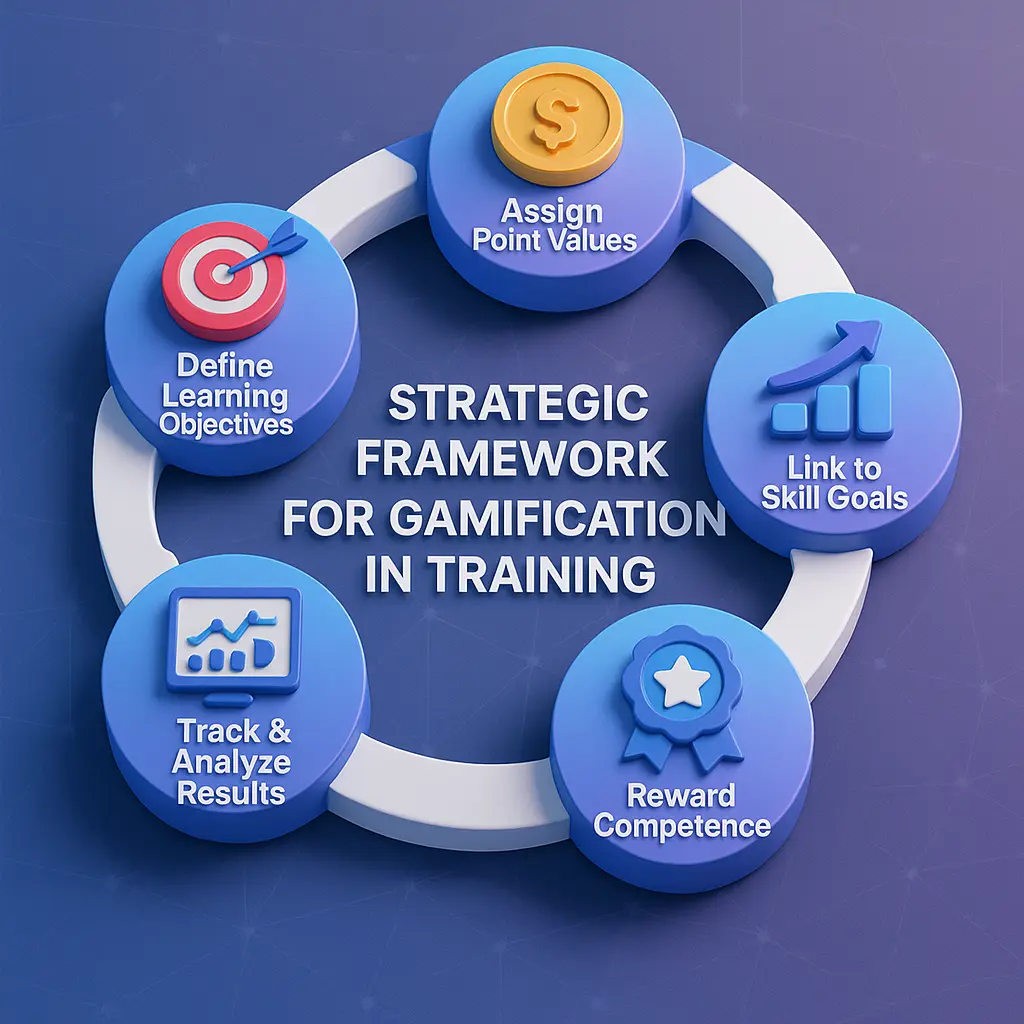
- Define Measurable Learning Objectives
– Identify what the organization needs to achieve — faster onboarding, compliance completion, skill mastery, or leadership readiness. - Map Behaviors That Lead to Those Outcomes
– Assign points for actions that demonstrate progress toward these goals, such as completing advanced modules, mentoring peers, or contributing to discussion forums. - Differentiate Between Activity and Competency Points
– Reward not only participation but also the quality of learning outcomes (e.g., achieving 90% in an assessment or applying a skill in simulation). - Integrate with LMS Analytics
– Use dashboards to measure correlations between point accumulation and job performance metrics like productivity, quality scores, or retention. - Build Fair and Transparent Rules
– Ensure the system is equitable, motivating employees across roles and experience levels without over-relying on competition.
Practical Example: How Advance the Team Implements This Approach
Within Advance the Team, point distribution is designed to reward both completion and competency growth. Learners earn baseline points for finishing modules, but they gain higher-value “competency points” for demonstrating skill proficiency through scenario-based quizzes or role simulations. This dual-layered design ensures that the system encourages depth of learning, not just course completion-a hallmark of strategic gamification in training.
4. Impact Metrics: How Points Translate into Measurable Business Results
In modern learning ecosystems, engagement alone isn’t success-impact is. The true strength of gamification in training lies in how effectively it converts motivation into measurable business outcomes. When points-based systems are designed with data at their core, they enable L&D leaders to quantify learning’s contribution to performance, productivity, and ROI with precision.
Quantifying the Business Value of Gamified Learning
A strategic points framework creates a measurable chain of impact-from learner engagement to business performance. Leading organizations track success through a mix of learning, performance, and financial metrics, such as:
- Learning Engagement: Participation rates, repeat logins, and average session time.
- Completion Efficiency: Percentage of learners completing courses on time.
- Time-to-Competence: Reduction in time needed for employees to reach proficiency in new roles or tools.
- Performance Improvement: Gains in productivity, sales figures, or service quality post-training.
- ROI Measurement: Comparing cost per learner and productivity uplift before and after gamified interventions.
Example: Measurable Impact of Gamification in Training
| Metric | Before Points-Based System | After Gamification in Training | Measured Impact |
|---|---|---|---|
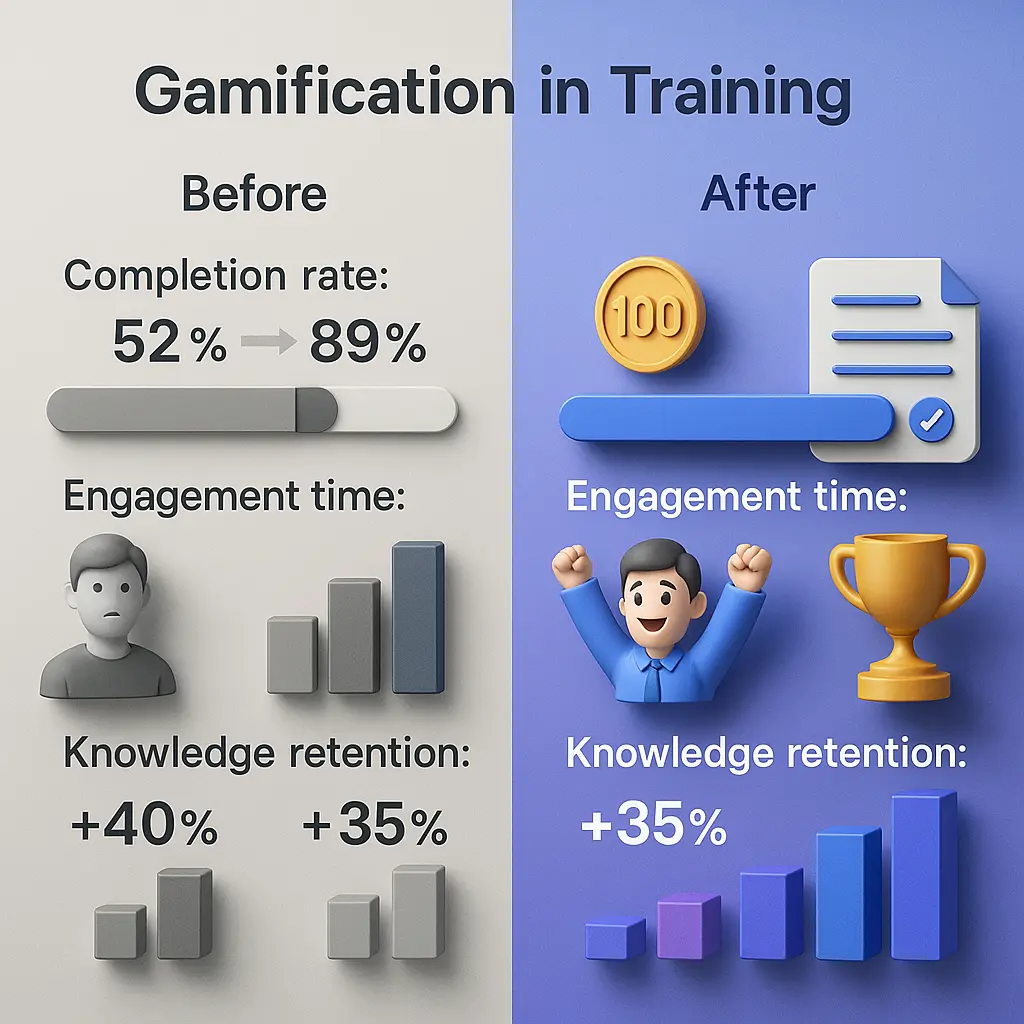
| Course Completion Rate | 58% | 87% | +29% improvement in completion and participation |
| Time-to-Competence | 10 weeks | 6.5 weeks | 35% faster onboarding and skill acquisition |
| Employee Engagement Index | 62% | 84% | +22% increase in active learning participation |
| Productivity per Employee | Baseline | +18% | Direct correlation between learning activity and output |
| Learning ROI | 120% | 178% | Clear business return on training investments |
5. Corporate Use Case: Turning Learning into a Performance Multiplier
When implemented with strategic intent, gamification in training can transform how organizations engage, upskill, and retain their workforce. Consider the example of a mid-sized global manufacturing company that was struggling to sustain participation in its compliance and technical training programs. Despite having a modern LMS, engagement plateaued at under 60%, and employees viewed learning as a box-checking exercise rather than a career enabler.
The Challenge
- Low completion rates for mandatory learning modules
- Declining participation in professional skill courses
- Limited visibility into how learning affected productivity or retention
The Strategy: Applying a Points-Based Learning Framework
To re-energize engagement, the company redesigned its training ecosystem using gamification in training principles. They introduced a points system integrated within their LMS, where employees earned points for:
- Completing compliance and safety certifications on time
- Engaging in advanced skill modules and peer-learning discussions
- Demonstrating job-relevant application through simulation tasks
Leaderboards and team-based challenges encouraged healthy competition, while rewards were tied not to tangible prizes but to recognition-quarterly “Top Learner” features, digital badges, and internal shoutouts from leadership.
Results Snapshot
Within six months of implementation, the company’s L&D analytics told a compelling story:
| Key Metric | Before Implementation | After Points-Based System |
|---|---|---|
| Course Completion Rate | 57% | 88% |
| Active Learners (Monthly) | 1,200 | 2,100 |
| Average Time-to-Competence | 9 weeks | 6 weeks |
| Voluntary Turnover (Yearly) | 18% | 11% |
| Training ROI | — | +42% improvement |
6. Infographic Section: The Points-to-Performance Model
Concept:
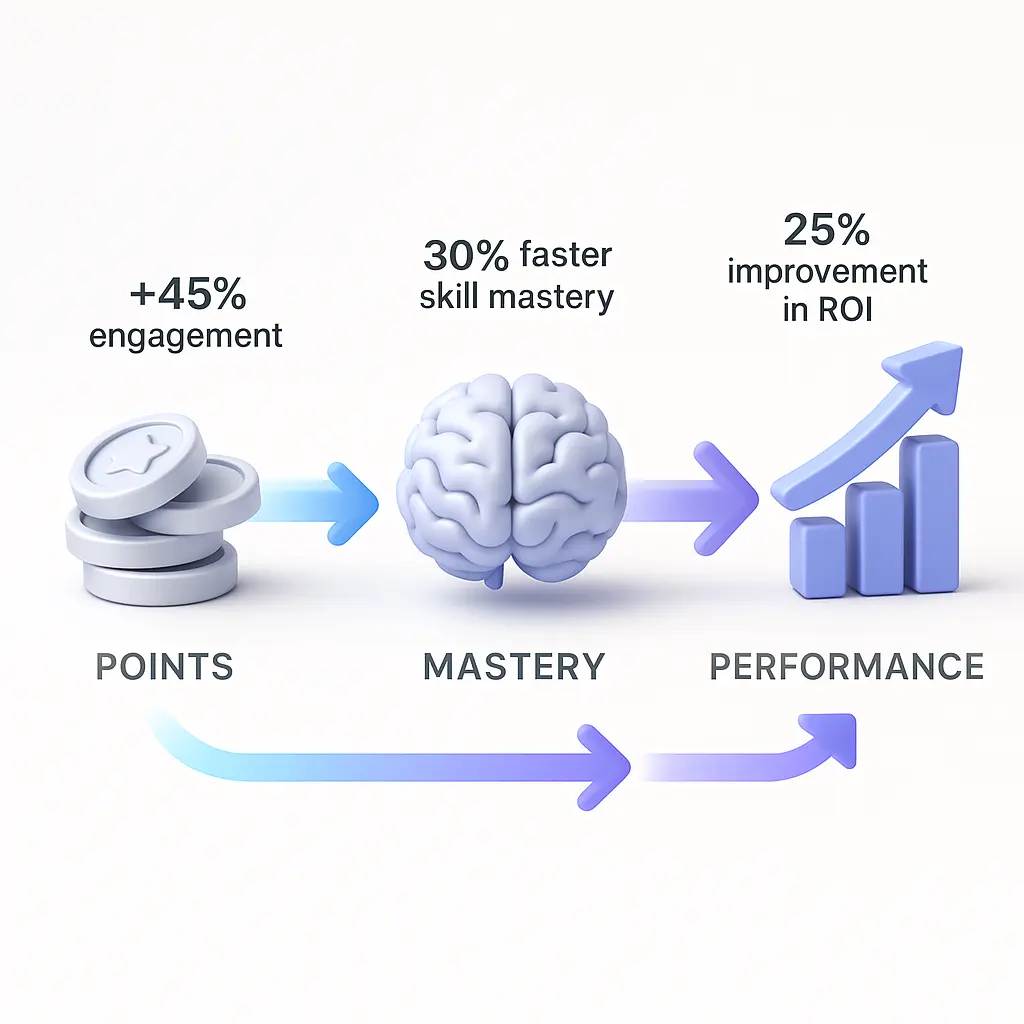
A clear visual flow showing how gamification in training transforms learner engagement into measurable business results. The model highlights the cause-and-effect chain from earning points to achieving organizational ROI-ideal for infographic design or internal L&D presentations
Visual Flow: “From Points to Performance”
Step 1: Points → Engagement
- Learners earn points for completing modules, challenges, and assessments.
- Instant feedback and visible progress trigger motivation and participation.
- Data Highlight: Organizations using gamified systems report up to 60% higher engagement (Deloitte).
Step 2: Engagement → Mastery
- Repetition and healthy competition reinforce knowledge retention.
- Employees revisit learning modules to improve their scores.
- Benchmark: Gamified learners show 43% better knowledge retention than traditional eLearning (TalentLMS).
Step 3: Mastery → Performance
- Points tied to competency-based assessments encourage skill mastery.
- LMS analytics connect points earned with job performance metrics.
- Example Metric: 35% faster time-to-competence observed in gamified learning environments.
Step 4: Performance → Business Outcomes
- Improved employee confidence and skill proficiency lead to higher productivity.
- Enhanced engagement reduces turnover and retraining costs.
- ROI Insight: Companies adopting gamification in training report an average ROI increase of 25–40% within the first year (ATD, LinkedIn Learning).
Data Highlights for the Infographic
- +29% higher course completion rates after implementing gamified points systems.
- +22% rise in active learning participation and repeat engagement.
- 35% faster onboarding and time-to-competence.
- Up to 40% improvement in training ROI when performance data is linked to points analytics.
Infographic Tip for Designers
Use a linear or circular flow design:
Points → Engagement → Mastery → Performance → Outcomes,
with each stage represented by an icon (e.g., coins → lightning bolt → target → graph → growth arrow).
Include a small analytics dashboard visual to reference how platforms like Advance the Team track each stage’s metrics in real time-reinforcing the measurable impact of gamification in training.
7. Integrating Points Systems with Broader Talent Strategy
The most effective gamification in training initiatives don’t operate in isolation-they integrate seamlessly into an organization’s broader talent and performance ecosystem. When points-based learning is connected to skill pathways, performance management, and recognition systems, it becomes a strategic lever for developing future-ready talent.
From Learning Engagement to Talent Development
A points system within an LMS can serve as more than just a motivational tool; it can act as a data-driven map of employee growth. Each point earned represents evidence of learning progress, skill acquisition, and behavioral alignment-metrics that are invaluable for HR and leadership teams.
How this integration works:
- Skill Pathways: Points highlight an employee’s journey across skill tiers-from beginner to advanced-helping L&D leaders track readiness for new roles.
- Performance Reviews: Learning points can be synced with performance management systems, offering managers objective data on skill application and development effort.
- Recognition Programs: Employees with consistent high scores can be featured in internal recognition campaigns or awarded professional development opportunities instead of just badges or prizes.
- Career Progression: Cumulative learning points serve as a transparent indicator of capability growth, supporting fair and data-based promotion decisions.
The Role of Analytics and AI in Refining Point Systems
As learning data scales, AI-driven analytics enhance the precision of gamification in training by identifying patterns in engagement and predicting future performance.
- Adaptive Learning Paths: AI adjusts point values dynamically based on difficulty level, learning style, or role-specific needs.
- Behavioral Insights: Predictive analytics can reveal which learning behaviors correlate most with job success.
- Continuous Optimization: AI models help recalibrate point allocations so they reward meaningful actions — not just frequent participation.
For instance, in Advance the Team, AI analytics connect earned points to competency frameworks across departments. The system doesn’t just track completion; it evaluates which skills are being strengthened and recommends targeted learning paths to close specific gaps. This approach ensures that the point system drives long-term competency mapping, not just short-term motivation.
Strategic Value for HR and Leadership
Integrating points into the wider talent ecosystem allows organizations to:
- Build data-backed learning cultures that tie directly to workforce capability goals.
- Enable continuous performance feedback without overhauling appraisal systems.
- Align employee motivation with measurable organizational outcomes like productivity and innovation.
8. Common Pitfalls and Best Practices for Sustainable Gamification
While gamification in training can significantly boost engagement and performance, its success depends on thoughtful design and ongoing management. Many organizations implement points systems enthusiastically but fail to sustain their effectiveness over time due to poor alignment, lack of transparency, or shallow reward strategies.
Common Pitfalls to Avoid
- Points Fatigue: When learners are rewarded too frequently or inconsistently, points lose their motivational value and become background noise.
- Superficial Rewards: Overemphasis on badges or leaderboards without linking them to real skill development leads to short-term participation rather than sustained growth.
- Lack of Fairness or Transparency: If point allocation isn’t clearly explained or equitable across roles, it can demotivate rather than inspire.
- One-Size-Fits-All Design: Failing to tailor the points system to different learning styles, roles, or difficulty levels reduces its impact.
- Neglecting Feedback Loops: Without analytics or learner feedback, organizations can’t identify when engagement starts to decline.
- Ignoring Business Alignment: Points that reward activity instead of outcomes (e.g., logging in vs. mastering a skill) fail to demonstrate ROI or relevance.
Best Practices for Long-Term Success
- Link Points to Purpose: Connect every point earned to a meaningful objective-compliance completion, skill mastery, or behavioral reinforcement.
- Balance Intrinsic and Extrinsic Motivation: Combine recognition and progress tracking with real growth opportunities such as certifications or leadership pathways.
- Maintain Transparency: Publish clear criteria for how points are earned, ensuring fairness across all departments and levels.
- Use Analytics for Optimization: Regularly analyze data to see which behaviors correlate with improved performance and adjust point weighting accordingly.
- Refresh Challenges Periodically: Introduce new learning missions or time-bound challenges to sustain enthusiasm and reduce monotony.
- Reward Competence, Not Just Activity: Allocate higher-value points for demonstrated skill application rather than mere participation.
- Encourage Collaboration: Use team-based point goals to foster collective learning and a shared sense of achievement.
Platforms like Advance the Team exemplify these principles by using analytics to monitor learner motivation and dynamically adjust point values based on engagement patterns and skill progression.
Conclusion
In the modern workplace, learning must do more than inform — it must inspire action, shape behavior, and deliver measurable business value. Gamification in training has emerged as a strategic bridge between engagement and performance, turning every learning interaction into an opportunity for growth and recognition.
By linking motivation to measurable outcomes, organizations move beyond participation metrics and build cultures where employees continuously upskill, collaborate, and strive for mastery. A well-structured points system does not merely gamify learning — it operationalizes motivation, translating engagement into capability and capability into results.