

Table of Contents
- 1.Introduction
- 2. Defining ROI in Employee Training Software
- 3. The Business Case for Digital Training Transformation
- 4. Core ROI Drivers of Employee Training Software
- 5. Measuring ROI in Employee Training Software
- 6. From Data to Decisions: Leveraging Analytics to Maximize Training ROI
- 7. Real-World ROI Examples
- 8. Overcoming Common Challenges in ROI Measurement
- 9. Strategic Role of CFOs in Maximizing Training ROI
- 10. Evaluating the Right Training Software
- 11. Calculating and Communicating ROI
- 12. Long-Term Value of Employee Training Software
- 13. CFO Checklist: Maximizing Training ROI
1.Introduction
In today’s performance-driven business landscape, learning is no longer a discretionary spend-it’s a measurable driver of profitability and workforce agility. For CFOs and business leaders, the focus has shifted from how much training costs to how much value it creates. Understanding training management software ROI is now critical to linking employee development directly to business performance.
The Shifting Role of Learning in Driving Profitability
- Skills are becoming obsolete faster than ever, making continuous learning a strategic investment rather than a support function.
- Research shows that organizations with effective training programs achieve 24% higher profit margins and up to 200% greater productivity per employee.
- Well-trained teams not only perform better but also stay longer, reducing turnover-related costs — a key lever in improving training management software ROI.
From Expense to Investment
Traditional learning programs were often treated as cost centers, with little visibility into business impact. Digital training platforms have changed that by enabling CFOs to:
- Measure direct financial outcomes such as reduced onboarding time, lower compliance costs, and improved productivity.
- Monitor indirect benefits like engagement, innovation, and leadership readiness.
- Access data-driven insights that connect learning initiatives to key operational KPIs — from sales growth to customer satisfaction.
This transparency transforms learning from an intangible HR activity into a quantifiable financial asset.
Key Themes in Training Management Software ROI
This article explores how modern training ecosystems deliver measurable business outcomes. Core areas include:
- Defining ROI in Learning: What “return” means in the context of employee capability and business performance.
- Quantifiable ROI Drivers: Cost reduction, productivity gains, compliance accuracy, retention improvement, and revenue growth.
- Measurement and Metrics: Financial formulas and KPI frameworks that make training management software ROI visible to CFOs.
- Strategic Alignment: How finance, HR, and operations can collaborate to maximize learning investment returns.
2. Defining ROI in Employee Training Software
For CFOs and business decision-makers, understanding training management software ROI begins with redefining what “return” means in the context of employee learning. Unlike traditional capital investments, training returns are realized through a combination of cost efficiencies, performance improvements, and long-term value creation.
What ROI Means in the Context of Employee Training
In financial terms, ROI measures how effectively an investment generates profit relative to its cost. In training, ROI expands beyond simple cost recovery-it reflects how learning contributes to measurable business outcomes such as productivity, compliance, retention, and revenue growth.
| ROI Dimension | Definition | Examples of Measurable Impact |
|---|---|---|
| Direct ROI | Quantifiable financial benefits | Lower training costs, faster onboarding, reduced turnover |
| Indirect ROI | Strategic or performance-based benefits | Improved customer satisfaction, innovation, leadership capability |
| Long-Term ROI | Sustained business advantage over time | Higher employee engagement, stronger culture, reduced risk |
However, modern analysis extends beyond simple cost-benefit evaluation to include value creation — the cumulative gains in agility, quality, and capability that drive sustainable growth.
Reframing ROI for Strategic Decision-Making
For today’s CFOs, the true measure of success lies in how learning investments contribute to strategic business outcomes. A comprehensive training management software ROI framework evaluates not just savings, but the overall uplift in:
- Workforce performance and output per employee
- Retention and engagement rates
- Compliance accuracy and risk reduction
- Revenue and profitability growth
In short, ROI in training software isn’t just about doing things cheaper-it’s about enabling the organization to perform better, faster, and smarter through measurable, data-driven learning outcomes.
3. The Business Case for Digital Training Transformation
For CFOs and business decision-makers, the shift to digital learning is not just a technology upgrade-it’s a financial and operational transformation. Modern organizations are rethinking how they measure and deliver learning outcomes, with a focus on training management software ROI and its direct link to productivity, compliance, and profitability.
Limitations of Conventional Training
Traditional training models—classroom sessions, workshops, and manual record-keeping-carry significant financial and operational inefficiencies. They lack scalability, transparency, and measurable impact.
Key drawbacks include:
- High administrative and delivery costs: Travel, accommodation, printed materials, and instructor fees inflate per-learner expenses.
- Limited scalability: Expanding training across departments or regions requires proportional cost increases.
- Inconsistent quality: Content delivery depends on trainers and timing, leading to variable learning outcomes.
- Lack of measurable data: Paper-based assessments and attendance tracking provide no actionable insights.
- Slow adaptability: Updating compliance or skill-based programs can take weeks, leaving organizations behind on critical training needs.
For CFOs, this translates to a learning investment that is difficult to justify or quantify-a challenge directly addressed by digital transformation.
Benefits of Automation, Analytics, and Scalability
Digital training platforms transform L&D operations by automating manual processes, centralizing data, and aligning learning with business metrics. The result is greater efficiency, cost savings, and measurable performance impact-key factors that strengthen training management software ROI.
| Capability | Traditional Model | Digital Training Advantage | Financial Impact |
|---|---|---|---|
| Automation | Manual scheduling, reporting, and tracking | Automated workflows, reminders, and progress tracking | Reduced HR and admin time |
| Analytics | Minimal visibility into performance | Real-time dashboards on engagement and completion | Data-driven decision-making |
| Scalability | High cost per additional learner | Seamless global rollout with stable cost structure | Predictable and sustainable ROI |
| Personalization | One-size-fits-all programs | Adaptive learning paths by role or department | Higher engagement and retention |
| Compliance | Paper-based recordkeeping | Automated certification and audit readiness | Reduced regulatory risk |
4. Core ROI Drivers of Employee Training Software
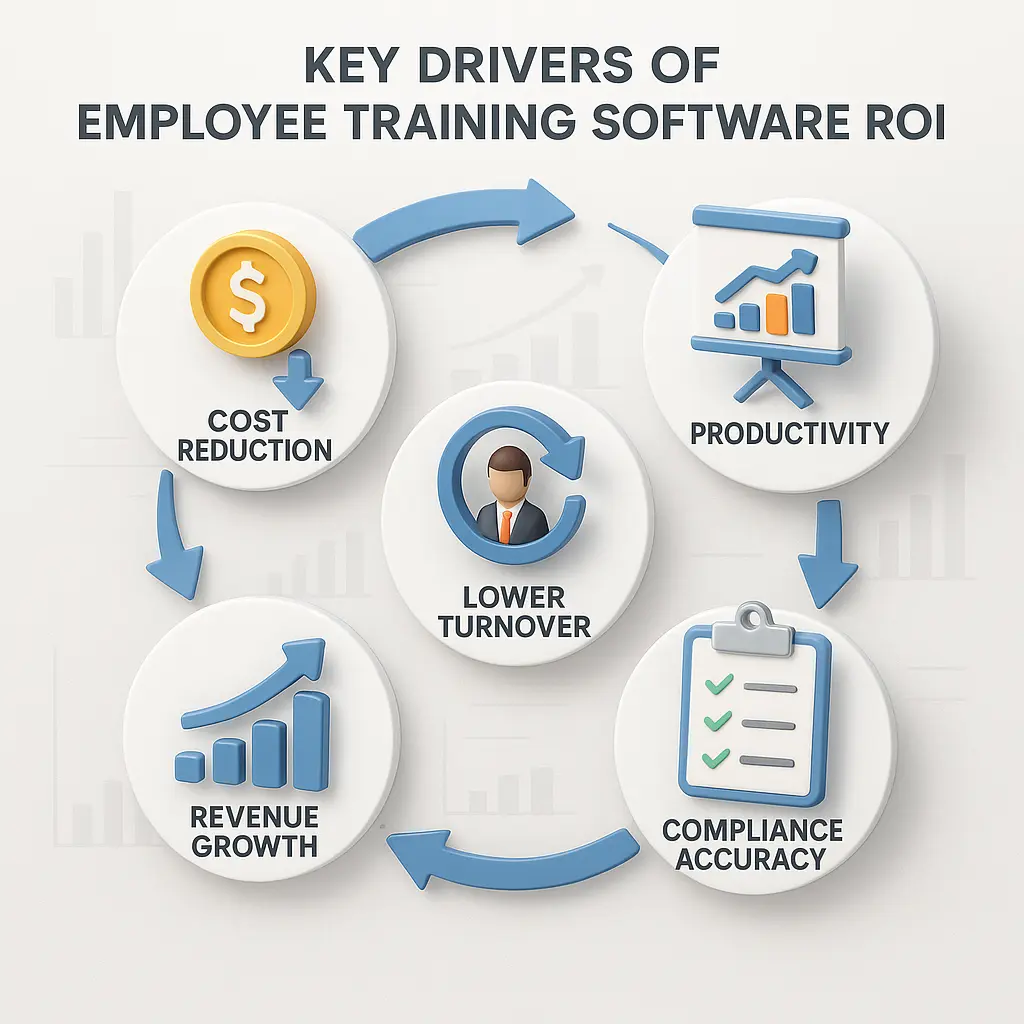
For CFOs and business leaders, understanding the core ROI drivers of employee training software is essential to link learning investments with measurable business performance. Effective training programs generate tangible financial benefits while enhancing workforce capability, making training management software ROI both visible and actionable.
1. Cost Reduction and Operational Efficiency
Training software reduces the direct and indirect costs of learning while improving scalability and delivery efficiency.
| Cost Factor | Traditional Training | With Training Software | Business Impact |
|---|---|---|---|
| Training Delivery | Classroom sessions, travel, and printed materials | Online modules, automated delivery | 40–60% reduction in delivery costs |
| Administrative Overhead | Manual scheduling and tracking | Automated workflows | Reduced HR/L&D labor hours |
| Content Updates | Reprinting and redistributing materials | Instant digital updates | Faster updates, lower maintenance costs |
| Scalability | Linear cost growth with employee count | Scale to large teams without proportional cost | Stable cost per learner |
2. Improved Employee Productivity
Training accelerates skill acquisition, reduces errors, and improves operational efficiency.
Key productivity drivers:
- Shorter time-to-competency for new hires and role transitions
- Continuous, on-demand learning reduces downtime
- Data-driven insights allow managers to target skill gaps
- Performance tracking ensures learning translates into measurable output
Business outcome: Companies implementing structured training see 20–25% productivity improvements, directly contributing to training management software ROI.
3. Lower Turnover and Higher Retention
Employee turnover is costly, both financially and operationally. Training software improves engagement, career growth, and satisfaction.
Impact on retention:
- Clear learning paths enhance employee motivation
- Career development programs increase loyalty
- Skills tracking supports succession planning
| Metric | Before Training Software | After Implementation |
|---|---|---|
| Average Turnover Rate | 18–25% | Reduced by 30–40% |
| Average Replacement Cost per Employee | 1.5x annual salary | Significant savings in recruitment and onboarding |
5. Measuring ROI in Employee Training Software
For CFOs and decision-makers, accurately measuring the impact of training initiatives is critical to understanding training management software ROI. Unlike traditional cost-tracking approaches, modern ROI assessment incorporates both direct financial benefits and indirect performance improvements that contribute to long-term business value.
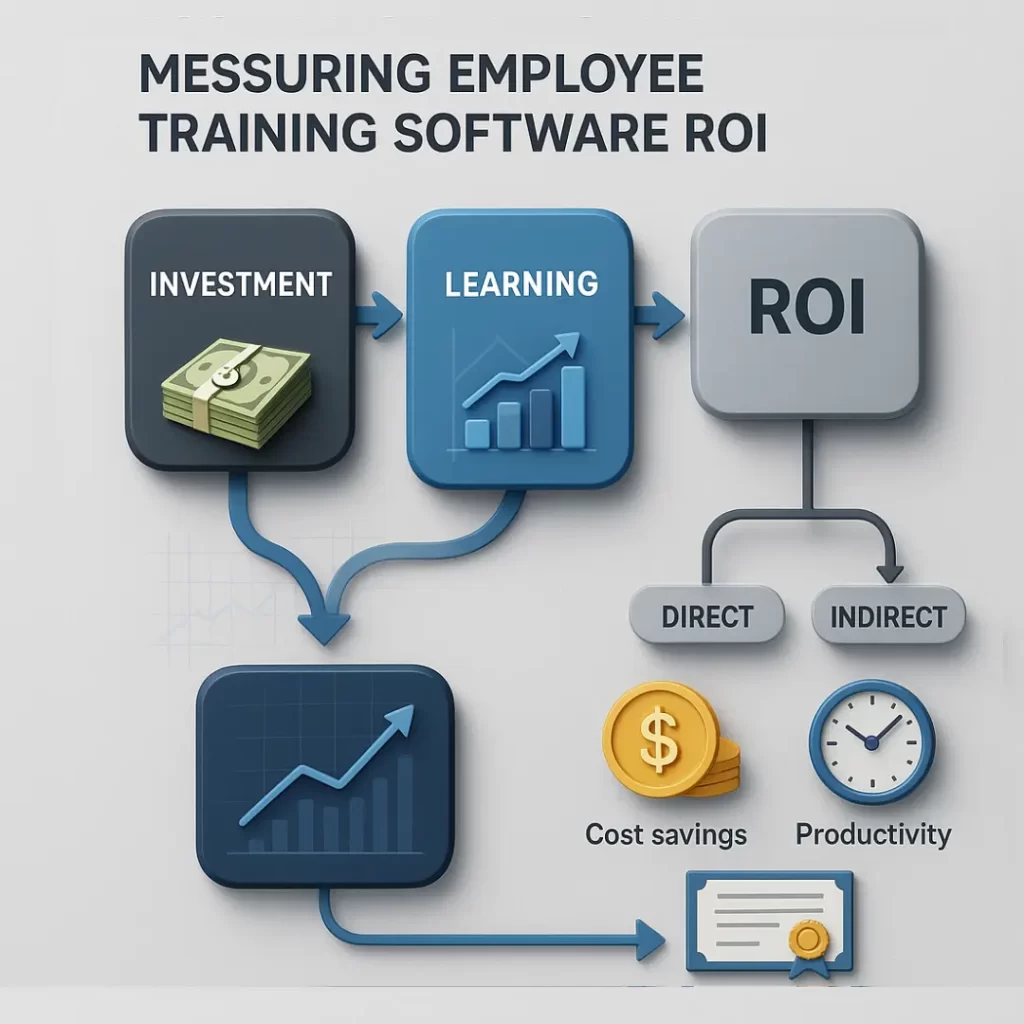
Direct vs. Indirect ROI Metrics
Direct ROI Metrics
These are measurable, financial outcomes directly attributable to training:
- Cost Savings: Reduced travel, venue, and material expenses through digital delivery
- Time-to-Competency: Faster onboarding and upskilling reduce productivity loss
- Turnover Reduction: Lower recruitment and replacement costs
- Revenue Impact: Improved sales performance or service efficiency due to enhanced skills
Indirect ROI Metrics
These are less tangible but equally impactful on organizational performance:
- Employee Engagement and Satisfaction: Higher engagement correlates with retention and productivity
- Knowledge Retention: Measured through assessments and skill validation
- Operational Quality: Fewer errors, improved compliance, and higher customer satisfaction
- Innovation and Agility: Ability to quickly deploy new skills in response to market demands
Key Measurable Indicators
To track both direct and indirect ROI, CFOs should focus on these performance indicators:
- Training Completion Rates: Percentage of employees completing required programs
- Assessment Scores and Skill Improvement: Measures of knowledge gain and proficiency
- Time-to-Competency: Average duration for employees to reach full productivity
- Employee Retention Rates: Changes in turnover following training initiatives
- Compliance Metrics: Number of certifications completed on time, audit readiness
- Revenue or Sales Metrics: Performance improvement attributable to training
- Productivity Metrics: Units produced, customer cases resolved, or process efficiency improvements
Tracking Methodologies
Effective ROI measurement relies on a combination of quantitative and qualitative data collection methods:
- Pre- and Post-Training Assessments: Evaluate knowledge or skill improvement before and after training sessions.
- Performance Dashboards: Track employee progress, completion rates, and engagement across programs.
- Operational KPI Correlation: Link learning outcomes to business metrics such as revenue, error rates, or production output.
- Cost-Benefit Analysis: Compare training costs against tangible benefits like savings, revenue increase, and reduced turnover.
- Longitudinal Tracking: Monitor sustained behavior change, performance improvement, and retention over time.
- Surveys and Feedback: Collect qualitative insights on employee satisfaction, engagement, and perceived value of training.
6. From Data to Decisions: Leveraging Analytics to Maximize Training ROI
Modern employee training software goes beyond content delivery—it provides actionable insights that connect learning outcomes to business performance. By translating data into decisions, organizations can continuously assess and enhance training management software ROI.
Dashboards and Real-Time Monitoring
- Centralized Visibility: Dashboards consolidate key learning metrics, making it easy to track program completion, engagement, and performance.
- Role-Based Insights: Tailored views for managers, HR, and finance enable focused monitoring of relevant KPIs.
- Progress Tracking: Visualizations highlight top-performing teams, skill gaps, and areas needing intervention.
Example: Software like Advance the Team provides built-in dashboards that allow organizations to quantify training impact and compare outcomes across departments or locations.
Key Performance Indicators (KPIs) for Continuous Assessment
- Completion and Engagement Rates: Measure participation and ensure learning adoption.
- Time-to-Competency: Track how quickly employees achieve proficiency after training.
- Productivity Metrics: Link skill improvements to operational output, sales performance, or service efficiency.
- Retention and Turnover: Evaluate the impact of learning on employee loyalty.
- Compliance Metrics: Monitor certifications and mandatory training for audit readiness.
By systematically measuring these KPIs, organizations can evaluate whether learning investments are translating into measurable business outcomes, strengthening training management software ROI.
Predictive Analytics for Strategic Planning
- Skill Gap Forecasting: Predict future workforce requirements based on current competencies and business objectives.
- Learning Path Optimization: Identify employees who would benefit most from targeted training to maximize ROI.
- Resource Allocation: Forecast training budgets and prioritize programs that yield the highest value.
- Performance Risk Mitigation: Anticipate areas where skill deficits could impact revenue, compliance, or productivity.
Predictive insights enable proactive, data-driven decision-making rather than reactive training interventions.
Integrating Financial Data with Learning Analytics
- Link training costs directly to operational KPIs such as revenue per employee, error reduction, or productivity gains.
- Compare program expenditures with measurable benefits to calculate precise ROI.
- Use analytics to simulate the impact of different training strategies on business outcomes and optimize investments.
Continuous ROI Assessment
- Real-time dashboards and predictive analytics allow organizations to monitor ROI continuously, not just at the end of a program.
- Decision-makers can adjust learning strategies dynamically, ensuring that investments remain aligned with business priorities.
- Integrating financial and operational data creates a closed-loop system where learning becomes a measurable driver of performance.
By leveraging analytics, KPIs, and predictive insights, companies can transform employee learning from a cost center into a strategic investment, providing clear, actionable evidence of training management software ROI. Platforms like Advance the Team exemplify this approach by combining learning metrics with reporting tools that quantify impact and guide strategic decisions.
7. Real-World ROI Examples
Measuring training management software ROI is most compelling when demonstrated through concrete business outcomes. Organizations across industries have realized measurable gains by implementing digital training programs, with benefits spanning onboarding efficiency, sales performance, and regulatory compliance.
1. Reducing Onboarding Time
- Challenge: New hires required 8–12 weeks to reach full productivity, delaying revenue contribution and increasing management workload.
- Solution: Implemented structured digital onboarding modules with assessments and progress tracking.
- Results:
- Time-to-competency reduced by 35–40%
- Early contribution to revenue increased due to faster ramp-up
- Managerial oversight and training hours reduced significantly
- ROI Impact: Faster onboarding translated into measurable cost savings and higher workforce productivity, boosting overall training management software ROI.
2. Improving Sales Performance
- Challenge: Sales teams struggled with inconsistent product knowledge and varying performance across regions.
- Solution: Deployed role-based digital learning programs, including scenario-based modules and quizzes to reinforce knowledge.
- Results:
- Sales conversion rates increased by 15–20%
- Average revenue per sales employee rose by 10–12%
- Training adoption was consistent across all locations, standardizing performance
- ROI Impact: The combination of skill development and measurable performance gains demonstrated a clear return on training investment.
3. Compliance in Regulated Industries
- Challenge: Manual compliance training led to missed deadlines, incomplete certification, and audit risk.
- Solution: Implemented automated training workflows with reminders, tracking, and reporting dashboards.
- Results:
- Compliance completion rates reached 100%
- Audit preparation time reduced by 50–70%
- Risk of regulatory penalties significantly minimized
- ROI Impact: Cost savings from reduced penalties and improved operational reliability enhanced training management software ROI while ensuring regulatory adherence.
Summary
These examples illustrate how digital training programs deliver measurable value across different business objectives. By reducing onboarding time, improving revenue-generating skills, and ensuring compliance, organizations can clearly demonstrate the financial and operational impact of training investments, making training management software ROI tangible and actionable.
8. Overcoming Common Challenges in ROI Measurement
Accurately assessing training management software ROI can be challenging due to data silos, organizational misalignment, and the difficulty of quantifying intangible benefits. Understanding these obstacles and applying practical solutions ensures that learning investments are properly measured and optimized.
1. Data Fragmentation
Challenge:
- Learning data often exists in multiple systems-spreadsheets, LMS platforms, and HR databases-making it difficult to consolidate and analyze.
- Disconnected data prevents accurate calculation of ROI and limits actionable insights.
Solutions:
- Centralize learning and performance data within a single platform or integrate systems through APIs.
- Implement real-time dashboards to aggregate completion, engagement, and performance metrics.
- Standardize data formats and reporting templates across departments to enable consistent analysis.
2. Misalignment Between HR, L&D, and Finance
Challenge:
- HR/L&D teams may focus on engagement and completion metrics, while finance is concerned with cost savings and revenue impact.
- Misaligned priorities can obscure true ROI and hinder strategic decision-making.
Solutions:
- Define shared objectives and metrics across HR, L&D, and finance teams.
- Link learning KPIs directly to operational and financial performance indicators.
- Conduct regular cross-functional reviews to validate assumptions and align reporting frameworks.
3. Estimating Intangible Benefits
Challenge:
- Soft outcomes such as employee engagement, leadership development, and innovation are difficult to quantify but have real financial impact.
- Ignoring these factors can undervalue training investments.
Solutions:
- Use proxy metrics such as retention rates, employee satisfaction scores, and performance improvements.
- Apply qualitative assessments, surveys, and manager evaluations to complement quantitative data.
- Incorporate scenario analysis to estimate potential long-term value from skill development and culture enhancement.
Summary
Overcoming these challenges is essential to producing accurate, actionable training management software ROI. By consolidating data, aligning cross-functional teams, and systematically estimating intangible benefits, organizations can ensure that learning investments are fully measured and optimized, turning training from a perceived cost into a verifiable business asset.
9. Strategic Role of CFOs in Maximizing Training ROI
CFOs play a critical role in transforming employee training from a cost center into a measurable driver of business value. By partnering with HR and L&D teams, embedding ROI into financial planning, and creating accountability, CFOs can ensure that learning investments deliver tangible returns.
1. Partnering with HR and L&D
- Align objectives: Collaborate with HR and L&D to define training goals that link directly to operational and financial outcomes.
- Set measurable KPIs: Establish shared metrics such as productivity improvements, retention rates, compliance completion, and revenue impact.
- Evaluate program effectiveness: Use data-driven insights to identify high-performing initiatives and underperforming programs.
2. Embedding Learning ROI in Financial Planning
- Integrate training costs into budgets: Treat learning initiatives as strategic investments rather than discretionary expenses.
- Forecast ROI: Incorporate projected productivity gains, cost savings, and revenue impact into financial planning models.
- Scenario analysis: Model the impact of different training strategies on organizational performance and profitability.
3. Creating Accountability and Governance
- Define ownership: Assign responsibility for learning outcomes across HR, L&D, and finance teams.
- Regular reporting: Track training management software ROI through dashboards, KPI reviews, and financial reports.
- Continuous improvement: Use insights to adjust training content, delivery methods, and resource allocation for maximum impact.
- Performance-linked incentives: Tie leadership and manager evaluations to measurable learning outcomes and ROI realization.
Actionable Insights
- Foster a culture where financial accountability and learning effectiveness are linked.
- Use ROI metrics to guide investment decisions in training programs, technologies, and resources.
- Ensure learning investments are treated as strategic drivers of workforce performance, revenue growth, and long-term competitiveness.
By embedding these practices, CFOs can transform learning into a quantifiable, strategic asset, ensuring that every training investment contributes to measurable business outcomes and strengthens training management software ROI.
10. Evaluating the Right Training Software
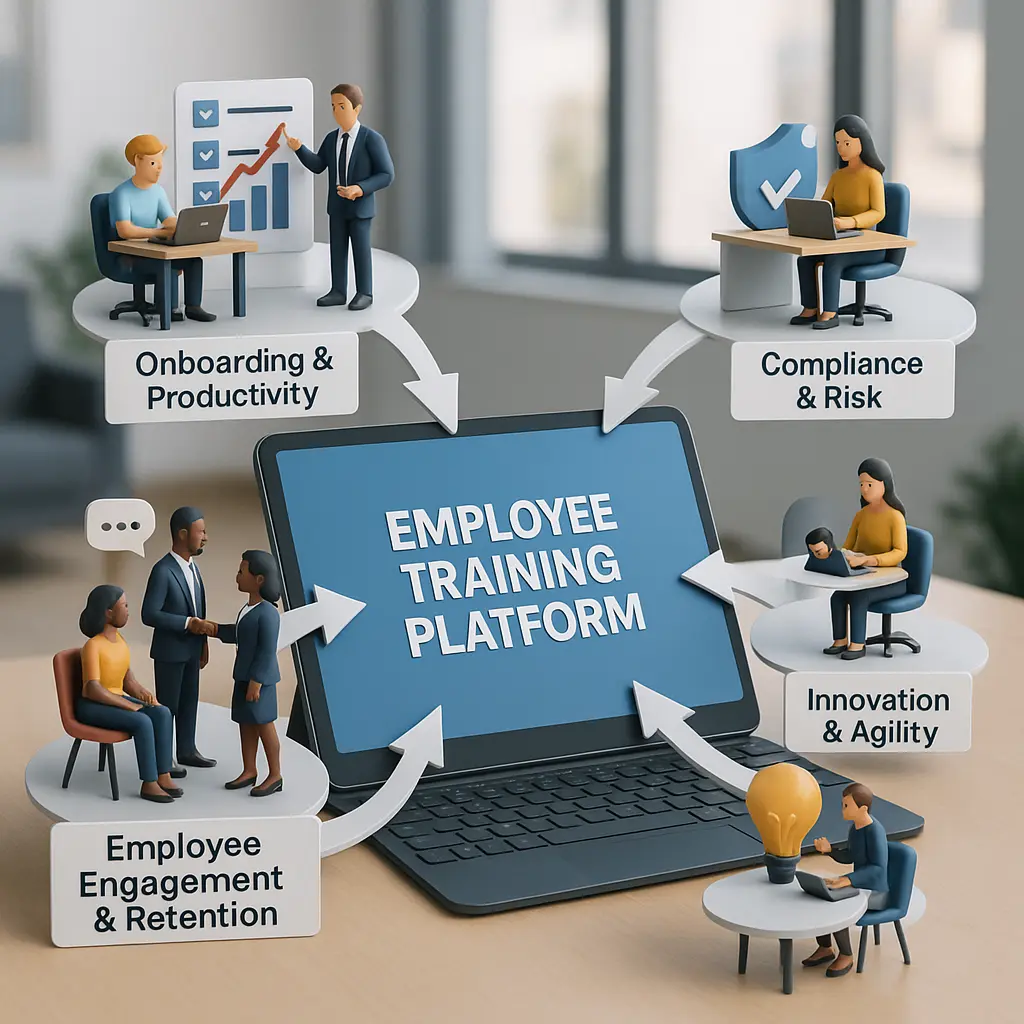
Selecting the right training software is critical to maximizing training management software ROI. Effective platforms do more than deliver content-they provide actionable insights, streamline administration, and drive measurable business outcomes.
Key Capabilities to Consider
| Capability | Why It Matters | Impact on ROI |
|---|---|---|
| Analytics & Reporting | Tracks completion, engagement, performance, and skill gaps | Enables data-driven decisions, continuous improvement, and quantifiable ROI |
| Scalability | Supports enterprise-wide deployment across locations and teams | Reduces cost per learner and ensures consistent quality, improving ROI as the organization grows |
| Automation | Automates enrollment, reminders, assessments, and reporting | Cuts administrative overhead and speeds up training delivery, directly impacting cost efficiency |
| Integration | Connects with HRIS, payroll, and performance management systems | Aligns learning outcomes with operational and financial metrics, enhancing ROI visibility |
| Usability | Intuitive interface for admins and learners | Increases adoption, reduces support costs, and improves learning outcomes |
| Learner Experience | Personalized, mobile-friendly, and interactive content | Drives engagement, retention, and performance, translating into measurable business impact |
Practical Evaluation Insights
- Data-Driven ROI: Choose platforms that provide dashboards and KPIs linking learning outcomes to business metrics. This strengthens training management software ROI.
- Future-Proofing: Ensure the platform can scale with organizational growth and evolving skill requirements.
- Automation & Efficiency: Automated workflows free HR and L&D resources to focus on strategy rather than administration.
- Integration & Alignment: Platforms that integrate with enterprise systems allow CFOs and managers to directly correlate learning with operational performance.
Example: Platforms like Advance the Team exemplify these capabilities by combining comprehensive analytics, automated workflows, and KPI alignment, helping organizations quantify training impact and maximize training management software ROI.
11. Calculating and Communicating ROI
Effectively calculating and communicating training management software ROI is essential to demonstrate the financial and operational value of learning investments. By using structured templates, clear metrics, and compelling narratives, organizations can translate training outcomes into board-ready insights that support strategic decision-making.
ROI Calculation Templates
- Cost-Benefit Analysis Template:
- Total Benefits: Productivity gains, reduced turnover costs, compliance savings, revenue improvements.
- Total Costs: Software licensing, content creation, employee learning hours, administrative overhead.
- Extended ROI Template: Includes both direct and indirect benefits:
- Direct: Cost savings, revenue impact, time-to-competency reduction
- Indirect: Employee engagement, skill retention, innovation contribution
- Platforms like Advance the Team provide built-in templates and dashboards that automate calculation, making ROI measurement more accurate and repeatable.
Presenting ROI in Board-Ready Terms
- Translate learning outcomes into financial impact: Show cost savings, productivity gains, and revenue contributions in monetary terms.
- Use visual dashboards and executive summaries: Make complex data easily digestible for decision-makers.
- Link ROI to strategic objectives: Tie training impact to operational KPIs, compliance, and overall business performance.
Building the Narrative from Investment to Performance Returns
- Investment Overview: Summarize total spending on software, content, and learning hours.
- Performance Outcomes: Present measurable results such as faster onboarding, improved sales, and reduced compliance risk.
- Financial Translation: Convert operational improvements into dollar or rupee values.
- Strategic Value: Highlight long-term benefits like employee engagement, retention, and workforce agility.
- Actionable Insights: Recommend next steps for scaling successful programs or addressing gaps.
Platforms like Advance the Team simplify this process by linking learning data directly to financial and operational metrics, enabling CFOs and leaders to clearly demonstrate training management software ROI in a concise, board-ready format.
Summary
Calculating and communicating ROI is not just about numbers-it’s about telling a compelling story from investment to measurable business impact. By leveraging templates, metrics, and integrated reporting tools, organizations can showcase how learning initiatives drive performance, strengthen decision-making, and maximize training management software ROI.
12. Long-Term Value of Employee Training Software
Investing in employee training software delivers more than immediate cost savings or productivity gains—it creates sustained, strategic value that strengthens organizational performance and competitive advantage. Over time, the ROI equation shifts from short-term efficiency to long-term agility and innovation.
Continuous Learning as a Competitive Advantage
- Organizations with a culture of continuous learning adapt faster to market changes and emerging technologies.
- Employees equipped with up-to-date skills contribute to higher quality outputs and more innovative solutions.
- Continuous skill development supports leadership pipelines and internal mobility, reducing dependency on external hires.
Impact on ROI: Investments in learning programs compound over time, enhancing training management software ROI as skill levels and business performance improve.
Driving Innovation and Strategic Agility
- Access to adaptive learning and advanced skill tracking enables employees to identify opportunities and implement solutions quickly.
- Teams trained in cross-functional competencies respond faster to new projects, customer needs, or process improvements.
- Predictive analytics from learning platforms help anticipate future skill gaps, aligning workforce capabilities with strategic priorities.
Business outcome: The organization becomes more agile, resilient, and capable of sustaining growth in a dynamic market.
Retention and Employee Engagement
- Learning programs that offer career progression and skill development increase employee satisfaction and loyalty.
- Higher engagement reduces turnover, recruitment costs, and knowledge loss.
- Recognition of learning achievements reinforces a high-performance culture.
Financial impact: Long-term retention and engagement contribute to measurable cost savings and productivity improvements, further strengthening training management software ROI.
Evolving the ROI Equation
- Short-term ROI: Focused on efficiency-reducing costs, faster onboarding, and immediate productivity gains.
- Medium-term ROI: Includes improved compliance, revenue performance, and employee engagement.
- Long-term ROI: Emphasizes strategic value-competitive advantage, innovation, retention, and organizational agility.
By taking a long-term perspective, organizations can see that the true value of training software extends beyond immediate savings, transforming learning into a strategic lever for sustained growth, workforce excellence, and measurable ROI.
13. CFO Checklist: Maximizing Training ROI
A structured approach ensures that learning investments deliver measurable returns and strategic value. The following 10 actionable steps help CFOs measure, optimize, and maximize training management software ROI while aligning financial strategy with workforce capability growth.
10 Actionable Steps
- Define Clear Objectives
- Establish business outcomes tied to training investments, such as productivity gains, compliance adherence, or revenue impact.
- Align HR, L&D, and Finance
- Create shared goals, metrics, and reporting standards to ensure cross-functional accountability.
- Identify Key Metrics
- Track both direct ROI (cost savings, revenue contribution) and indirect ROI (employee engagement, retention, skill growth).
- Centralize Data and Reporting
- Consolidate learning, performance, and financial data to enable accurate ROI calculation and strategic insights.
- Integrate Learning with Operational KPIs
- Link training outcomes to measurable business performance indicators such as productivity, error reduction, and customer satisfaction.
- Leverage Automation and Analytics
- Use dashboards and predictive analytics to continuously monitor learning impact and forecast future skill gaps.
- Standardize ROI Calculation Templates
- Implement consistent financial models to quantify cost savings, revenue gains, and long-term value from training investments.
- Communicate Impact Across Stakeholders
- Present ROI in board-ready terms, highlighting both short-term efficiency gains and long-term strategic benefits.
- Continuously Optimize Programs
- Adjust learning content, delivery methods, and resource allocation based on performance metrics and feedback loops.
- Foster Accountability and Recognition
- Tie performance reviews and incentives to measurable learning outcomes, ensuring ownership and sustained results.
By following this checklist, CFOs can systematically measure, optimize, and communicate the value of learning investments, ensuring that training management software ROI is not just tracked, but maximized as a strategic driver of organizational performance.
Conclusion
Employee training software is no longer a peripheral tool—it is a strategic asset that drives measurable business performance. By digitizing learning, automating processes, and providing actionable insights, organizations can transform training from a cost center into a clear source of value.
Platforms like Advance the Team exemplify how intelligent learning systems link employee development to operational and financial outcomes, enabling organizations to maximize training management software ROI.
Investing in intelligent training systems ensures that every learning initiative contributes directly to organizational growth, operational efficiency, and measurable training management software ROI.