
Table of Contents
- 1.Introduction: Why Employee Training Has Become a Strategic Imperative for SMEs
- 2.The SME Training Landscape: Unique Constraints and Emerging Opportunities
- 3. Common Employee Training Challenges Faced by SMEs
- 4. The Cost of Inaction: What Happens When Training Challenges Persist
- 5. Smart Solutions-How SMEs Can Overcome Training Challenges
- 6. Implementation Roadmap: Building an Agile, ROI-Driven Training Culture
1.Introduction: Why Employee Training Has Become a Strategic Imperative for SMEs
Small and medium enterprises (SMEs) are evolving faster than ever-adapting to digital transformation, hybrid work models, and the growing expectations of a dynamic, multigenerational workforce. Yet amid this rapid change, Employee Training Challenges in SMEs are becoming increasingly visible. Limited budgets, time constraints, and fragmented training processes often prevent SMEs from building the skilled, motivated teams they need to stay competitive.
In today’s business environment, structured employee training is no longer a “nice-to-have”-it’s a strategic necessity. Studies show that:
- Companies that invest in comprehensive training programs experience 24% higher profit margins than those that don’t (Association for Talent Development).
- Organizations with strong learning cultures report 37% greater employee productivity and 34% higher retention rates (Deloitte).
- Every dollar spent on training yields an average return of $4.53 in increased productivity (IBM study).
For SMEs, these numbers aren’t just statistics-they represent real opportunities to boost performance and sustain growth through effective employee development.
However, the road to achieving these outcomes isn’t straightforward. Many small and mid-sized businesses face systemic hurdles that limit training impact, such as:
- Limited access to dedicated learning teams or budgets
- Difficulty scaling programs as the business grows
- Low employee engagement or completion rates
- Inefficient tracking of learning progress and ROI
These Employee Training Challenges in SMEs not only affect day-to-day productivity but also influence long-term business resilience. Without well-structured learning systems, skills gaps widen, employee motivation declines, and organizational agility suffers-making it harder for SMEs to compete with larger, better-resourced enterprises.
A focused, data-driven approach to employee development can change that narrative. By aligning training initiatives with measurable outcomes-such as productivity gains, retention improvements, and training ROI-SMEs can transform learning from a cost into a competitive advantage.
2.The SME Training Landscape: Unique Constraints and Emerging Opportunities
The SME learning environment is distinct-dynamic, fast-paced, and often resource-constrained. Unlike large enterprises with dedicated L&D departments and structured budgets, small and medium businesses rely on lean teams where employees juggle multiple roles. This versatility helps SMEs stay agile but also creates gaps in systematic learning and skill development.
Unique Characteristics of SMEs Affecting Training
- Multitasking Workforce: Employees frequently wear multiple hats-handling sales, operations, and client service simultaneously-leaving little time for structured learning.
- Limited Budgets: Training investments often compete with immediate business priorities like marketing or technology upgrades.
- Rapid Growth and Change: As SMEs scale quickly, skill requirements shift faster than training programs can adapt.
- Lack of Dedicated L&D Staff: Most SMEs don’t have in-house training specialists, relying instead on ad-hoc workshops or informal peer learning.
These conditions create the foundation for many Employee Training Challenges in SMEs, where intent often outpaces execution. While leaders recognize the importance of employee development, the absence of structured systems and data-driven measurement makes consistent improvement difficult.
SME vs. Large Enterprise: A Training Investment Snapshot
| Metric | SMEs | Large Enterprises |
|---|---|---|
| Average annual training spend per employee | $700–$1,000 | $1,400–$1,800 |
| Share of companies with a dedicated L&D function | ~35% | ~85% |
| Average training hours per employee per year | 22 hours | 55 hours |
| Use of digital learning or LMS tools | 40% | 78% |
3. Common Employee Training Challenges Faced by SMEs
Small and medium enterprises operate in an environment of constant change-balancing rapid growth with limited resources. While they understand that a skilled workforce drives productivity and innovation, translating that vision into structured learning is often difficult. Unlike large organizations, SMEs rarely have the luxury of dedicated training departments or extensive budgets. As a result, Employee Training Challenges in SMEs are uniquely complex-affecting not only learning outcomes but also overall business agility and employee performance. Addressing these Employee Training Challenges in SMEs effectively is critical for improving training ROI and boosting workforce productivity.
Below are the four most persistent and impactful challenges SMEs face when managing workforce training.
3.1. Limited Training Budgets and Resource Constraints
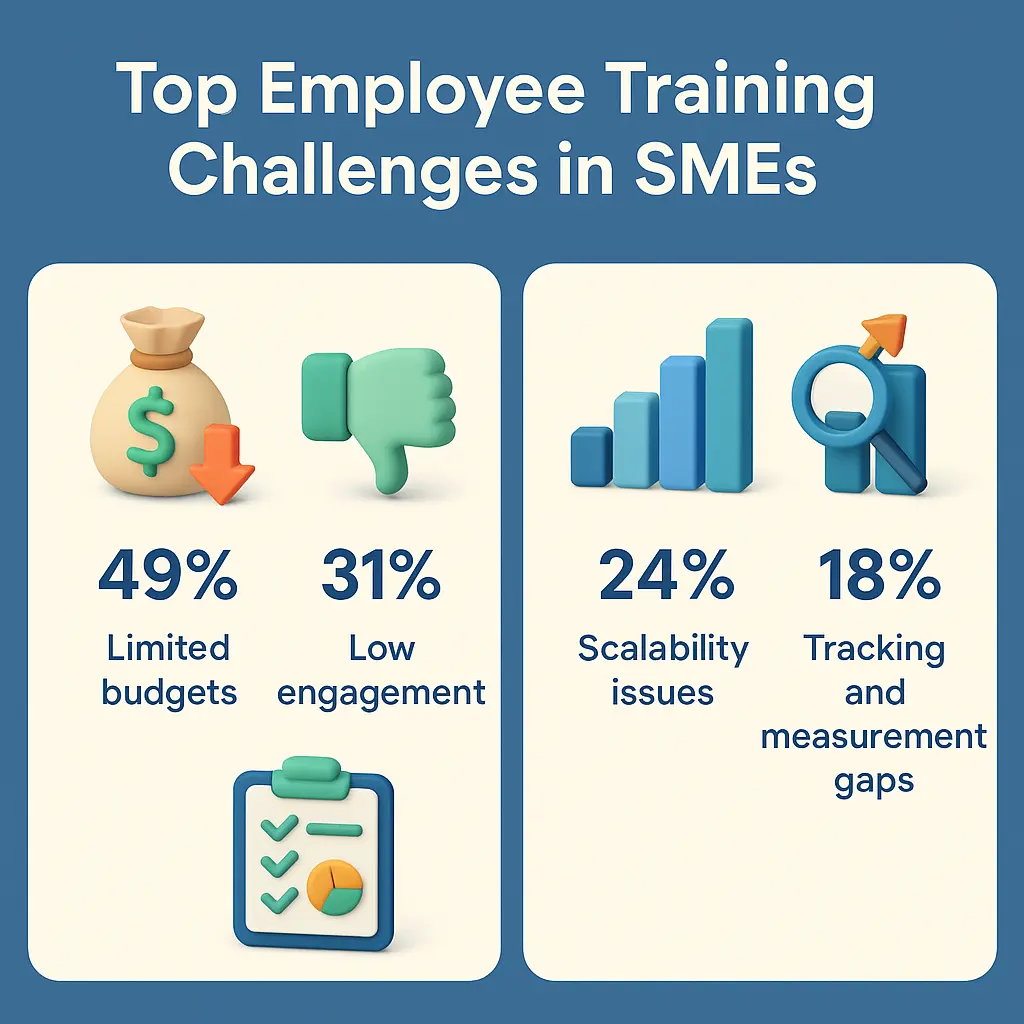
For many SMEs, financial and human resources are stretched thin. Training budgets often compete with immediate operational priorities like sales, customer acquisition, or technology upgrades. These constraints contribute to fragmented, one-off learning initiatives, highlighting the Employee Training Challenges in SMEs that prevent sustained skill development and consistent workforce performance. Effectively addressing Employee Training Challenges in SMEs is essential for improving training ROI and overall business agility.
Key realities:
- According to LinkedIn’s Workplace Learning Report 2024, SMEs spend 40–60% less on training per employee compared to large enterprises.
- Over 55% of small businesses lack a dedicated L&D budget or team, relying instead on ad-hoc workshops or vendor-led sessions.
- Without access to scalable digital platforms, SMEs often face rising costs for in-person sessions and limited tracking capability.
Business consequence: Inconsistent learning outcomes, skill gaps, and slower productivity growth are common Employee Training Challenges in SMEs.
Strategic takeaway: Adopting affordable, cloud-based LMS for SMEs can optimize resource use by automating course delivery, reducing cost per learner, and ensuring continuous training even with lean budgets.
3.2. Low Engagement and Completion Rates
One of the most overlooked Employee Training Challenges in SMEs is learner engagement. When training feels irrelevant or time-consuming, employees-especially those managing multiple roles-tend to disengage.
Common patterns:
- Studies show that average course completion rates in SMEs hover around 35–40%, significantly lower than in larger firms with structured feedback and recognition systems.
- Time constraints, static content, and lack of real-world relevance are major deterrents.
- Without gamification or progress tracking, training becomes a compliance activity rather than a learning opportunity.
Impact on performance:
Low engagement directly reduces training ROI, weakens knowledge retention, and limits behavioral change on the job.
Strategic insight: Integrating microlearning modules, interactive content, and recognition mechanisms within a training management system can make learning more flexible and appealing for time-pressed SME employees.
3.3. Scalability and Content Consistency Issues
As SMEs grow-often across new geographies or business units-maintaining learning consistency becomes difficult. Training materials may differ between teams or locations, leading to uneven performance and misaligned skill levels.
Typical challenges include:
- Dependence on individual managers or trainers to deliver sessions.
- Lack of standardized content repositories or update mechanisms.
- Manual coordination across departments, making scaling inefficient.
Data point: Only 40% of SMEs currently use a centralized LMS, resulting in duplication of effort and inconsistent delivery quality.
Business implication: Uneven customer experiences, onboarding delays, and knowledge silos that slow down operations.
Strategic recommendation: Cloud-based LMS for SMEs ensures uniform content delivery, real-time updates, and automated training assignment-supporting scalability as the business expands.
3.4. Tracking, Measurement, and Compliance Gaps
The inability to track, measure, and report training outcomes remains one of the most critical Employee Training Challenges in SMEs. Without reliable data, leaders struggle to prove value, assess impact, or ensure compliance in regulated sectors.
Key insights:
- Over 60% of SMEs rely on spreadsheets or manual reports to monitor learning progress.
- Few link training metrics-like completion rates or skill scores-to business KPIs or ROI.
- Compliance documentation is often incomplete or decentralized, increasing audit risks.
Consequences: Missed insights into training ROI, compliance risks, and an inability to make data-driven workforce decisions.
Strategic next step: Implementing a training management system with built-in analytics and compliance tracking helps HR leaders visualize performance trends and quantify business impact.
4. The Cost of Inaction: What Happens When Training Challenges Persist
When Employee Training Challenges in SMEs go unaddressed, the business consequences extend far beyond missed learning goals-they directly affect profitability, growth, and competitiveness. Training is often viewed as a soft investment, but its absence has hard, measurable costs. Ignoring skill gaps, low engagement, and poor learning consistency erodes productivity, drives higher turnover, and weakens customer satisfaction.
In a resource-sensitive SME environment, these impacts compound quickly, reducing both performance and profitability.
Tangible Business Costs of Ignoring Training Gaps
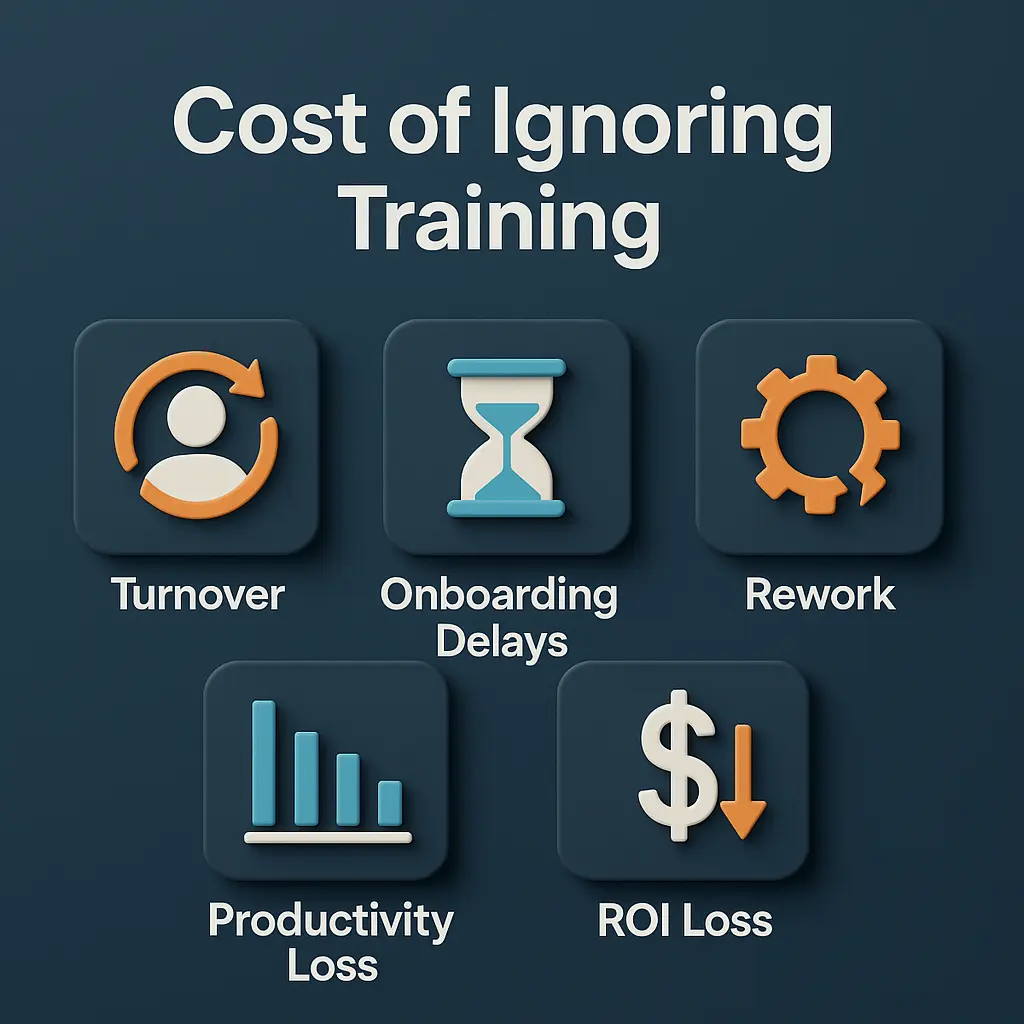
- Increased Employee Turnover:
Employees without growth opportunities are 2.5x more likely to leave within a year (LinkedIn Learning 2024). Replacing an employee can cost 30–50% of their annual salary, creating a financial strain for smaller teams. - Lower Productivity and Output:
Untrained or inconsistently trained employees perform tasks 20–30% less efficiently, leading to reduced throughput and higher operational costs. - Rework and Quality Issues:
Lack of standardized training leads to errors, rework, and service inconsistencies—especially in customer-facing roles. Studies suggest that poorly trained teams can increase rework rates by up to 25%. - Extended Onboarding Time:
Without structured learning frameworks, new hires take longer to reach full productivity. SMEs that lack formal onboarding programs spend up to 60% more time getting employees job-ready. - Compliance and Safety Risks:
In regulated sectors, training lapses can lead to fines, penalties, or legal exposure. Non-compliance due to inadequate documentation is a growing concern for SMEs scaling into new markets. - Training ROI Loss:
Without proper tracking and evaluation, training investments become difficult to justify. SMEs risk losing up to 40% of potential ROI due to unmeasured learning impact or incomplete adoption.
Estimated Business Impact of Poor Training
| Impact Area | Estimated Loss | Key Cause |
|---|---|---|
| Employee turnover | 30–50% of annual salary per lost employee | Lack of development opportunities |
| Productivity decline | 20–30% lower efficiency | Unclear role training & inconsistent standards |
| Onboarding delays | +60% longer ramp-up time | No structured onboarding program |
| Rework & quality errors | Up to 25% increase in rework rate | Skill gaps and unclear SOPs |
| ROI shortfall | 30–40% training ROI loss | Poor tracking & lack of measurement tools |
5. Smart Solutions-How SMEs Can Overcome Training Challenges
After understanding the scope of Employee Training Challenges in SMEs, the next step is identifying practical, scalable solutions that align learning with real business outcomes. The most successful small and medium enterprises approach training strategically-focusing on measurable ROI, continuous learning, and intelligent use of technology.
This section outlines four key solution areas that help SMEs convert training obstacles into opportunities for sustainable performance and growth.
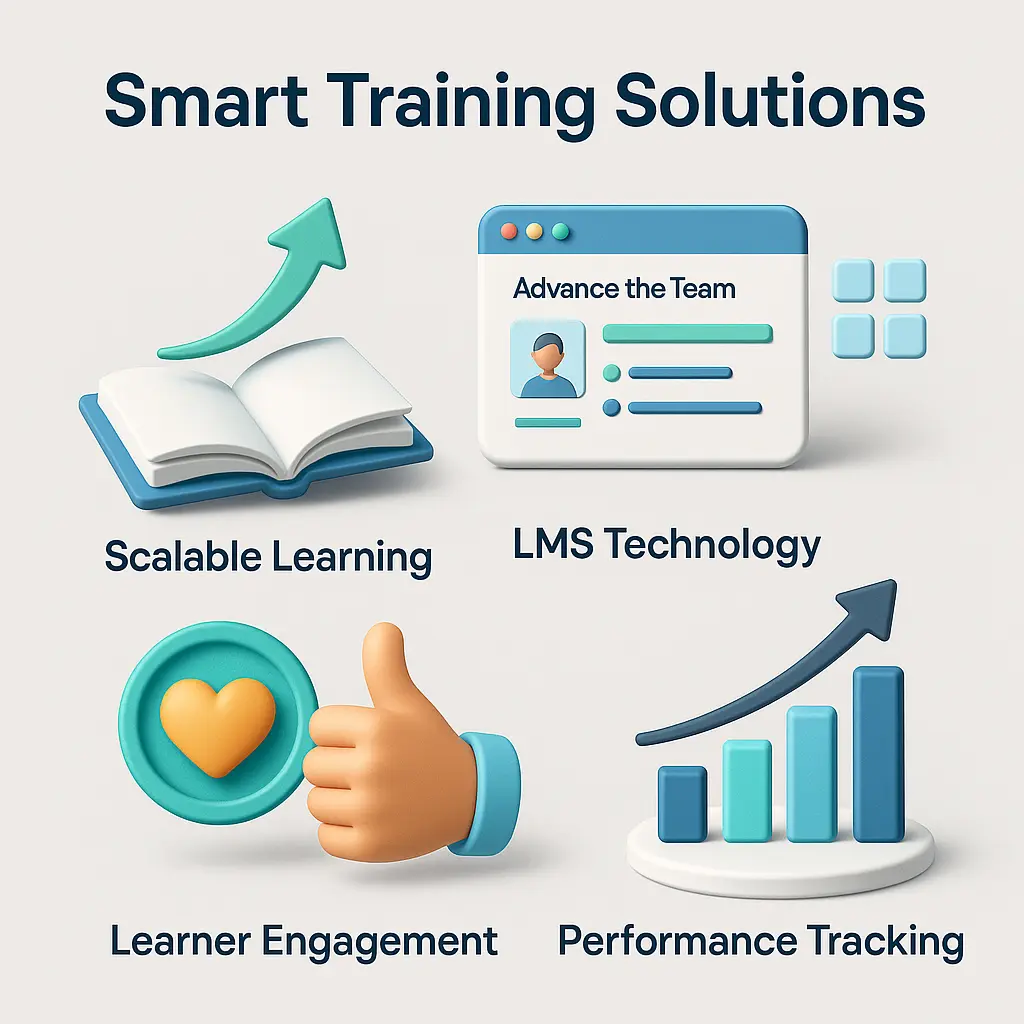
5.1 Building a Scalable Learning Strategy
For SMEs, the foundation of effective employee development begins with strategy, not software. A well-structured learning plan aligns training directly with business objectives-improving productivity, retention, and profitability.
Key elements of a scalable learning strategy:
- Align learning with KPIs: Identify critical business goals-such as reducing onboarding time or improving customer satisfaction-and design training programs around them.
- Adopt a blended learning model: Combine instructor-led, on-the-job, and digital training to maximize flexibility and cost-efficiency.
- Use data for decision-making: Track participation, assessment results, and role-specific skill gaps to refine content and delivery over time.
In SMEs, scalability is essential. As the business grows, training must evolve without inflating cost or complexity. Platforms like Advance the Team provide SMEs with a centralized structure to standardize content delivery and seamlessly expand learning programs across teams-ensuring training consistency at every stage of growth.
5.2 Leveraging Technology to Drive Training ROI
Modern learning management systems (LMS) have redefined how SMEs approach training. By automating administrative processes, reducing manual tracking, and providing 24/7 access to learning content, technology directly improves both cost efficiency and training ROI.
Benefits of adopting LMS for small and medium enterprises:
- Automation: Eliminates repetitive tasks like tracking attendance or sending reminders.
- Cost efficiency: Digital courses cut expenses tied to travel, venue, and trainer fees.
- Accessibility: Employees can learn anytime, anywhere-ideal for hybrid or distributed teams.
- Analytics: Real-time insights help HR teams measure training effectiveness and performance outcomes.
For instance, Advance the Team enables SMEs to automate training workflows, integrate mobile access for frontline staff, and deliver data-driven insights through an advanced analytics dashboard. This allows decision-makers to see direct links between learning participation, performance metrics, and business impact.
5.3 Enhancing Learner Engagement and Retention
Employee participation is one of the most critical Employee Training Challenges in SMEs. Low engagement leads to incomplete learning cycles and poor skill retention. Overcoming this requires designing training experiences that are interactive, personalized, and relevant.
Practical engagement boosters:
- Gamification: Introduce badges, leaderboards, and progress tracking to increase motivation.
- Microlearning: Deliver concise, 5–10 minute lessons that fit easily into an SME employee’s busy schedule.
- Personalized learning paths: Tailor courses based on job roles, skill gaps, or career goals.
- Social learning: Encourage peer-based learning and discussion forums for real-world knowledge exchange.
A platform like Advance the Team addresses these challenges through adaptive learning modules and personalized dashboards that dynamically adjust to each employee’s progress. This not only improves engagement but also strengthens long-term retention-turning learning into a habit rather than an obligation.
5.4 Tracking Performance and Measuring Impact
Without data, even the most engaging training programs fail to demonstrate business value. Tracking and analytics are crucial for converting learning activity into quantifiable business outcomes.
Core capabilities SMEs should implement:
- Integrated analytics: Monitor metrics such as completion rates, average scores, and knowledge retention.
- Performance correlation: Link training outcomes with KPIs like sales growth, service quality, or reduced rework.
- ROI visualization: Translate learning data into clear, financial insights to guide investment decisions.
- Compliance documentation: Automate recordkeeping for audits and certifications.
By leveraging a training management system with built-in reporting-such as the analytics suite in Advance the Team-SMEs gain a complete view of training effectiveness. The ability to measure both behavioral and financial impact transforms training from a cost center into a performance driver.
Conclusion: From Challenges to Measurable Gains
Solving Employee Training Challenges in SMEs requires more than awareness-it demands structure, scalability, and actionable insight. By adopting a strategic learning framework, leveraging LMS technology, and focusing on data-driven engagement, SMEs can unlock measurable business results.
Through automation, analytics, and personalized learning, solutions like Advance the Team empower small and medium enterprises to maximize training ROI, reduce costs, and elevate overall workforce productivity.
6. Implementation Roadmap: Building an Agile, ROI-Driven Training Culture
Overcoming Employee Training Challenges in SMEs requires more than deploying technology-it demands a structured roadmap that aligns people, processes, and systems. A strong training culture doesn’t emerge overnight; it evolves through deliberate actions that connect learning outcomes with business goals. SMEs can build an agile, ROI-driven framework by following these practical steps.
Step 1: Assess Current Training Gaps and Needs
Start by conducting a thorough skills and process audit. Understand where training is falling short and how it impacts business performance.
- Identify existing training methods, frequency, and participation rates.
- Map skills required for current and future business goals.
- Gather feedback from managers and employees to uncover bottlenecks or engagement barriers.
A clear baseline helps SMEs prioritize high-impact areas and avoid redundant training investments.
Step 2: Align Training Goals with Business Objectives
Training must serve measurable outcomes-such as productivity improvement, customer satisfaction, or employee retention.
- Define clear KPIs: onboarding time reduction, performance improvement, or sales growth.
- Create a competency framework linking each role to specific learning outcomes.
- Set short-term (quarterly) and long-term (annual) training milestones tied to business performance indicators.
This alignment ensures training remains focused, relevant, and results-oriented.
Step 3: Adopt Scalable LMS Integration
Technology is the backbone of a modern continuous learning environment. Implementing a scalable LMS for small and medium enterprises streamlines training delivery, reduces manual tracking, and improves accessibility.
- Choose an LMS that supports mobile learning, analytics, and automation.
- Digitize onboarding, compliance, and skill development modules.
- Integrate with existing HR systems to centralize data and simplify reporting.
Platforms like Advance the Team simplify LMS integration by offering automated progress tracking, customizable learning paths, and analytics dashboards-helping SMEs standardize training while maintaining flexibility.
Step 4: Build Engagement and Feedback Loops
An effective training culture thrives on participation and iteration. Encourage active learning and collect feedback continuously to refine content and delivery.
- Introduce microlearning, gamification, and social learning tools to boost engagement.
- Schedule regular surveys to evaluate course relevance and learner satisfaction.
- Use performance data to identify skill gaps and update training content dynamically.
Engagement-driven feedback not only enhances learning effectiveness but also sustains long-term motivation among employees.
Step 5: Measure, Optimize, and Scale
Once the framework is live, focus on quantifiable improvement and scalability.
- Monitor KPIs such as completion rates, performance improvements, and cost savings.
- Compare training ROI across departments to identify best practices.
- Continuously update training modules to match evolving business goals and market trends.
A data-driven review cycle ensures that every learning initiative contributes to measurable business impact.
Conclusion
In today’s competitive business landscape, addressing Employee Training Challenges in SMEs is no longer optional—it’s essential for sustainable growth. When small and medium enterprises invest in structured, technology-enabled learning through modern LMS platforms like Advance the Team, they transform training from a cost center into a strategic training investment that drives measurable productivity growth, engagement, and scalability.
By overcoming barriers such as limited budgets, low participation, and lack of tracking, SMEs can create an agile training culture built on data, personalization, and continuous learning.
Ultimately, turning Employee Training Challenges in SMEs into opportunities for innovation and improvement positions these organizations for lasting SME success, where every learning initiative contributes directly to business performance and ROI.