

Table of Contents
- 1. Introduction
- 2. Understanding Training Measurement: Definitions, Scope, and Strategic Value
- 3. The Business Case for Training Analytics
- 4. The Core KPIs Every SME Should Track
- 5. Training Effectiveness Models Every SME Should Use
- 6. Building a Modern L&D Measurement Framework
- 7. Using Analytics Dashboards to Monitor Training Performance
- 8. Measuring ROI: Quantifying the Financial Impact of Training
- 9. Building Automated Reporting, Data Hygiene, and Governance Standards
- 10. Identifying Skill Gaps and Mapping Workforce Capability
- 11. Measuring Post-Training Behavioral Change and Performance Improvements
- 12. How Compliance Training Strengthens Risk Reduction, Audit Readiness, and Operational Stability
- 13. Building a Continuous Improvement Loop with Training Analytics
- 14. Roadmap for Building a Measurement-First L&D Culture
1. Introduction
In today’s skills-driven economy, modern SMEs must prioritize SME training measurement to link learning initiatives with productivity and cost savings. Competition, digital transformation, and rising workforce expectations require organizations to measure employee training success with the same rigor they apply to sales, operations, and financial performance. When learning outcomes are tracked systematically, businesses gain clarity on how training influences productivity, reduces operational inefficiencies, and strengthens long-term capability building across teams.
Effective measurement turns training from a cost center into a measurable performance driver. By capturing the right KPIs-such as proficiency gain, behavioral change, and post-training performance improvements-SMEs can quantify the real impact of learning on business results. Data-driven insights enable leaders to identify which learning initiatives accelerate productivity, where skill gaps persist, and how training quality affects customer experience, compliance, and workforce readiness. As a result, HR and L&D teams can make informed decisions that directly contribute to profitability, operational agility, and workforce resilience.
However, many organizations still struggle to evaluate training beyond completion rates or learner satisfaction scores. This gap limits their ability to justify budgets, optimize learning investments, or link training to strategic priorities. Measuring employee training success is no longer optional; it is essential for creating a high-performing, future-ready workforce.
Key Challenges for SMEs
Key Opportunities Through Measurement
By adopting a structured, analytics-first approach and leveraging modern training management systems, SMEs can transform their learning programs into engines of measurable business impact.
2. Understanding Training Measurement: Definitions, Scope, and Strategic Value
For SMEs, SME training measurement is more than counting hours spent or courses completed—it is about evaluating how learning initiatives translate into real business outcomes. Effective measurement allows leaders to assess whether employees are acquiring the right skills, applying knowledge on the job, and contributing to organizational performance. Without connecting training to measurable outcomes, SMEs risk investing in programs that do not deliver tangible results.
At its core, training measurement helps organizations answer three critical questions:
- Are employees learning what they need to learn?
- Are they applying those skills in real work scenarios?
- Is the business seeing measurable improvements as a result?
When leaders track the right indicators-such as proficiency uplift, project turnaround time, error reduction, customer satisfaction improvement, and compliance reliability-they gain visibility into whether training is achieving its intended purpose. This clarity enables HR, L&D, and operations teams to prioritize high-impact programs, eliminate ineffective content, and optimize investments.
Why Connecting Training Outcomes to Business KPIs Is Essential
Aligning learning programs with business KPIs ensures that training drives measurable impact. For example, a sales training program should not only track course completion but also measure improvements in conversion rates or average deal size. When SMEs implement structured SME training measurement, they can demonstrate the direct value of learning initiatives, prioritize high-impact programs, and justify further investment in L&D.
By connecting outcomes to KPIs, SMEs can:
- Translate learning activity into measurable business impact
- Identify root causes of performance gaps with data
- Prioritize training initiatives that directly improve operational results
- Strengthen decision-making with evidence rather than intuition
This alignment elevates L&D from a support function to a strategic capability enabler.
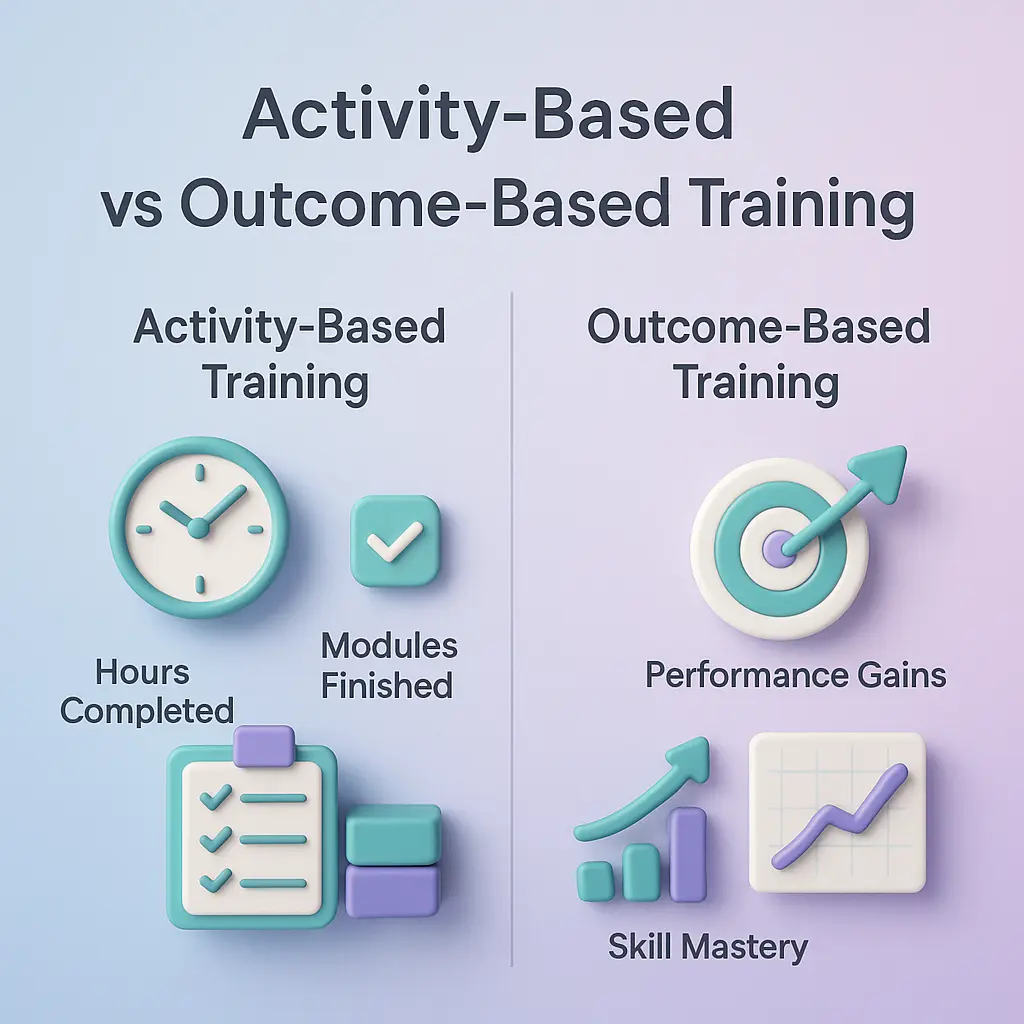
Activity-Based Training vs. Outcome-Based Training
| Aspect | Activity-Based Training | Outcome-Based Training |
|---|---|---|
| Focus | Hours spent, modules completed | Skill application, performance impact |
| Measurement | Attendance and satisfaction | Productivity, quality, and KPI changes |
| Success Definition | “Training was delivered” | “Training improved business results” |
| Decision-Making | Intuition-driven | Data-driven and KPI-aligned |
| Value to SMEs | Limited insight | High clarity on ROI and capability growth |
Shifting from activity-based to outcome-based approaches ensures that SME training measurement captures true business impact rather than just activity levels.
3. The Business Case for Training Analytics
For SMEs, SME training measurement is not just a tactical task—it is a strategic enabler that drives cost efficiency, productivity gains, and performance improvement. By analyzing training data, leaders can identify which learning initiatives deliver tangible business outcomes, optimize resource allocation, and make informed decisions about future programs. Organizations that implement structured SME training measurement can turn learning investments into measurable returns.
When SMEs adopt analytics-driven learning practices, they move from reactive training decisions to proactive capability building. Instead of relying on intuition or anecdotal feedback, leaders gain measurable indicators of skill growth, behavioral change, and productivity impact. This clarity enables them to create targeted, cost-efficient training programs that address actual skill gaps and drive meaningful improvement across teams.
How SMEs Benefit from Training Analytics
3.1 Cost Reduction Through Smarter Training Investment
Analytics reveal which courses generate strong performance outcomes and which offer minimal value. This helps SMEs eliminate low-impact training, reduce training hours that don’t contribute to performance, and optimize L&D spending.
3.2 Productivity Gains Across Teams and Functions
By quantifying proficiency uplift, task accuracy, and time-to-productivity, analytics help identify the training initiatives that genuinely enhance workflow efficiency. This ensures employees spend more time performing and less time struggling with skill gaps.
3.3 Measurable Performance Improvement
Training analytics allow leaders to track how learning influences KPIs such as sales conversion, project turnaround time, operational accuracy, customer satisfaction, and compliance reliability. This creates a direct link between upskilling efforts and business outcomes.
3.4 Data-Driven Decision-Making for HR, L&D, and Operations
Real-time dashboards and trend analysis empower decision-makers with clear evidence-not assumptions. Leaders can forecast skill needs, identify potential performance risks, and allocate learning resources where they deliver the highest impact.
Measurable Business Outcomes Enabled by Training Analytics
- Reduced operational errors and rework
- Faster onboarding and shorter time-to-productivity
- Higher employee performance consistency across teams
- Improved compliance reliability and lower regulatory risk
- Increased customer satisfaction through better service quality
- Optimized training costs and higher ROI on learning investments
When SMEs embrace training analytics, they transform learning from a routine function into a strategic mechanism for growth, efficiency, and competitive advantage.
4. The Core KPIs Every SME Should Track
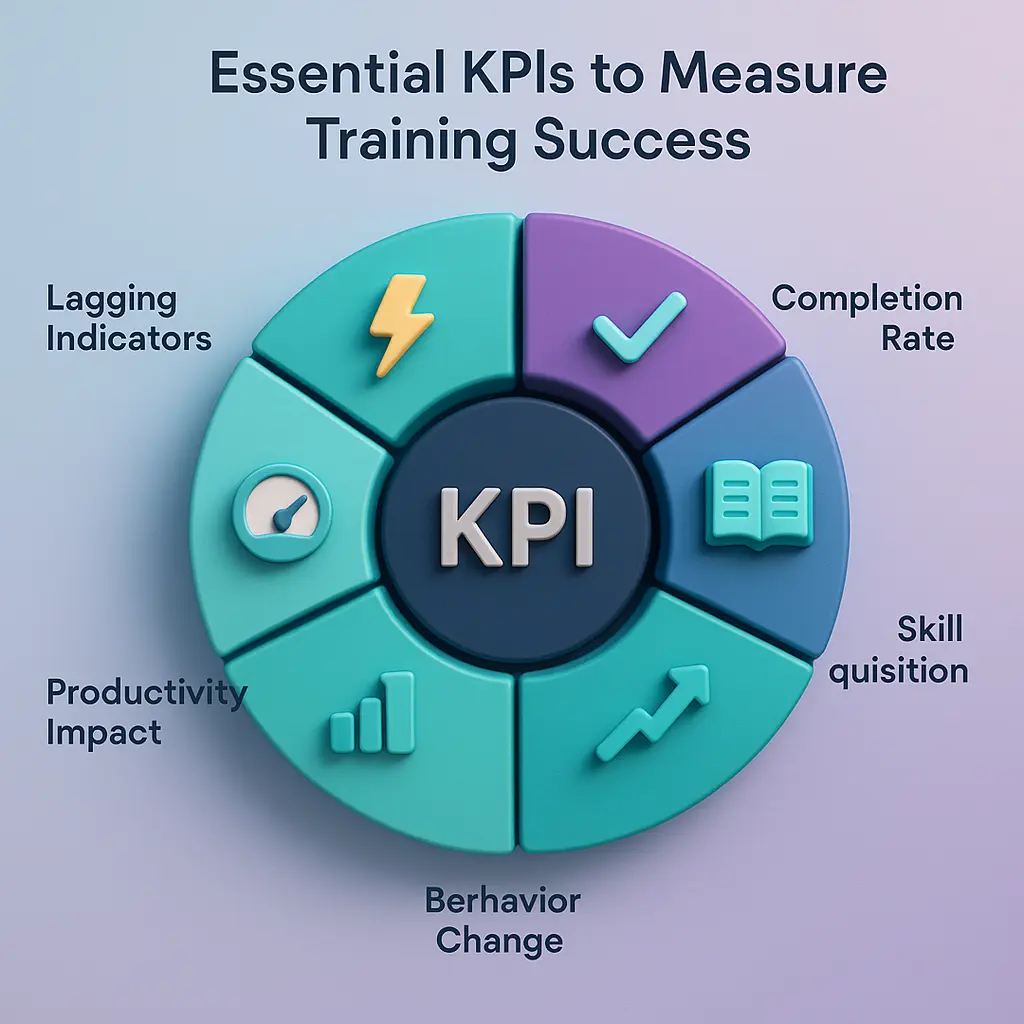
To make SME training measurement actionable, SMEs need to track the right KPIs. These indicators help leaders monitor employee engagement, completion rates, skill acquisition, behavioral changes, and the impact on overall productivity. Lagging indicators reveal long-term effectiveness and ensure learning investments translate into measurable business results.
4.1 Engagement Metrics
Key Engagement KPIs:
- Log-in frequency and platform usage
- Session participation rates
- Interaction with learning materials
- Time spent on modules
Engagement KPIs show whether employees are actively participating in training and interacting with content meaningfully. High engagement signals learner motivation and training relevance, while low engagement helps identify friction points such as poor content design, limited time availability, or lack of managerial support.
4.2 Completion Metrics
Key Completion KPIs:
- Course completion rate
- Assessment completion rate
- Certification achievement
- Drop-off points in the learning journey
Completion metrics help SMEs understand how effectively learners progress through training programs. Tracking these indicators reveals content barriers, identifies learners who may need additional support, and ensures that mandatory training-such as compliance or technical modules-is completed on time.
4.3 Skill Acquisition Metrics
Key Skill Acquisition KPIs:
- Pre- and post-training assessment scores
- Proficiency level improvement
- Skill mastery percentage
- Learning retention indicators
Assess employees’ knowledge and skills post-training through tests, simulations, or practical assignments. Effective SME training measurement ensures that skill growth aligns with business needs.
4.4 Behavioral Change Metrics
Key Behavioral KPIs:
- On-the-job application of new skills
- Changes in work habits or decision-making
- Feedback from managers and peers
- Quality or compliance improvements
Behavioral change is the critical bridge between learning and real-world performance. These KPIs help leaders assess whether employees are applying new knowledge in their daily tasks and whether the training has influenced long-term workplace behavior.
4.5 Productivity and Performance KPIs
Key Productivity KPIs:
- Task completion speed
- Error or defect reduction
- Customer service improvements
- Sales or operational output
Productivity KPIs connect training outcomes directly to business performance. By measuring improvements in speed, accuracy, and quality, SMEs can determine whether training contributes to higher efficiency and better results in core operations.
4.6 Lagging Indicators
Key Lagging KPIs:
- Revenue growth linked to upskilling
- Reduced turnover and improved retention
- Fewer safety or compliance incidents
- Long-term performance trends
Lagging indicators provide a long-term view of training impact. They show how learning contributes to strategic outcomes such as improved profitability, a more capable workforce, and reduced risk. While slower to measure, these indicators validate the overall effectiveness of the training strategy.
By tracking these KPI categories collectively, SMEs gain a comprehensive and data-driven view of training performance-enabling leaders to refine programs, optimize investments, and consistently drive measurable business impact.
5. Training Effectiveness Models Every SME Should Use
To reliably measure employee training success, SMEs need structured, proven models that translate learning activities into measurable outcomes. Three of the most widely used frameworks—Kirkpatrick, Phillips ROI, and CIPP—help leaders evaluate training from multiple angles, including engagement, learning quality, behavioral change, and financial impact, making them essential for effective SME training measurement. Below are concise explanations of each model along with actionable bullet points to guide practical application.
5.1 The Kirkpatrick Model (4 Levels)
The Kirkpatrick Model is the most established framework for assessing training effectiveness. It evaluates training across four progressive levels, moving from learner reactions to actual business results.
Key Components:
- Level 1: Reaction – Measures learner satisfaction and perceived relevance.
- Level 2: Learning – Evaluates knowledge, skill, and attitude improvements.
- Level 3: Behavior – Assesses whether employees apply new skills on the job.
- Level 4: Results – Measures impact on organizational KPIs such as productivity, quality, and customer outcomes.
This model helps SMEs build a complete view of training performance, ensuring that learning translates into real-world improvements.
5.2 The Phillips ROI Method
An extension of the Kirkpatrick Model, the Phillips ROI Method adds a fifth level focused on financial return, enabling SMEs to quantify the monetary value of training investments.
Key Components:
- Data Collection – Gather performance metrics before and after training.
- Isolation of Effects – Determine how much improvement is attributable to training.
- Cost-Benefit Analysis – Compare training costs against measurable benefits.
- ROI Formula – Calculate ROI as a percentage to evaluate financial impact.
- Intangible Benefits – Document non-financial outcomes such as morale or teamwork.
This method appeals to business leaders who want clear financial justification for training initiatives.
5.3 The CIPP Evaluation Model (Context, Input, Process, Product)
The CIPP Model provides a holistic, decision-oriented approach to evaluating training at every stage-from planning through impact measurement.
Key Components:
- Context Evaluation – Identify performance gaps and define training needs.
- Input Evaluation – Assess resources, technology, and training design alternatives.
- Process Evaluation – Monitor delivery quality, participation, and engagement.
- Product Evaluation – Measure outcomes, improvements, and long-term effectiveness.
CIPP is especially useful for SMEs seeking continuous improvement because it emphasizes both strategic planning and real-time evaluation.
By applying these three models, SMEs can assess training comprehensively-capturing learner experience, performance outcomes, financial impact, and organizational value.
6. Building a Modern L&D Measurement Framework
A robust measurement system enables SMEs to measure employee training success in a way that directly supports business goals, operational efficiency, and long-term capability building. Instead of treating L&D as an isolated function, leaders can integrate SME training measurement into the organization’s performance ecosystem-ensuring every program contributes to productivity, quality, compliance, or customer outcomes. The foundation of an effective measurement framework lies in clarity: clear objectives, clear KPIs, and clear data workflows.
Below is a structured approach SMEs can follow to build a scalable, outcome-driven measurement system.
Step 1: Align Training Goals With Business Objectives
Start by defining the specific business outcomes the organization wants to improve. Successful measurement begins with clarity on why training is needed and what it should impact.
Key actions:
- Identify business challenges such as low productivity, skill gaps, or quality issues
- Translate these challenges into training goals (e.g., reduce errors, speed up task completion)
- Secure alignment with operational leaders to ensure goals are realistic and measurable
When training objectives mirror business objectives, every learning initiative has a defined purpose and a measurable performance target.
Step 2: Define Clear KPIs for Each Training Program
Each training initiative should have its own KPI set, shaped by the skills being developed and the outcomes expected.
Recommended KPI categories:
- Engagement: usage, participation, time spent
- Learning: proficiency improvement, assessment scores
- Behavioral change: on-the-job application, manager observations
- Performance: productivity, accuracy, customer satisfaction
- Lagging indicators: revenue impact, reduced incidents, improved retention
These KPIs ensure training performance is assessed from the learner level all the way to the business level.
Step 3: Map KPIs to Performance Outcomes
Linking KPIs to performance outcomes creates a direct line of sight between training and business impact.
Ways to establish alignment:
- Connect skill metrics to task-level improvements
- Align behavioral KPIs with operational workflows
- Tie performance KPIs (e.g., fewer errors, faster cycle time) to department goals
- Validate improvements using pre- and post-training comparisons
This mapping allows SMEs to understand which capabilities drive measurable results and where training delivers the highest ROI.
Step 4: Build Standardized Data Collection and Validation Processes
Reliable data sits at the heart of any measurement framework. SMEs must formalize how training data is captured, validated, and integrated across teams.
Best practices:
- Use automated tracking through the LMS
- Standardize assessments and evaluation rubrics
- Validate data accuracy with periodic audits
- Integrate training data with performance management tools where possible
Strong data governance ensures that analytics insights are trustworthy and actionable.
Step 5: Establish Continuous Reporting and Insight Cycles
Reporting should not be a one-time activity. SMEs need a structured reporting rhythm that helps decision-makers refine training programs continuously.
Recommended reporting workflow:
- Weekly or monthly dashboard reviews
- Quarterly skill gap analysis
- Annual training effectiveness reviews
- Insight-sharing sessions with team leaders
This rhythm turns data into decisions, enabling ongoing optimization.
Step 6: Foster Collaboration Between HR, L&D, and Operations
A measurement-first system works only when all departments participate in defining KPIs, validating data, and interpreting results.
Key collaboration points:
- HR defines skill expectations and talent goals
- L&D drives training design and evaluation
- Operations monitors performance improvements and flags capability gaps
Cross-functional collaboration ensures training remains aligned with evolving business needs.
Step 7: Use Insights to Continuously Improve Training Programs
A mature L&D measurement framework is built on iteration. SMEs should refine training content, delivery methods, and assessment strategies based on insights gathered.
Continuous improvement focus areas:
- Identify underperforming modules
- Personalize learning paths based on skill gaps
- Adjust training formats to improve engagement
- Scale high-impact programs across teams
This ensures the measurement system not only evaluates training-but actively strengthens it.
By following these steps, SMEs can build an L&D measurement framework that is strategic, scalable, and deeply integrated with organizational performance-ensuring every training dollar drives measurable business outcomes.
7. Using Analytics Dashboards to Monitor Training Performance
Analytics dashboards play a central role in helping SMEs measure training success with clarity and consistency. Instead of manually compiling spreadsheets or relying on anecdotal feedback, leaders gain real-time visibility into how employees learn, how skills progress, and where performance gaps still exist. Dashboards consolidate data from multiple sources-engagement, assessments, behavioral indicators, and productivity metrics-into a single, decision-ready view that HR, L&D, and operational managers can act on immediately.
Modern dashboards allow SMEs to monitor learner progress at both individual and team levels, making it easier to identify who is advancing, who needs support, and which courses are delivering measurable impact. Trend charts highlight patterns in completion, proficiency, and performance, enabling leaders to detect issues early—such as declining engagement, skill stagnation, or bottlenecks in the learning journey. This level of visibility ensures timely, targeted interventions and strengthens SME training measurement by aligning insights with business goals.
Platforms like Advance the Team offer an example of how automated dashboards can streamline this process by surfacing insights such as skill gap hotspots, learner progress trajectories, and post-training performance indicators. While every SME may use different tools, the principle remains the same: dashboards transform raw learning data into actionable intelligence, enhancing SME training measurement across teams.
With a well-structured analytics dashboard,SMEs can
- Monitor training progress in real time and intervene where participation drops.
- Identify capability gaps by comparing proficiency levels across teams.
- Track performance improvement following training and tie it to operational KPIs.
- Spot high-value training programs that consistently produce better outcomes.
- Ensure data-driven decision-making for HR, L&D, and department heads.
By centralizing learning insights and performance data, analytics dashboards empower SMEs to manage training as a measurable, strategic function-driving continuous improvement and long-term workforce capability growth.
8. Measuring ROI: Quantifying the Financial Impact of Training
For SMEs operating with tight budgets and high performance demands, the ability to calculate training ROI is essential. A structured ROI workflow allows leaders to measure employee training success and implement robust SME training measurement, not only in terms of skill development but also through clear financial outcomes. By capturing both direct and indirect benefits, SMEs can demonstrate how learning investments translate into cost savings, productivity gains, and improved operational efficiency.
Direct benefits include measurable improvements such as reduced errors, faster task completion, increased sales conversion, or fewer compliance incidents. Indirect benefits-often equally valuable-include higher employee morale, better collaboration, lower turnover, and stronger customer satisfaction. When combined, these metrics provide a comprehensive picture of training’s financial contribution.
A consistent ROI calculation process ensures that L&D decisions are evidence-based and tied to strategic priorities. It also enables HR and operations leaders to justify training budgets, prioritize high-impact programs, and evaluate learning initiatives using standard ROI and cost–benefit analysis techniques.
Sample ROI Calculation Workflow
| Step | Description |
|---|---|
| 1. Identify Performance Gap | Define the business problem training is intended to solve (e.g., error rate, productivity delay, sales inefficiency). |
| 2. Measure Baseline | Capture pre-training KPIs such as task time, accuracy, revenue contribution, or incident count. |
| 3. Capture Post-Training Performance | Measure improvements after training (e.g., faster cycle time, fewer defects, higher output). |
| 4. Isolate Training Impact | Determine what percentage of improvement is directly attributable to training using manager feedback, control groups, or historical data. |
| 5. Convert Improvement to Monetary Value | Assign financial value to saved hours, reduced errors, increased sales, or avoided penalties. |
| 6. Calculate Total Benefits | Sum all direct and indirect financial gains. |
| 7. Subtract Total Training Costs | Include content development, trainer time, employee training hours, and technology expenses. |
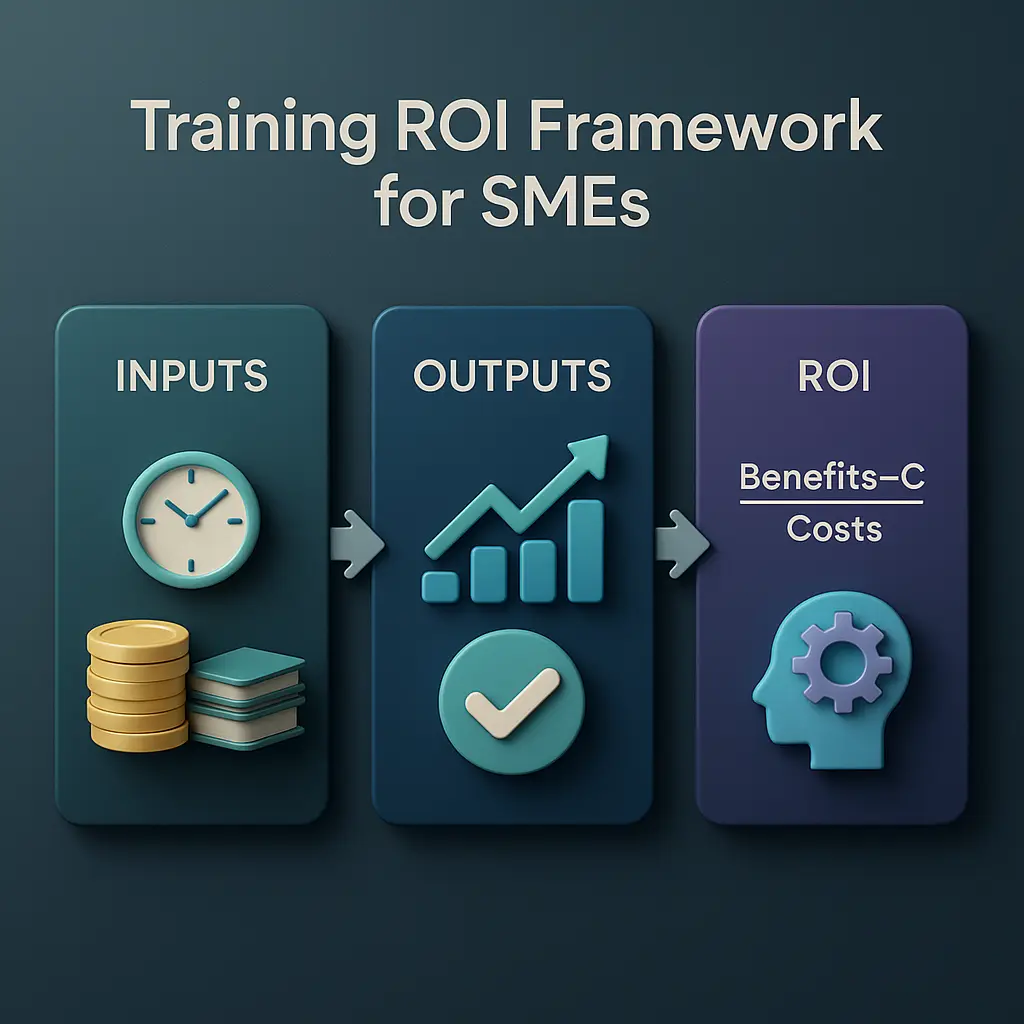
| 8. Apply ROI Formula | ROI (%) = [(Total Benefits – Total Costs) / Total Costs] × 100 |
By using a standardized ROI methodology, SMEs gain the ability to quantify the financial return of training initiatives with greater accuracy. This ensures training investments support strategic goals, strengthen operational performance, and deliver measurable business value.
9. Building Automated Reporting, Data Hygiene, and Governance Standards
For SMEs aiming to consistently measure employee training success, building a reliable reporting infrastructure is just as important as defining KPIs or selecting the right analytics model. Without automated workflows, clean data, and clear governance rules, training insights can become inconsistent, incomplete, or difficult to trust. A structured reporting ecosystem ensures that every metric-whether engagement, skill acquisition, or productivity impact-is captured accurately and delivered to decision-makers in a timely, actionable format.
Automated Reporting Workflows
Automated reporting helps SMEs eliminate manual effort, reduce errors, and ensure insights are delivered on a predictable schedule. Instead of HR or L&D teams exporting spreadsheets each month, dashboards and analytics engines can generate recurring reports on learner progress, skill gaps, and performance trends.
Platforms like Advance the Team illustrate how automated workflows streamline this process by delivering scheduled reports, highlighting KPI variances, and alerting managers when engagement or performance falls below thresholds. The goal is not automation for convenience, but automation for reliability and scalability.
Core elements of effective automated reporting:
- Scheduled weekly/monthly performance reports
- Real-time alerts for low engagement or skill stagnation
- Auto-generated trend analysis for leadership reviews
- Integration with HRIS or performance systems to enrich insights
This system ensures that training decisions are always backed by up-to-date data.
Ensuring Data Hygiene
High-quality insights require high-quality data. SMEs must enforce strong data hygiene practices to avoid inconsistencies, duplication, or inaccurate metrics that can distort training performance evaluations.
Key data hygiene practices include:
- Standardizing naming conventions for courses and assessments
- Ensuring consistent data entry by HR, L&D, and managers
- Regularly auditing reports for anomalies or gaps
- Validating pre- and post-training assessment structures
- Removing outdated or duplicate records from the LMS
Clean, consistent data enables leaders to trust their dashboards and analytics outputs-improving both accuracy and decision-making quality.
Creating Governance Rules
A well-defined governance structure ensures that training data is captured, stored, and used responsibly. Governance provides clarity on roles, responsibilities, and rules, preventing misinterpretation of data and ensuring compliance with internal and external requirements.
Key governance components:
- Clear ownership of data (HR, L&D, operations)
- Defined KPI standards for all training programs
- Access controls for sensitive learner and performance data
- Documentation of reporting processes and decision rules
- Review protocols for KPI changes or new measurement criteria
Governance transforms training analytics from ad hoc reporting into a standardized, repeatable system that supports organizational growth.
By combining automation, clean data, and strong governance, SMEs can create a powerful analytics foundation that delivers consistent, credible insights-ensuring training is measured accurately and used to drive measurable business performance.
10. Identifying Skill Gaps and Mapping Workforce Capability
For SMEs to consistently measure employee training success, they must first understand the current state of workforce capability. Skill gap identification and capability mapping provide the foundation for data-driven training decisions, enabling leaders to allocate resources where they will have the greatest business impact. When executed correctly, this process ensures that learning programs are tightly aligned with operational goals, performance needs, and future workforce requirements.
Identifying Skill Gaps
Skill gaps emerge when the skills employees currently possess do not match the skills required to achieve business objectives. SMEs can use a combination of performance data, assessments, and manager feedback to detect these gaps early and plan targeted interventions.
How SMEs can identify skill gaps:
- Conduct role-based assessments and proficiency evaluations
- Compare performance KPIs against expected benchmarks
- Use manager evaluations to validate skill application on the job
A data-backed view of skill gaps helps pinpoint where training is necessary-and prevents SMEs from investing in areas that do not influence performance.
Mapping Workforce Capability
Capability mapping involves evaluating team-wide skills, strengths, and readiness levels to determine whether the workforce can meet current and future operational demands. This enables SMEs to plan talent development, succession, and upskilling strategies with confidence.
Core elements of capability mapping:
- Visualizing skill distribution across teams and functions
- Categorizing employees by proficiency level (e.g., beginner, proficient, expert)
- Identifying capability bottlenecks that could impact productivity or quality
This structured view allows leaders to target high-risk capability gaps before they affect customer outcomes or operational efficiency.
Aligning Training With Business Needs
The ultimate goal of skill gap identification and capability mapping is to ensure that training directly supports business performance. When training addresses validated gaps, SMEs can expect measurable improvements in productivity, quality, and customer satisfaction.
To ensure alignment:
- Link each training program to a clear business objective (e.g., reduce onboarding time, improve accuracy, increase sales output)
- Prioritize training initiatives based on the severity and business impact of the identified gaps
This alignment ensures that training programs are not only relevant but also strategically targeted.
By systematically identifying skill gaps, mapping capabilities, and aligning training with organizational needs, SMEs can build a high-performing workforce that is equipped to meet both current challenges and future demands. This approach ensures learning interventions are purposeful, measurable, and tightly connected to business outcomes.
11. Measuring Post-Training Behavioral Change and Performance Improvements
Once employees complete a learning program, the real question is – did their behavior, performance, or decision-making actually improve?
This is where structured post-training evaluation becomes essential for reliable SME training measurement.
11.1 Track Behavioral Change on the Job
Behavioral change indicators reveal whether employees are applying new skills in real situations.
Key methods include:
- Manager Observation Checklists
Managers document changes in communication, teamwork, compliance, or problem-solving behavior. - Pre- vs Post-Training Behavioral Benchmarks
Compare how employees handled tasks before training vs. after implementing new knowledge.
11.2. Measure Performance Shifts Over Time
Performance metrics quantify how employees’ productivity or quality has changed:
- Output KPIs: task completion rate, work accuracy, cycle time reduction
- Quality KPIs: defect reduction, fewer rework cases
- Customer KPIs: improved customer ratings, faster issue resolution
- Safety KPIs: decline in incidents or policy violations
Use rolling 30-day and 90-day comparisons to identify short-term and long-term improvements.
11.3 Evaluate Operational Outcomes
For SMEs, even small improvements translate into measurable business impact.
Operational outcomes to track include:
- Process Efficiency Gains
Faster workflows, fewer operational delays, or streamlined hand-offs. - Cost Reductions
Lower overtime costs, reduced training rework, or improved resource utilization. - Revenue-Linked Outcomes
Increase in sales conversions, improved service delivery, or faster turnaround times.
11.4 Link Training Outcomes to Business Results
To truly assess impact, SMEs should connect employee performance shifts to organizational changes:
- Are trained employees completing tasks faster or with fewer errors?
- Are customer complaints decreasing after service training?
- Is team collaboration improving after leadership sessions?
This creates a full-loop performance narrative that goes beyond satisfaction surveys and shows how training reshapes day-to-day behavior and business results.
12. How Compliance Training Strengthens Risk Reduction, Audit Readiness, and Operational Stability
Compliance programs are more than regulatory requirements – they directly influence how securely and smoothly an SME operates. Effective compliance training supported by reliable SME training measurement ensures employees understand rules, follow procedures, and prevent costly violations.
12.1 Reduces Organizational Risk
Well-structured compliance training lowers exposure to regulatory, operational, and financial risks by:
- Helping employees recognize and avoid risky behaviors
- Reducing chances of data breaches, safety incidents, or procedural errors
- Ensuring all staff understand industry laws, internal policies, and ethical guidelines
This leads to fewer disruptions and more consistent operations.
12.2 Improves Audit Readiness
A trained workforce makes external and internal audits faster and more accurate.
- Employees know documentation requirements, reporting timelines, and audit processes
- Teams follow standardized procedures, leaving fewer gaps for auditors to flag
- Automated learning records simplify proof of compliance anytime
Audit readiness becomes a continuous state instead of a stressful, last-minute effort.
12.3 Strengthens Operational Stability
Compliance training ensures employees operate within safe, consistent, and predictable workflows.
- Reduces errors in high-risk tasks such as financial handling, data management, procurement, or safety procedures
- Improves cross-team coordination because everyone follows the same rules
- Minimizes downtime caused by mistakes, accidents, or non-compliance penalties
This stability supports smoother operations and better long-term business performance.
13. Building a Continuous Improvement Loop with Training Analytics
For SMEs, long-term training effectiveness depends on the ability to learn from data, refine programs, and consistently enhance workforce capabilities. A continuous improvement loop allows organizations to measure training success over time by examining what works, what doesn’t, and where learning investments should shift. This approach ensures L&D becomes an adaptive, data-driven function rather than a static, one-time activity.
13.1 Use Learner Behavior Patterns to Refine Design
Analyzing how employees interact with training content reveals valuable insights:
- Which modules learners revisit or abandon
- Average time spent per activity
- Drop-off points and engagement dips
- Patterns between learning habits and performance outcomes
These signals help SMEs identify cognitive load issues, content complexity problems, or mismatches between skill levels and training design.
13.2 Evaluate Content Performance with Quantitative and Qualitative Data
Content effectiveness becomes clearer when organizations track:
- Completion and success rates
- Assessment accuracy trends
- Post-training confidence or satisfaction levels
- Impact on task quality and job performance
This analysis ensures training content evolves to stay relevant, practical, and tightly aligned with operational needs.
13.3 Use Analytics Platforms to Close the Loop
Modern training systems make improvement cycles easier by centralizing data and generating insights. For example, Advance the Team enables SMEs to observe trends across engagement, assessments, and on-the-job outcomes, helping L&D leaders determine which programs deliver measurable value.
13.4 Convert Insights into Iterative Enhancements
To sustain continuous improvement, SMEs should:
- Update content frequently based on performance gaps
- Adjust learning paths to match skill progression
- Introduce microlearning when attention patterns suggest overload
- Recalibrate KPIs as business priorities evolve
This iterative approach ensures training remains dynamic and strategically aligned.
13.5 Reinforce the Feedback Loop Across Stakeholders
A sustainable improvement cycle requires collaboration across HR, L&D, functional teams, and frontline managers. Regular feedback reviews and data discussions ensure insights translate into real operational enhancements.
By embedding analytics and behavioral insights into every stage of the learning lifecycle, SMEs develop a self-improving training ecosystem-one that continuously strengthens capability, efficiency, and business performance.
14. Roadmap for Building a Measurement-First L&D Culture
For SMEs to maximize the value of training investments, they must create a culture where decisions are driven by evidence, performance data, and strategic alignment. A measurement-first approach ensures leaders consistently measure training success and use insights to shape learning priorities, improve programs, and strengthen workforce capability.
Below is a practical, step-by-step roadmap to help SMEs build this culture sustainably.
Step 1: Establish Clear Ownership and Accountability
Define who is responsible for measurement and how insights flow across the organization.
Key Roles
- HR & L&D Leaders: Set measurement strategy, define KPIs, and ensure alignment with business outcomes.
- Functional Managers: Validate performance metrics, track on-the-job impact, and provide feedback loops.
- Data Analysts / Learning Analysts: Build dashboards, analyze trends, and ensure data integrity.
- Executives: Champion measurement culture and tie results to business priorities.
Step 2: Align L&D Goals With Organizational Objectives
- Identify critical business priorities-productivity, safety, quality, sales, compliance, or operational efficiency.
- Translate these priorities into measurable learning KPIs.
- Build training programs that directly support performance improvement.
Step 3: Adopt the Right Technology Infrastructure
Learning systems, analytics tools, and reporting workflows are essential for accuracy, speed, and scalability.
Technology Requirements
- LMS with strong analytics and automated reporting capabilities
- Dashboards showing engagement, assessment, and performance trends
- Integrations with HRIS or productivity systems
- Secure data governance and role-based access controls
Step 4: Standardize Measurement Processes Across the Organization
Every training program should follow a structured measurement framework.
Process Foundations
- Use consistent pre- and post-training assessments
- Collect behavior and performance data from managers
- Evaluate learning retention at defined intervals
- Track both leading indicators (engagement) and lagging indicators (productivity gains)
Step 5: Build Automated Reporting Workflows
- Reduce manual reporting by using LMS automation and scheduled analytics reports
- Ensure managers receive actionable insights regularly
- Standardize formats so dashboards look consistent across departments
Step 6: Embed Data in Decision-Making
- Review training insights in monthly business meetings
- Prioritize programs with the highest performance impact
- Reallocate budget from low-value training to high-impact areas
- Use analytics to shape curriculum updates and new learning paths
Step 7: Create Continuous Feedback and Optimization Loops
- Gather learner feedback, behavioral outcomes, and operational metrics
- Identify skill gaps, workflow bottlenecks, and emerging needs
- Update content and learning paths based on real performance data
- Repeat the cycle to maintain organizational agility
Step 8: Reinforce Culture Through Communication and Leadership Support
- Share success stories that highlight measurable impact
- Train managers to interpret and act on training data
- Celebrate improvements in productivity, efficiency, and employee capability
- Strengthen transparency so employees see how training connects to career growth
By following this roadmap, SMEs can transform L&D from a cost center into a measurable engine of productivity, operational excellence, and workforce capability-anchored by a culture that values data, accountability, and continuous improvement.
Conclusion
For SMEs, the ability to measure training success is no longer optional-it is the foundation of a high-performance, data-driven learning culture.
By aligning training with business goals, defining clear KPIs, using analytics dashboards, maintaining strong data governance, and creating continuous improvement loops, organizations can turn learning investments into measurable gains in productivity, capability, and operational efficiency.
When leaders integrate automated reporting, track behavioral and performance outcomes, calculate ROI, and refine programs based on real workforce data, training evolves from a cost center into a strategic engine for business growth.
In short, SMEs that embed measurement into every stage of the learning lifecycle are the ones that build stronger teams, reduce risks, improve decision-making, and achieve sustainable competitive advantage.