

Table of Contents
- 1. Introduction
- 2. Understanding SME Growth Stages - And Where Training Breaks Down
- 3. Why SMEs Need Scalable Training Infrastructure (Not Just an LMS)
- 4. Introducing Advance The Team as a Scalable Training Operating System for SMEs
- 5. SME Use Cases: Where Advance The Team Resolves Critical Training Pain Points
- 6. Scalability in Action: How Advance The Team Grows With the Business
- 7. Automation That Removes Training as a Manual Workload
- 8. Data, Dashboards & Decisions: The Analytics Layer SMEs Need
- 9. Ensuring Compliance, Consistency, and Audit Readiness at Scale
- 10. Integrations & Systems Alignment for Growing SMEs
- 11. Measurable Business Outcomes: The ROI of Scalable Training for SMEs
- 12. Future-Proofing SME Growth With Advance The Team
- 13. Strategic Recommendations for SME Decision-Makers
1. Introduction
As SMEs scale, their ability to train people consistently, quickly, and accurately often lags behind their operational growth. What begins as founder-led knowledge sharing or informal shadowing soon becomes an organizational bottleneck-slowing onboarding, reducing productivity, and creating avoidable errors. This is why many high-growth SMEs eventually reach a point where training becomes the constraint, not the enabler. The need for scalable training software for SMEs emerges not as a “nice-to-have,” but as a core operational requirement.
Without structured training systems, SMEs face capability gaps that compound over time. Employees learn different versions of the same process, teams adopt inconsistent approaches, and leaders spend hours correcting preventable mistakes. These inefficiencies remain hidden at first, but as headcount increases and processes expand, the cost becomes increasingly visible.
The Hidden Costs of Unstructured or Manual Training
- Longer onboarding cycles that delay time-to-productivity and stretch manager bandwidth.
- Rework and quality issues caused by teams applying inconsistent procedures.
- Compliance exposure when policies and safety instructions aren’t delivered or documented uniformly.
- Increased managerial burden, with supervisors repeatedly explaining the same tasks.
- High turnover risk, as new employees feel unsupported or unclear about expectations.
Across fast-growing organizations, these hidden costs can represent substantial lost revenue opportunities, reduced customer satisfaction, and slower scale-up.
Why Capability Gaps Expand as SMEs Grow
As companies expand, operations evolve faster than internal learning structures. New roles emerge, products diversify, and customer demands increase-yet the internal ability to teach, standardize, and reinforce skills often remains static. This mismatch leads to:
- Skills gaps between tenured employees and new hires
- Inconsistent performance across teams or locations
- A lack of visibility into what employees actually know or can execute
- Leaders relying on assumptions rather than data to make workforce decisions
These capability gaps eventually impact strategic growth-limiting a company’s ability to launch new services, expand into new regions, or maintain service quality.
The Shift Toward Software-Driven Enablement
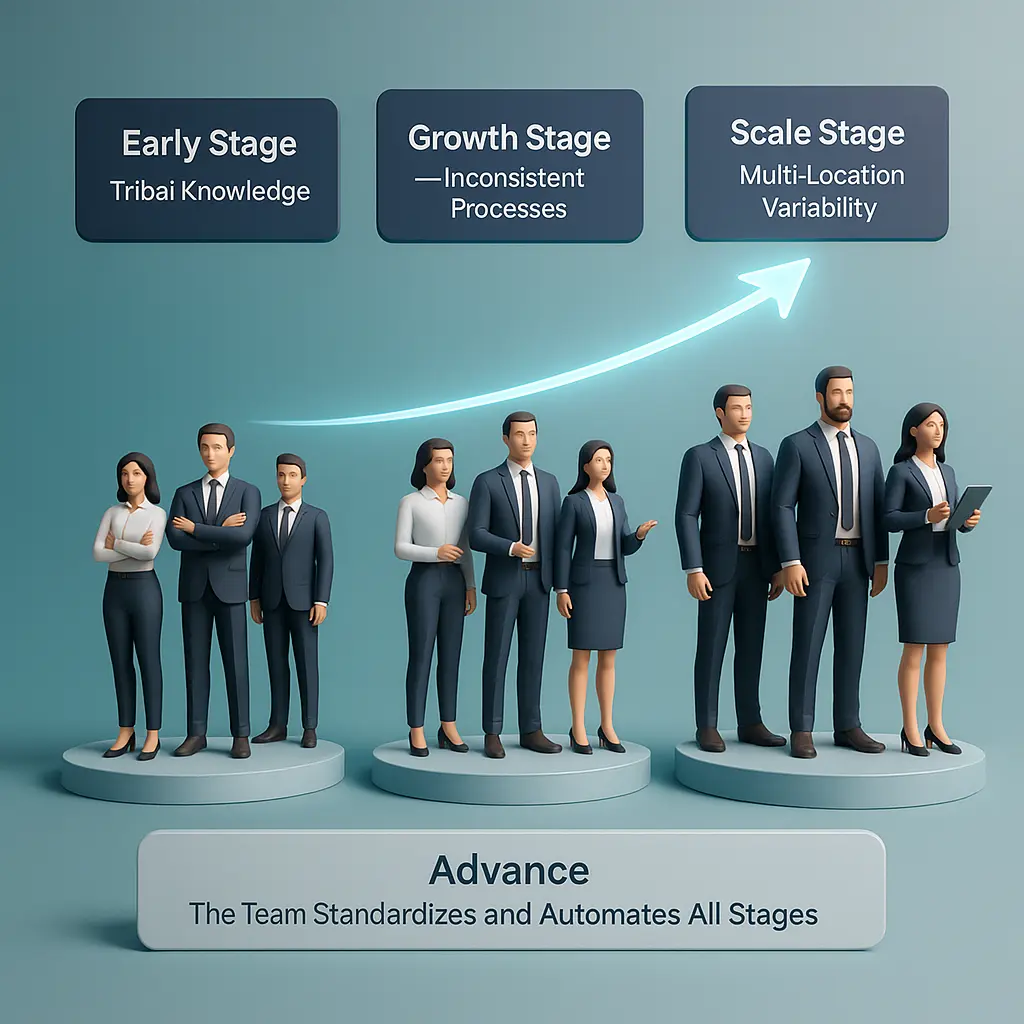
Modern SMEs are now moving from fragmented training methods to centralized, automated, analytics-driven enablement platforms. Instead of relying on tribal knowledge or person-dependent coaching, they adopt scalable training software for SMEs that offers:
- Standardized training workflows
- Automated onboarding and role-specific learning paths
- Real-time analytics on employee progress, competency, and risk
- Consistent delivery of SOPs, compliance updates, and product knowledge
- A repeatable system that grows as the business grows
This shift reduces operational friction and positions training as a strategic lever-not an administrative task. With automation, data visibility, and standardized processes, SMEs can unlock higher productivity, stronger performance consistency, and a more resilient workforce ready to support long-term growth.
2. Understanding SME Growth Stages – And Where Training Breaks Down
SMEs evolve through distinct phases, and at each stage, the demands on training infrastructure shift dramatically. What works for a 10-person team rarely works for a 50- or 200-person organization. As operations expand, new roles emerge, processes multiply, and customer expectations rise-yet many SMEs still rely on informal coaching, scattered documentation, or traditional LMS tools that were never designed for rapid, fluid growth. This is where adoption of scalable training software for SMEs becomes essential, offering structure and predictability in environments defined by change.
Early-Stage SMEs: Founder-Driven Knowledge Transfer Limits
In the early phase, training typically depends on the founder or a handful of senior employees. While this approach feels efficient initially, it begins to strain the organization once hiring accelerates.
Key limitations include:
- Person-dependent training, with critical knowledge residing in individual heads rather than structured systems.
- Inconsistent handovers, resulting in new employees receiving different instructions from different trainers.
- Lack of documentation, making it difficult to replicate onboarding or maintain quality.
- Minimal tracking, leaving leadership unaware of gaps in employee capability or compliance.
Traditional LMS platforms offer content storage but lack the workflow automation and simplicity early-stage SMEs need to standardize repeatable processes.
Growth-Stage SMEs: Scaling Teams Without Scaling Training
As SMEs expand into new markets or add additional teams, their earlier training methods quickly become insufficient. Hiring speeds up, roles diversify, and process complexity increases, exposing capability gaps that hinder operational performance.
Common breakdown points at this stage:
- Slow onboarding, as managers spend excessive time repeating explanations.
- Fragmented training content across PDFs, shared drives, and informal notes.
- Siloed skill development, with no unified understanding of who knows what.
- Inability to update content at scale, leading to outdated or conflicting instructions.
Traditional LMS tools fail here because they are built for static content delivery-not dynamic operational training. They lack role-based automation, version control, and integrated analytics needed to support fast-growing teams.
Maturity-Stage SMEs: Complexity Outpaces Manual Training
In mature SMEs, the challenge shifts from creating training to managing it across multiple functions, locations, and compliance environments. The business now needs consistent standards, audit readiness, and performance insights-not more slides and checklists.
Key friction points include:
- Multi-location inconsistency, where each branch or team interprets processes differently.
- Regulatory pressure, requiring documented, trackable training workflows.
- Performance variability, as leaders cannot see competency gaps in real time.
- High training overhead, with HR and operations teams struggling to manage manual or outdated systems.
At this stage, traditional LMS platforms become a liability. They cannot automate recurring workflows, track operational tasks, or integrate with HR and operations systems, resulting in fragmented learning experiences.
Why SMEs Need Training Infrastructure That Evolves With Them
Across all growth phases, SMEs require more than content storage-they need training that mirrors business operations. This is why modern organizations are shifting toward scalable training software for SMEs that can:
- Adapt to new roles, products, and processes
- Automate onboarding and compliance training
- Deliver standardized content across fast-growing teams
- Provide analytics and insights that guide decision-making
As SMEs expand, their training systems must evolve from being reactive and manual to being proactive, automated, and intelligence-driven. Scalable platforms enable this transformation.
3. Why SMEs Need Scalable Training Infrastructure (Not Just an LMS)
As SMEs grow, their operational complexity increases faster than their ability to train people consistently. Traditional LMS platforms-designed primarily for static content delivery-cannot keep pace with the dynamic, role-specific, process-heavy learning needs of modern SMEs. What these organizations truly require is scalable training infrastructure built to automate workflows, standardize knowledge, and support real-time capability development. This is where scalable training software for SMEs becomes indispensable, offering a system that evolves with the business rather than holding it back.
The Risk of Tribal Knowledge in Growing Teams
Many SMEs rely heavily on “tribal knowledge”-the undocumented, experience-based instructions that senior employees pass down informally. While this works early on, it becomes a major liability as headcount grows.
Key risks include:
- Inconsistent outcomes, with employees executing tasks differently based on who trained them.
- Dependency on individuals, making the business vulnerable when key employees resign or shift roles.
- Unscalable onboarding, since informal knowledge transfer cannot handle increased hiring volume.
- Quality erosion, as outdated or incorrect information spreads across teams.
A traditional LMS can store documents, but it cannot operationalize them into repeatable, automated training workflows that eliminate the uncertainty created by tribal knowledge.
Why SMEs Need Role-Based, Workflow-Driven Training
Fast-growing businesses operate through structured workflows-onboarding sequences, SOP-driven tasks, compliance steps, and recurring updates. These processes require training systems that can mirror real work, not just present content.
A scalable training infrastructure supports:
- Role-based onboarding paths aligned with job responsibilities and competency needs.
- Automated assignment rules that adapt when roles, departments, or locations expand.
- Process-first training, where employees practice real tasks, not just consume information.
- Version-controlled SOPs, instantly updated across the organization.
This approach ensures every employee receives the right training at the right time, improving consistency and reducing operational friction.
Improving Time-to-Productivity Through Predictable, Automated Training
For SMEs, speed matters. Every additional day a new hire takes to reach productivity represents lost revenue, delayed service quality, and increased managerial burden.
Scalable training infrastructure drives measurable improvements in:
- Onboarding efficiency, reducing ramp-up time by standardizing what new hires learn.
- Manager bandwidth, eliminating repetitive coaching and allowing leaders to focus on high-impact work.
- Skill acquisition speed, using structured workflows instead of ad hoc learning.
- Capability tracking, enabling data-driven decisions about employee readiness.
Here again, scalable training software for SMEs provides automation and analytics that traditional LMS tools simply lack.
LMS vs. Scalable Training Infrastructure
| Capability | Traditional LMS | Scalable Training Infrastructure |
|---|---|---|
| Content delivery | ✔ Yes | ✔ Yes |
| Role-based workflows | ✖ Limited | ✔ Automated, dynamic |
| SOP & process training | ✖ Not designed for it | ✔ Core functionality |
| Version control & instant updates | ✖ Manual | ✔ Centralized and automated |
| Time-to-productivity impact | Minimal | High, measurable |
| Skills and competency tracking | Basic | Advanced, analytics-driven |
| Scalability with org growth | Low | High |
The Strategic Shift SMEs Must Make
As SMEs continue to scale, training can no longer remain a reactive, content-centric activity. They must adopt training infrastructure that supports operational growth, standardizes tasks, and provides data-backed visibility into workforce performance. By moving beyond a basic LMS and embracing a holistic training system, SMEs build a workforce capable of supporting long-term expansion with confidence and consistency.
4. Introducing Advance The Team as a Scalable Training Operating System for SMEs
As SMEs outgrow the limitations of traditional LMS platforms, they need a solution built for operational training, rapid growth, and real-time workforce enablement. Advance The Team fulfills this need by functioning not as a content repository, but as a scalable training operating system-a platform designed to standardize processes, accelerate onboarding, and embed continuous capability-building across every team. Positioned as scalable training software for SMEs, it delivers automation, structure, and insights that directly support the pace and pressure of SME growth.
Unlike conventional LMS tools that prioritize course hosting, Advance The Team focuses on the realities SMEs face daily: limited managerial bandwidth, high variability in performance, multi-role teams, and the constant introduction of new products, services, and processes. It transforms training into a predictable, measurable, and repeatable system that grows with the organization.
How Advance The Team Goes Beyond a Traditional LMS
Traditional LMS platforms struggle to serve fast-growing SMEs because they were built for corporate e-learning, not operational readiness. Advance The Team fills that gap by integrating training, workflows, and performance insights into a single, scalable environment.
Key differentiators include:
- Workflow-driven training, not just content consumption-employees learn by following operational tasks, SOPs, and checklists that mirror real work.
- Automation-first architecture, enabling onboarding sequences, reminders, and role-based assignments to run without manual intervention.
- Real-time analytics, giving leaders visibility into competency gaps, readiness, compliance status, and performance patterns.
- Instant content updates, ensuring new instructions, product changes, or policy revisions are deployed across teams immediately.
- Role-specific learning paths, aligned with job responsibilities, department structures, and organizational growth.
This combination turns training into a core operational process rather than a standalone HR function.
Built for SME Realities: Fast Growth, Lean Teams, Continuous Change
SMEs often operate under constraints that large enterprises don’t face-tight budgets, fewer trainers, multi-tasking managers, and rapid shifts in business needs. Advance The Team addresses these realities directly.
It aligns with SME challenges by offering:
- Minimal setup demand, allowing teams to implement the platform quickly without deep L&D expertise.
- Scalable content structures, making it easy to add new roles, locations, workflows, and SOPs as the organization expands.
- Reduced managerial load, through automated training delivery and progress tracking.
- Lower operational risk, with standardized instructions and built-in compliance workflows.
- Data-driven visibility, enabling leadership to make informed decisions about staffing, performance, and resource allocation.
These capabilities empower SMEs to maintain consistency, quality, and efficiency even as their workforce scales.
A Strategic System That Supports Long-Term Growth
By acting as a training operating system, Advance The Team helps SMEs build a resilient, capable workforce that can absorb growth without compromising performance. The platform enhances operational agility, reduces onboarding time, and creates a high-trust environment where employees understand expectations clearly and can execute tasks reliably.
For SMEs looking to professionalize training, reduce inconsistencies, and support expansion, Advance The Team offers the ideal foundation-delivering the structure and intelligence that traditional LMS platforms cannot provide. This is why it is emerging as one of the most effective scalable training software for SMEs in today’s fast-moving business environment.
5. SME Use Cases: Where Advance The Team Resolves Critical Training Pain Points
High-growth SMEs often struggle with fragmented training practices that slow down operations, reduce consistency, and increase managerial workload. Advance The Team addresses these issues by functioning as scalable training software for SMEs, transforming training from a manual, person-dependent activity into a predictable, automated, and measurable system. The platform supports a wide range of real-world SME scenarios-from onboarding to compliance-and eliminates the operational friction that typically emerges as organizations expand.
Below are the core use cases where Advance The Team delivers immediate and measurable impact.
1. Onboarding at Scale: Faster Ramp-Up, Less Managerial Burden
For fast-growing SMEs, onboarding becomes a bottleneck when hiring accelerates. Managers spend hours explaining the same tasks, and new employees often receive inconsistent guidance.
Advance The Team solves this by providing:
- Automated onboarding paths triggered by role, department, or location
- Standardized sequences for company orientation, product training, and task-specific learning
- Clear progress visibility, ensuring no steps are skipped
- Faster time-to-productivity, reducing ramp-up time by delivering structured, step-by-step training
By offering repeatable onboarding workflows, the platform ensures every new hire follows the same high-quality path-something traditional LMS tools cannot replicate.
2. SOP Training & Process Standardization: Eliminating Variability
As SMEs grow, inconsistent execution becomes a major operational risk. Employees learn “their version” of tasks, and SOPs stored across PDFs, Google Drive, or chat threads quickly become outdated.
Advance The Team strengthens process training through:
- Task-level SOP modules that walk employees through exact workflows
- Version-controlled updates deployed instantly across all teams
- Checklists, demonstrations, and task confirmations that mirror real operational work
- Centralized SOP governance, reducing tribal knowledge and mistakes
This ensures every employee-new or experienced-follows the same processes, improving quality and reducing errors across the organization.
3. Compliance & Policy Training: Consistency, Documentation, and Audit Readiness
SMEs face growing regulatory responsibilities-safety policies, HR compliance, documentation standards, and industry-specific regulations. Manual tracking of compliance quickly becomes unmanageable.
Advance The Team supports compliance workflows with:
- Automated renewal cycles, reminders, and re-certification tasks
- Digital acknowledgment logs for policies and mandatory trainings
- Structured learning paths for safety procedures, product updates, and regulatory requirements
- Real-time dashboards showing who is compliant, overdue, or at risk
This makes the platform more than a learning tool-it becomes an audit-ready compliance engine.
4. Role-Based Upskilling: Building Capabilities for Growth
As SMEs evolve, new roles emerge and existing teams require continuous upskilling. Traditional LMS platforms deliver content, but they cannot structure capability-building into clear, role-driven workflows.
Advance The Team delivers smarter upskilling through:
- Competency-based learning paths mapped to specific job functions
- Automated assignment rules that adjust as employees move roles or gain responsibilities
- Hands-on, task-centric modules that reinforce real operational skills
- Progress and competency tracking, helping leaders identify gaps early
This allows SMEs to build an internal talent pipeline and support long-term workforce agility.
5. Multi-Location & Distributed Team Training: Consistency Across Every Branch
For SMEs operating multiple branches or remote teams, maintaining training consistency is a major challenge. Each location tends to adopt its own processes, leading to performance variability.
Advance The Team unifies training across locations with:
- Location-based training paths tailored to specific operational needs
- Centralized control, ensuring all branches follow up-to-date SOPs
- Real-time insights into training completion and performance by location
- Scalable content deployment, ideal for teams that expand rapidly
With the platform’s automation and structure, every location receives the same high-quality training-reducing operational risk and improving performance consistency.
Why These Use Cases Matter for Growing SMEs
Across onboarding, SOP execution, compliance, and upskilling, SMEs require predictable systems-not ad hoc processes. Advance The Team, as scalable training software for SMEs, brings structure, automation, and analytics to these critical workflows. By addressing the core pain points that hinder operational performance, the platform ensures SMEs can grow without sacrificing quality, efficiency, or compliance.
6. Scalability in Action: How Advance The Team Grows With the Business
For SMEs, growth rarely happens in a straight line. New roles emerge, product lines expand, teams multiply, and operational complexity increases-often faster than internal processes can handle. This is where Advance The Team proves its value as scalable training software for SMEs, enabling organizations to expand without losing consistency, quality, or operational control. Instead of forcing SMEs to overhaul their training systems every time they grow, the platform scales dynamically, adapting to new structures, workflows, and business realities.
Modular Workflows That Expand as the Business Evolves
SMEs need flexible training architecture-not rigid courses-and Advance The Team delivers this through modular, building-block-style workflows.
Key capabilities include:
- Configurable modules that can be combined to create role-based training paths, SOP bundles, onboarding flows, or compliance sequences.
- Reusable components that allow learning teams to update a single module and instantly deploy changes across multiple roles or departments.
- Process-level granularity, giving SMEs the ability to train employees on individual tasks, complex workflows, or multi-step operational procedures.
- Drag-and-drop structure, allowing even non-L&D teams to design or modify training without technical expertise.
This modularity ensures that as new roles or processes emerge, SMEs can add them without disrupting existing workflows.
Automated Assignments That Support Rapid Workforce Expansion
When SMEs scale, manual training assignments become impossible to maintain. New hires join weekly, teams move between roles, and compliance requirements evolve-making automation essential.
Advance The Team supports rapid growth through:
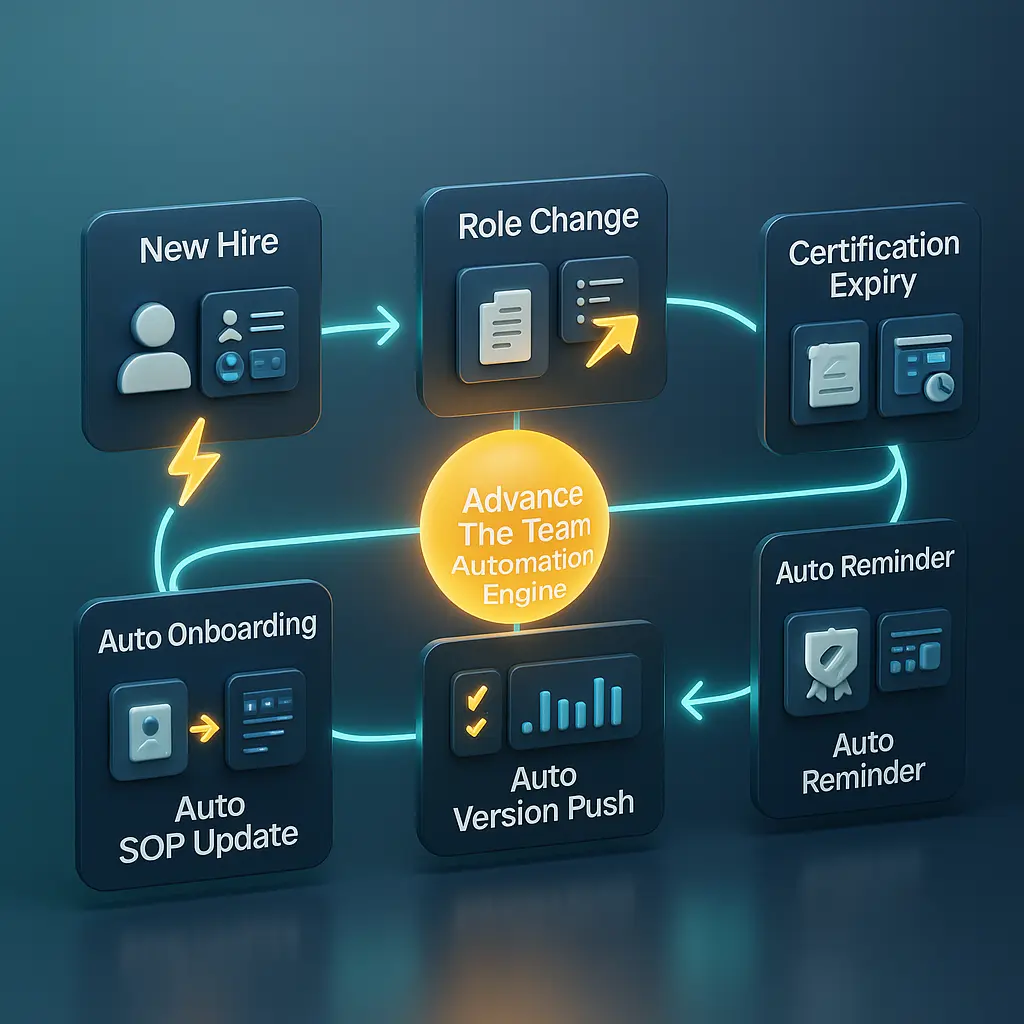
- Role-based assignment rules that automatically deploy relevant training as soon as an employee joins or changes position.
- Department and location mapping, ensuring the right teams receive the right training without administrative intervention.
- Recurring workflows, ideal for compliance renewals, product knowledge updates, or SOP revisions.
- Trigger-based automation, where specific events-like a policy update or new SOP-push instant training to affected teams.
This reduces administrative overhead and ensures employees always have access to timely, accurate, and relevant training.
Infrastructure Designed for Multi-Team and Multi-Location Scalability
As SMEs grow into new markets or expand operational teams, training systems must keep up. Traditional LMS platforms often break at this point because they lack operational flexibility.
Advance The Team scales seamlessly by offering:
- Multi-location capability, allowing centralized training oversight with localized customization.
- Standardized training templates, ensuring every branch operates under the same quality standards.
- Consistent content distribution, so updates are instantly reflected across all teams.
- Analytics that segment performance by location, role, or department-critical for growth-stage decision-making.
This ensures rapid expansion does not lead to fragmentation, inconsistency, or operational drift.
Supporting Dynamic SME Growth Through Continuous Adaptation
SMEs frequently tweak processes, launch new services, and reorganize teams. A scalable training infrastructure must support that agility.
Advance The Team enables continuous adaptation through:
- Instant SOP updates, eliminating outdated instructions.
- Flexible learning paths, adjusted easily as job roles evolve.
- Real-time insights, showing emerging skill gaps as the organization grows.
- Low-lift maintenance, reducing the strain on HR, L&D, or operations teams during periods of rapid scaling.
This adaptability ensures that training keeps pace with business change-rather than trailing behind it.
The Result: Training That Strengthens, Not Slows, Growth
By combining modular workflows, automated assignments, and multi-location scalability, Advance The Team becomes foundational to how SMEs grow. It ensures training remains a catalyst for expansion rather than a point of friction. As scalable training software for SMEs, it delivers the structure, consistency, and automation required to support long-term success-no matter how fast or how far the organization scales.
7. Automation That Removes Training as a Manual Workload
For most SMEs, training becomes a heavy, repetitive, and time-consuming task-especially when managers must repeatedly explain processes, chase completions, or manually roll out updates. As teams grow, this burden compounds. Advance The Team eliminates this operational drag by embedding automation into every layer of training delivery, transforming it from a manual workload into a self-running, structured system. This automation-first approach is a core reason the platform stands out as scalable training software for SMEs, supporting lean teams that need efficiency without sacrificing quality.
Auto-Triggered Onboarding That Runs Itself
In fast-growing SMEs, new hires can join weekly-or even daily. Manually onboarding each employee is not sustainable.
Advance The Team reduces onboarding workload with:
- Automated onboarding flows that trigger the moment a new employee is added
- Role-based pathways that instantly assign the right modules, SOPs, and workflows
- Pre-scheduled tasks and reminders that keep new hires on track without manager intervention
- Clear, centralized dashboards that show progress without the need for manual check-ins
This ensures that every new hire receives the same high-quality onboarding, regardless of start date, location, or manager availability.
Centralized Content Updates Deploy Instantly Across Teams
Whenever an SOP, product requirement, or policy changes, SMEs typically spend days trying to communicate updates-often with inconsistent results. Manual rollouts lead to knowledge gaps and operational risk.
Advance The Team prevents this by enabling:
- Single-source updates, where a change in one module instantly updates all connected workflows
- Automated notifications to ensure employees receive and acknowledge new instructions
- Version control, so leadership can track who has seen what and when
- Immediate cross-location rollout, keeping every branch aligned with current standards
This centralized update system dramatically reduces errors and ensures training reflects the latest business requirements.
Automation That Frees Up Managerial and HR Bandwidth
Lean SME teams cannot afford to waste hours on administrative training tasks. Automation directly reduces workload and improves overall productivity.
Key productivity gains include:
- Eliminating repetitive explanations, since workflows deliver clear, step-by-step guidance
- Reducing follow-up, as reminders and alerts run automatically
- Minimizing the need for manual tracking, with dashboards showing real-time completion and readiness
- Simplifying compliance cycles, with automatic reassignment of annual or biannual training
Managers regain valuable time, HR teams avoid micromanagement, and employees receive consistent, high-quality training without delays.
Why Automation Strengthens SME Performance
Automation doesn’t just reduce effort-it enhances outcomes. When SMEs rely on manual training, inconsistencies emerge, productivity slips, and knowledge decays. Automated training ensures that processes are executed the same way every time, reducing dependency on individual trainers and lowering operational risk.
With Advance The Team, automation becomes a strategic advantage, enabling the platform to truly function as scalable training software for SMEs-one that supports growth, preserves quality, and frees teams from administrative burden.
8. Data, Dashboards & Decisions: The Analytics Layer SMEs Need
For most SMEs, the real value of training isn’t in content creation-it’s in the ability to measure, improve, and predict performance outcomes. As businesses scale, manually interpreting spreadsheets, attendance logs, or completion screenshots becomes unmanageable. What SMEs truly need is an analytics layer designed to reveal performance gaps early, accelerate decision-making, and provide clarity across roles, departments, and locations. This is where scalable training software for SMEs fundamentally changes the game.
Modern training infrastructure must give leaders the visibility to understand not just who completed what, but what those completions actually mean for readiness, quality, and performance. Data-driven training ensures teams stay aligned, consistent, and compliant even as the business evolves.
What the Right Analytics Layer Should Deliver
- Predictive Insights for Workforce Readiness
Instead of waiting for errors, delays, or quality issues to surface, predictive analytics highlight emerging skill gaps, compliance risks, and inconsistent performance patterns before they turn into business disruptions. - Real-Time Progress Tracking Across Teams & Locations
SMEs need visibility that updates instantly – not end-of-month summaries. Leaders can instantly see:- Completion rates
- Overdue training
- Adoption trends
- At-risk employees or teams
- Competency & Skill Mapping for Every Role
Role-based competency visibility helps teams understand exactly where employees stand today and what additional training is required to elevate performance. This is essential for succession planning, upskilling, and workforce development. - Role-Based Dashboards That Simplify Decision-Making
Instead of universal dashboards that overwhelm users, every stakeholder – operations managers, HR teams, supervisors, and frontline employees – gets a personalized view of what matters most to them.
Why SMEs Can’t Depend on Traditional LMS Reporting
Traditional LMS reporting is static, outdated, and primarily designed for compliance checkboxes-not operational excellence. SMEs require:
- Actionable metrics, not generic completion stats
- Deeper insights into quality, productivity, and cycle times
- Data connected directly to real-world workflows and KPIs
- Visualization that enables decision-making, not administrative burden
This is precisely why scalable training software for SMEs must include a modern analytics engine – one that aligns training outcomes with business performance.
9. Ensuring Compliance, Consistency, and Audit Readiness at Scale
For SMEs operating in regulated industries-or simply striving for operational excellence-compliance is no longer a once-a-year exercise. It requires continuous documentation, standardized processes, and clear proof that employees are trained, certified, and aligned with policy updates. The problem is that most traditional LMS platforms treat compliance as a static checkbox, leaving SMEs exposed during audits and vulnerable to inconsistent execution on the front line. This is where scalable training software for SMEs becomes essential, providing real-time oversight and auditable proof of workforce readiness.
A modern compliance framework must ensure policies are understood, training is trackable, and documentation is immediately accessible. With a centralized and automated system, SMEs reduce risk, improve accountability, and maintain day-to-day operational consistency.
Core Compliance Capabilities SMEs Need
- Policy & SOP Training Workflows
A strong system automatically assigns new or updated policies to relevant roles, tracks completion, and captures employee acknowledgments. This ensures consistent adoption across locations and departments. - Automated Re-Certifications & Expiry Tracking
Compliance isn’t permanent-certifications expire and require periodic renewal. Automated reminders and workflow triggers prevent lapses that could lead to regulatory penalties, safety incidents, or quality breakdowns. - Centralized Documentation & Version Control
SMEs need one source of truth for SOPs, policies, training records, and acknowledgments. Version history ensures employees always access the most current documentation while preserving full audit trails. - Audit-Ready Reporting & Evidence Capture
Whether it’s a client audit, industry certification, or internal inspection, leaders must produce accurate data instantly. The right system provides downloadable proof of:- Policy completions
- Certification timelines
- Employee competency maps
- Retraining workflows
- Training exceptions and resolutions
Why SMEs Can’t Rely on Spreadsheets or Legacy LMS Tools
Manual tracking introduces errors, delays, and inconsistent documentation that become liabilities during audits. Legacy LMS tools aren’t built to manage dynamic compliance environments, multi-location operations, or real-time workforce changes.
With scalable training software for SMEs, compliance becomes proactive, predictable, and automated-reducing operational risk while strengthening accountability across the organization.
10. Integrations & Systems Alignment for Growing SMEs
As SMEs expand, their operational stack becomes more complex-HRIS platforms, CRM systems, payroll tools, workforce management software, and communication apps all begin to multiply. Without integration, these systems operate in silos, creating duplicated data, misaligned employee records, and time-consuming manual updates. This fragmentation also weakens training effectiveness, because learning workflows rely on accurate, up-to-date employee information. This is where scalable training software for SMEs must function as a connected layer, not an isolated platform.
Modern SMEs need training infrastructure that seamlessly exchanges data with core business systems, ensuring employees are automatically enrolled, assigned, and monitored based on real operational inputs-not guesswork or manual triggers.
Key Integration Capabilities That Strengthen SME Operations
- HRIS & Payroll Integrations
Automatic syncing of employee profiles, roles, departments, and employment status eliminates double entry and ensures training assignments change the moment people join, move roles, or exit. - CRM Integrations for Customer-Facing Teams
Customer operations, sales, and support teams need live-updated training linked to real performance metrics. CRM integration aligns training paths with pipeline updates, service tiers, customer SLAs, and skill gaps. - User Provisioning & Access Automation
New hires are provisioned instantly, contractors can be managed with time-bound access, and role changes update permissions without admin intervention. This strengthens governance and reduces onboarding delays. - Workforce Management & Scheduling Systems
Integrating with shift or scheduling tools allows training workflows to respect availability, making learning assignments more practical and reducing operational disruption. - Elimination of Data Silos
When systems share data, SMEs gain:- Unified employee records
- Consistent training compliance data
- Streamlined reporting
- Reduced administrative burden
With scalable training software for SMEs, integrations reinforce accuracy, strengthen cross-department alignment, and ensure training is always tied to real business operations-not manual spreadsheets or outdated employee lists.
11. Measurable Business Outcomes: The ROI of Scalable Training for SMEs
For SMEs under pressure to grow efficiently, every investment must demonstrate clear, measurable returns. Training is no exception. When learning processes are manual, inconsistent, or tied to outdated LMS tools, SMEs face avoidable costs-long onboarding cycles, variable performance, recurring errors, and operational rework. Implementing scalable training software for SMEs transforms training from a cost center into a productivity engine by standardizing execution, accelerating employee readiness, and providing visibility into performance outcomes.
A data-driven training infrastructure allows SMEs to quantify improvements in capability, compliance, and productivity. As processes mature, leaders can directly link training quality to business metrics such as output per employee, operational accuracy, and customer satisfaction.
Key ROI Drivers for Growing SMEs
- Reduced Onboarding Time & Faster Ramp-Up
Automated training paths and role-based workflows cut onboarding cycles by 30–50%, enabling new hires to achieve full productivity days or even weeks sooner. - Performance Consistency Across Teams & Locations
When every employee follows the same SOPs, SMEs experience fewer deviations, stronger service quality, and greater operational reliability. - Error Reduction & Quality Improvements
Standardized training minimizes common mistakes-especially in sales, support, logistics, compliance, and manufacturing environments-leading to fewer customer complaints and rework costs. - Lower Administrative Burden
Automation eliminates hours of manual coordination and tracking. Lean HR teams gain back time that can be reinvested in strategic talent development. - Compliance Risk Mitigation
Documented completions, policy acknowledgments, and automated re-certifications reduce the risk of fines, safety incidents, or audit failures. - Operational Cost Savings
SMEs save on trainer time, travel, repetitive sessions, corrective actions, and lost productivity caused by inconsistent knowledge transfer.
How Scalable Training Converts Into Measurable SME Metrics
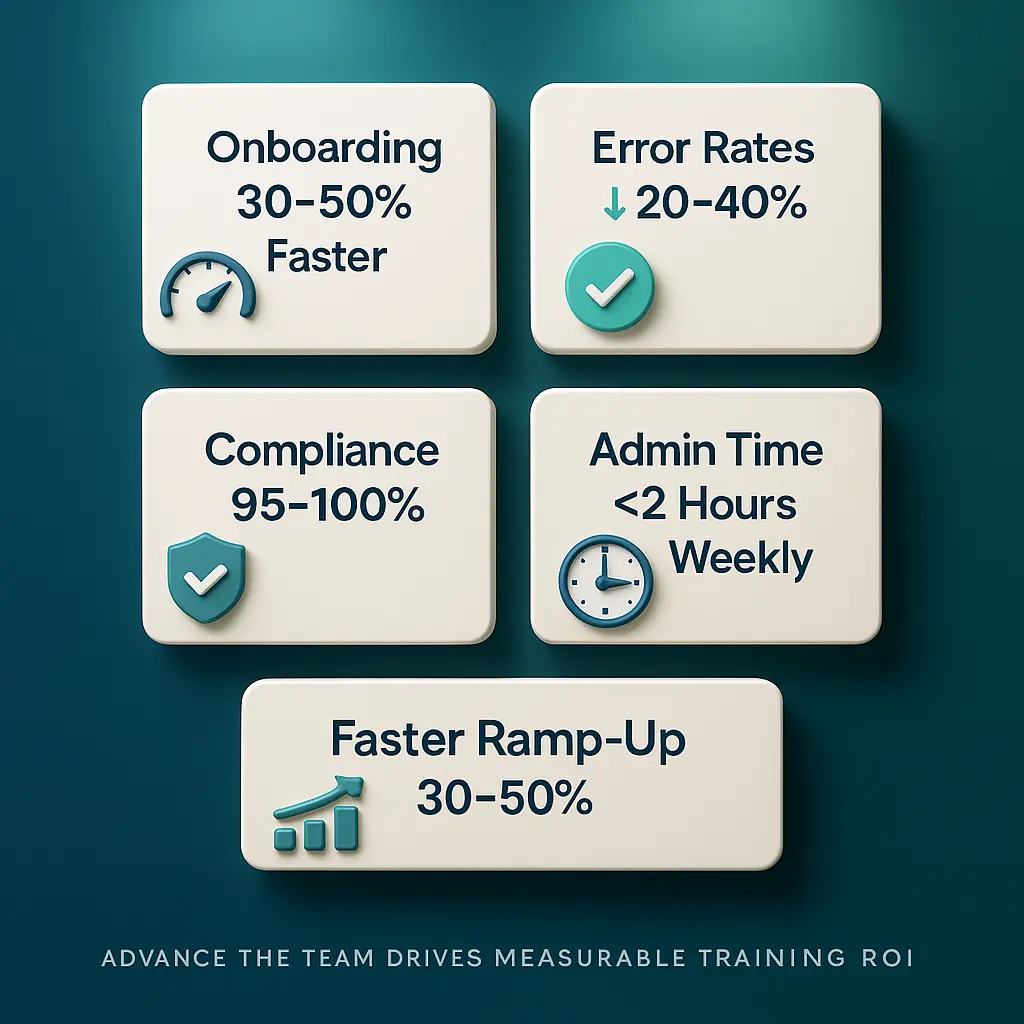
Below is a simplified ROI snapshot demonstrating how scalable training software for SMEs impacts the bottom line:
| Metric | Before Implementation | After Implementation |
|---|---|---|
| Onboarding Time | 20–30 days | 8–15 days |
| Error/Defect Rate | High variability | 20–40% reduction |
| Compliance Completion | Inconsistent | 95–100% timely completion |
| Admin Time Spent on Training | 8–12 hours/week | <2 hours/week |
| Productivity of New Hires | Slow ramp-up | Faster by 30–50% |
What This Means for SME Leaders
- Profitability improves because employees contribute value sooner.
- Training stops being a bottleneck and becomes a scalable foundation for growth.
- Leaders gain predictable, data-backed insights to guide workforce planning and performance improvement.
- Consistency strengthens the brand and customer experience-crucial in competitive markets.
With scalable training software for SMEs, ROI is not theoretical. It is observable, trackable, and directly tied to the operational performance metrics that matter most to growing small and mid-sized businesses.
12. Future-Proofing SME Growth With Advance The Team
As SMEs scale, the demands on their people, processes, and operational systems evolve rapidly. What works at 20 employees becomes insufficient at 50-and almost unmanageable at 200 without structured, technology-enabled training infrastructure. Advance The Team helps SMEs build the foundation needed for long-term growth by transforming training from a reactive necessity into a strategic enabler. With scalable training software for SMEs, organizations can future-proof their workforce capabilities and maintain operational excellence even as complexity increases.
Future-proofing is not just about adding more courses or digitizing SOPs. It’s about creating a mature, repeatable system that strengthens execution, develops talent continuously, and adapts as new roles, products, and markets emerge.
How Advance The Team Prepares SMEs for Long-Term Growth
- Expansion-Readiness Across New Teams, Locations, and Markets
As SMEs expand-whether through multi-location operations, new business verticals, or additional product lines-training workflows scale seamlessly. Advance The Team provides modular, role-based structures that can be replicated instantly without recreating content or processes from scratch. - Continuous Learning Culture Built Into Daily Operations
Instead of treating training as an event, SMEs can embed continuous development into everyday workflows:- Microlearning tied to roles
- Automatic skill path updates
- Competency-based progression
- Performance-linked learning loops
This turns learning into a sustained habit, not a periodic intervention.
- Process Maturity That Reduces Variability and Reinforces Standards
As businesses grow, inconsistencies inevitably creep in. Advance The Team standardizes how work is done, ensuring that operational knowledge stays institutionalized, not dependent on individuals. - Capability Development for Future Roles
SMEs can prepare employees for leadership, cross-functional roles, and higher-level responsibilities through structured development pathways-mitigating talent gaps that often slow scaling. - Adaptability to Technology, Compliance, and Market Changes
Whether compliance rules shift, a product is updated, or a new system is implemented, changes can be rolled out instantly across the entire workforce with clear tracking and audit readiness.
Why This Matters for SME Leaders
- Growth becomes predictable rather than chaotic.
- Knowledge is preserved even through turnover or team changes.
- Talent pipelines strengthen because employees have clear pathways to advance.
- Operational consistency remains intact regardless of scale.
With Advance The Team, SMEs gain more than training software-they gain a long-term capability engine designed to evolve with the business. For leaders focused on sustainable scaling, resilient processes, and high-performing teams, this is the foundation that supports the next stage of growth and beyond.
13. Strategic Recommendations for SME Decision-Makers
As SMEs scale, training can no longer remain an informal, reactive function. To sustain growth, leaders must treat enablement as a strategic discipline anchored in systems, automation, and measurable performance. The following recommendations help decision-makers evaluate their current training maturity and determine when to transition toward scalable training software for SMEs-and specifically when a platform like Advance The Team becomes a strategic necessity.
13.1 Assess Your Current Training Maturity
Most SMEs underestimate how much inefficiency stems from outdated or inconsistent training. Conduct a structured review across four areas:
- Process Standardization: Are SOPs centralized, current, and consistently followed?
- Training Delivery: Is learning happening systematically or only during role changes and firefighting?
- Tracking & Documentation: Can you provide proof of training, compliance, and readiness instantly?
- Performance Consistency: Are errors or rework increasing as you grow?
Gaps in any of these areas signal that existing systems-spreadsheets, manual onboarding, or a basic LMS-may be limiting your scale potential.
13.2 Prioritize Automation to Reduce Administrative Load
Lean HR and operations teams cannot manually manage assignments, reminders, updates, version control, or multi-location training needs as headcount grows. Prioritize automation in:
- Onboarding workflows
- Role-based training paths
- Re-certifications and compliance cycles
- Content updates and versioning
- Employee provisioning and deactivation
Automation frees leaders to focus on workforce development, not repetitive coordination.
13.3 Align Training With Business Goals
Training must directly support strategic outcomes:
- Reduced onboarding time
- Improved customer experience
- Lower error rates
- Stronger operational consistency
- Readiness for expansion
If your training activity is not producing measurable business improvements, the system behind it likely needs modernization.
Know When It’s Time to Adopt Advance The Team
- Training is delaying onboarding or expansion
- Performance varies across locations or teams
- Audits or compliance checks are stressful or manual
- Turnover disrupts knowledge transfer
- Managers rely heavily on tribal knowledge instead of structured workflows
- Leadership needs clearer visibility into capability and readiness
In these scenarios, Advance The Team offers the structured, scalable infrastructure required to stabilize operations and support growth.
13.4 Treat Training as a Continuous Capability, Not a One-Time Project
Investing in scalable training software for SMEs isn’t just about fixing short-term issues-it establishes a long-term capability engine. Sustained learning maturity allows SMEs to scale predictably, adapt to market changes, and ensure that operational excellence continues as teams grow.
Conclusion
As SMEs evolve, the complexity of their operations increases faster than their internal training structures can keep up. Manual onboarding, inconsistent processes, and outdated LMS tools create barriers that limit productivity, drive up operational costs, and weaken performance consistency. Overcoming these challenges requires scalable training software for SMEs that can streamline knowledge transfer, automate critical workflows, and provide real-time visibility into workforce capability.
Advance The Team enables SMEs to move beyond reactive training and build a long-term operational advantage. By standardizing execution, reducing onboarding time, strengthening compliance, and aligning learning with business goals, it functions as a true training operating system that evolves with the organization.
For leaders focused on sustainable, predictable growth, investing in a scalable training infrastructure is no longer optional-it’s a direct multiplier of performance, readiness, and competitive strength.