

Table of Contents
- 1. Introduction: The Strategic Weight of LMS Infrastructure Decisions
- 2. Understanding the Two Models: Cloud-Based vs On-Premise Training Systems
- 3. Key Business Differences: A Practical Breakdown for SME Decision-Makers
- 4. ROI Comparison: Measuring Long-Term Business Value
- 5. Real-World Trends and Data Insights (2025–2026 Outlook)
- 6. Decision Framework: Choosing the Right Model for Your SME
- 7. The Future of SME Learning Infrastructure
1. Introduction: The Strategic Weight of LMS Infrastructure Decisions
For today’s small and medium-sized enterprises (SMEs), the learning management system (LMS) is no longer a back-office utility-it’s a strategic driver of workforce readiness, operational efficiency, and competitive growth. As organizations digitize their business processes and prepare for hybrid, skill-driven teams, the choice of training infrastructure has become a board-level decision.
In 2026, the conversation around Cloud vs On-Premise LMS for SMEs isn’t just about technology preferences-it’s about business impact. Training delivery now directly influences how fast teams learn, how consistently they perform, and how effectively an enterprise can scale without inflating overheads. For IT Heads and CTOs, the LMS platform serves as both an enabler and a constraint to digital transformation goals.
Why This Decision Matters
- The right LMS architecture can reduce administrative overheads by up to 40%, freeing IT resources for higher-value initiatives.
- Scalable, analytics-driven learning environments help SMEs upskill employees faster and improve project delivery outcomes.
- Poorly chosen systems-whether due to rigid infrastructure or hidden maintenance costs-can slow adoption and limit ROI across business units.
SMEs today operate in a high-velocity digital economy where agility is everything. Cloud platforms promise instant scalability, automated updates, and reduced dependency on in-house IT, while on-premise systems offer tighter control, security customization, and data sovereignty. Each model carries strategic trade-offs in cost, flexibility, and long-term ROI.
The upcoming sections will decode these trade-offs-helping decision-makers evaluate which model aligns best with their organization’s goals, resources, and growth ambitions. Ultimately, the Cloud vs On-Premise LMS for SMEs debate is not about what’s “modern” or “traditional,” but about which system sustains measurable performance and drives business transformation in the years ahead.
2. Understanding the Two Models: Cloud-Based vs On-Premise Training Systems
Before making an infrastructure decision, SME leaders must understand what truly differentiates the two dominant learning management system models-cloud-based and on-premise. Both approaches can deliver effective digital learning experiences, but their architecture, management, and scalability implications vary significantly.
Cloud-Based LMS: Flexible, Hosted, and Scalable
A cloud-based LMS is hosted on external servers and managed by a third-party provider. It operates on a subscription or pay-as-you-grow model, where the vendor handles installation, updates, and maintenance.
Key characteristics:
- Hosting & Management: Fully managed by the LMS vendor-no in-house server setup required.
- Accessibility: Users can access the platform anytime, anywhere through secure web or mobile interfaces.
- Scalability: Resources can be instantly scaled up or down based on learner volumes or business needs.
- Maintenance: Automatic software updates, ensuring consistent performance and security compliance.
- Cost Model: Operational expenditure (OpEx)-predictable monthly or annual subscription costs.
Cloud-based LMS platforms are especially attractive for SMEs seeking agility and reduced IT dependency. They allow organizations to quickly deploy, train, and onboard teams without worrying about infrastructure management or version control.
On-Premise LMS: Controlled, Customized, and Self-Managed
An on-premise LMS is installed on an organization’s internal servers and maintained by its IT team. This model gives full ownership and control over system configuration, security, and data storage.
Key characteristics:
- Hosting & Management: Hosted within the company’s infrastructure and managed by internal IT resources.
- Control: Greater authority over customization, integrations, and compliance standards.
- Security: Data resides entirely within the organization’s network-beneficial for industries with strict data governance.
- Maintenance: Updates, patches, and backups handled manually by the IT department.
- Cost Model: Capital expenditure (CapEx)-higher upfront investment but long-term asset ownership.
While on-premise systems provide maximum control, they also demand ongoing technical maintenance, hardware investments, and longer deployment cycles-factors that can strain SME budgets and bandwidth.
Comparing the Two: Scalability and Flexibility in Focus
The biggest strategic difference between the two models lies in scalability and flexibility.
- Cloud LMS: Scales dynamically as the organization grows-ideal for SMEs expanding across locations or managing hybrid teams.
- On-Premise LMS: Offers predictable performance but limited scalability; expanding capacity often requires new hardware or licenses.
For today’s growing organizations, evaluating Cloud vs On-Premise LMS for SMEs is about balancing control with adaptability. Cloud systems empower agility and cost efficiency, while on-premise setups appeal to businesses with advanced IT capabilities and strict data mandates. The right choice depends on which approach best aligns with your operational strategy and long-term digital transformation goals.
3. Key Business Differences: A Practical Breakdown for SME Decision-Makers
Selecting between cloud and on-premise LMS models is not merely a technical choice-it’s a strategic business decision that shapes cost efficiency, operational agility, and long-term return on investment. Below is a practical, data-driven breakdown designed to help SME leaders make an informed decision based on measurable impact.
3.1 Cost Structure and Financial Impact
The financial model is often the first-and most decisive-factor for SMEs evaluating LMS options.
Cloud-Based LMS
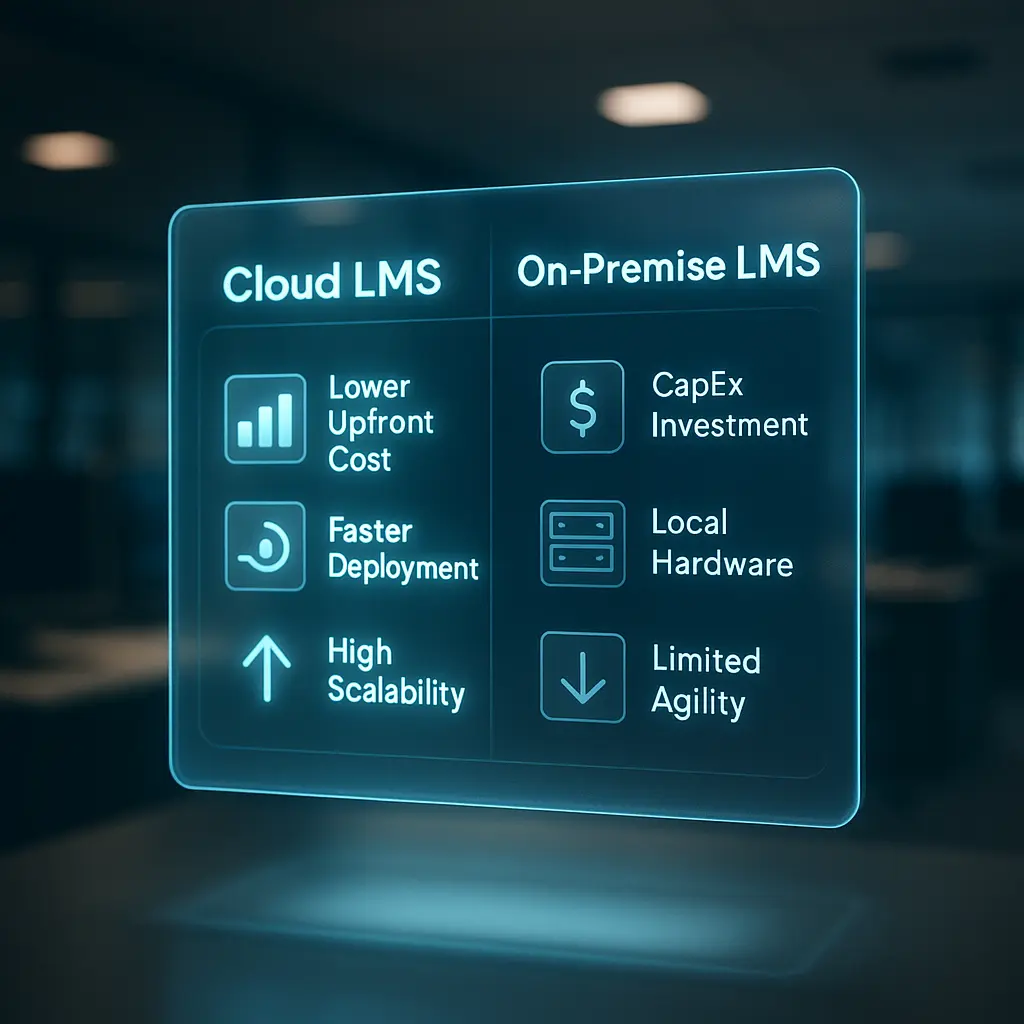
- Operates on a subscription (OpEx) model with predictable monthly or annual costs.
- No upfront investment in hardware, data centers, or dedicated IT staff.
- Automatic updates and hosting are included in the vendor’s pricing.
- Easier to budget for, with costs scaling directly with usage.
On-Premise LMS
- Requires significant upfront CapEx for servers, licenses, and infrastructure setup.
- Recurring expenses include IT maintenance, software patches, and power consumption.
- Hardware refresh cycles (typically every 3–5 years) increase total cost of ownership (TCO).
- Hidden costs often arise from downtime, manual updates, and support contracts.
Advisory Note
SMEs using “Advance the Team” benefit from a predictable OpEx model-reducing initial IT overheads while maintaining enterprise-grade functionality.
This ensures budget flexibility without compromising on training performance.
| Comparison Area | Cloud-Based LMS | On-Premise LMS |
|---|---|---|
| Initial Cost | Low (subscription-based) | High (hardware + licensing) |
| Long-Term TCO | Moderate, scalable | High, cumulative maintenance |
| Scalability Cost | Incremental per user | Requires hardware expansion |
| Maintenance Effort | Managed by vendor | In-house IT responsibility |
3.2 Scalability and Business Agility
In an SME environment, growth rarely follows a linear path-making scalability a cornerstone of long-term learning strategy.
Cloud-Based LMS
- Instantly scales with new learners or departments-no downtime or hardware procurement.
- Ideal for remote or hybrid teams needing consistent access across geographies.
- Supports rapid deployment for new training modules or compliance programs.
On-Premise LMS
- Scaling requires additional servers, configuration, and IT oversight.
- Expansion can take weeks or months, depending on resource availability.
- Less adaptable to workforce fluctuations or seasonal hiring trends.
Advisory Note:
Companies leveraging “Advance the Team” often highlight its scalability advantage-supporting workforce expansion and multi-location rollouts seamlessly, without additional IT investment.
3.3 Data Security and Compliance
Data security remains a top concern for IT leaders, especially those managing sensitive employee or compliance data. Both models have distinct strengths depending on governance priorities.
Cloud-Based LMS
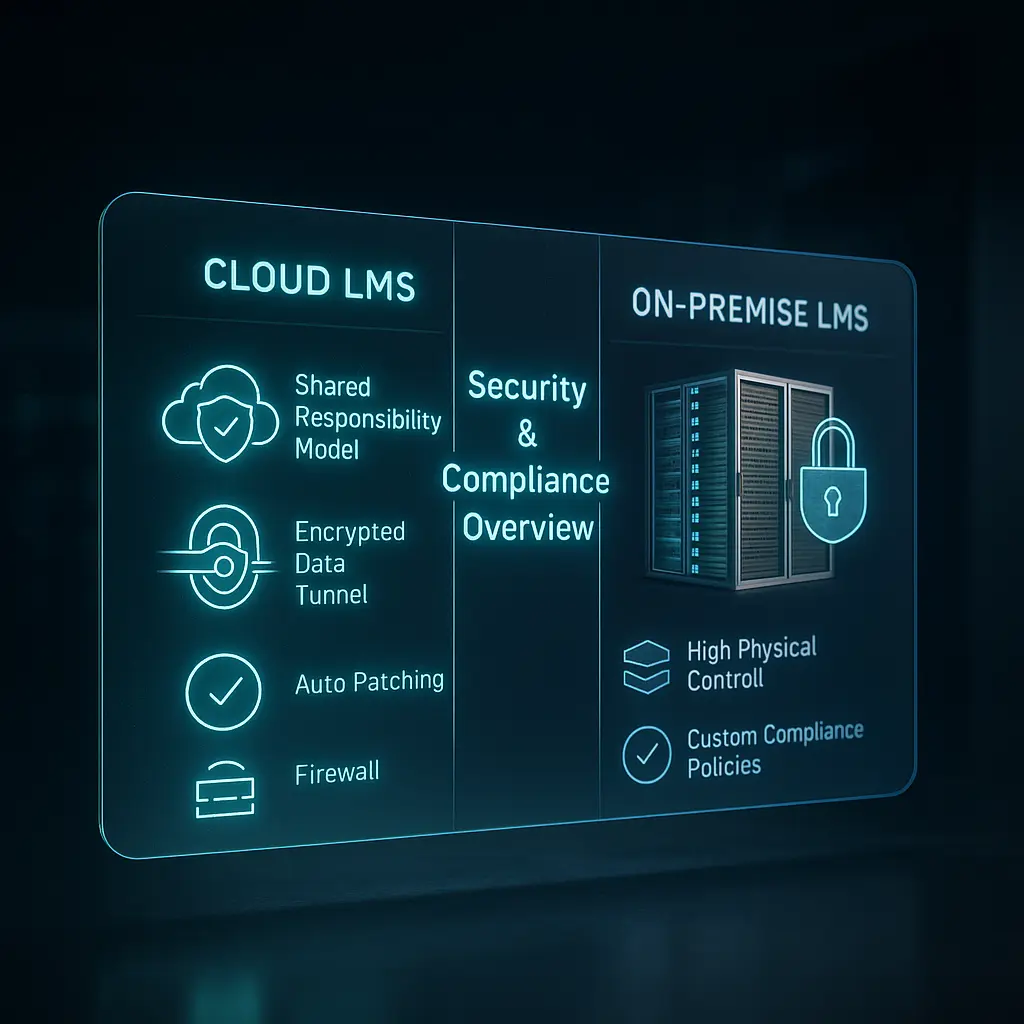
- Enterprise-grade encryption, SSO (Single Sign-On), and continuous compliance updates (e.g., ISO 27001, GDPR).
- Backups and recovery handled by certified cloud vendors with redundant infrastructure.
- Shared responsibility model-vendors secure the environment, clients manage access and policies.
On-Premise LMS
- Full control over security configurations and internal access policies.
- Beneficial for organizations in highly regulated industries with in-house data governance protocols.
- Risk of outdated patches or insufficient security measures if internal IT resources are limited.
Insight:
In Cloud vs On-Premise LMS for SMEs discussions, many smaller firms lean toward cloud solutions due to the higher baseline security investments vendors provide-often exceeding what in-house teams can sustain.
3.4 Maintenance and System Uptime
Ongoing maintenance determines the real cost of ownership and operational reliability of any LMS deployment.
Cloud-Based LMS
- Vendor manages updates, patches, and system monitoring automatically.
- Typical uptime exceeds 99.9%, backed by service-level agreements (SLAs).
- IT teams are free to focus on strategy rather than troubleshooting.
On-Premise LMS
- Requires regular manual updates, backups, and system monitoring.
- Any failure or patch delay directly impacts accessibility and performance.
- Average uptime depends entirely on internal IT efficiency-often between 95–98% for SMEs without redundancy systems.
Advisory Note:
With “Advance the Team,” SMEs experience optimized uptime and zero-maintenance deployment cycles-critical for organizations where training interruptions translate into lost productivity.
3.5 Integration and Customization Flexibility
An LMS must integrate seamlessly with HR systems, CRMs, and performance analytics tools to deliver business value.
Cloud-Based LMS
- Offers plug-and-play APIs and prebuilt integrations for modern tech stacks (e.g., Microsoft 365, Slack, Salesforce).
- Enables rapid connection with HRIS, payroll, or ERP systems.
- Customizations are configuration-driven rather than code-heavy, reducing implementation time.
On-Premise LMS
- Highly customizable through internal development teams.
- Allows deeper backend access for organizations needing niche features.
- However, each customization adds long-term maintenance complexity.
Strategic Perspective:
For most SMEs, the flexibility of Cloud vs On-Premise LMS for SMEs hinges on resource trade-offs. Cloud solutions like “Advance the Team” provide enough configuration options for business agility-without the technical debt and update risks associated with bespoke on-premise customizations.
4. ROI Comparison: Measuring Long-Term Business Value
Return on investment (ROI) is the ultimate measure of whether an LMS deployment truly supports an organization’s growth strategy. For SMEs, where training budgets must directly translate into measurable performance gains, evaluating ROI requires a structured framework-one that extends beyond cost savings to include productivity, engagement, and long-term capability development.
4.1 Framework for Evaluating LMS ROI
A comprehensive ROI framework for learning technology should consider four key pillars:
- Cost Efficiency: Reduction in administrative overhead, IT maintenance, and infrastructure spend.
- Productivity Gains: Time saved in managing, tracking, and delivering learning content.
- Learning Outcomes: Improved knowledge retention, compliance completion rates, and employee performance metrics.
- Scalability ROI: Ability to support organizational growth without proportional cost increases.
Each of these factors behaves differently across Cloud vs On-Premise LMS for SMEs, especially when analyzed over a multi-year adoption horizon.
4.2 The Role of Automation and Analytics in ROI Acceleration
Modern LMS platforms, especially cloud-based ones are designed with automation and analytics at their core-features that drastically improve both efficiency and insight-driven decision-making.
- Automation: Cloud LMSs automate course assignments, reporting, and compliance tracking-reducing manual intervention by up to 60%.
- Real-Time Analytics: Dashboards provide instant visibility into learner progress, course completion, and training ROI, allowing IT and L&D leaders to optimize resources continuously.
- Continuous Improvement: Data-driven insights helps identify underperforming programs and align training investments with business goals.
By contrast, on-premise systems often rely on manual data exports or custom scripts for analytics-slowing down reporting cycles and limiting agility.
4.3 Comparative ROI Timeline (3–5 Year Outlook)
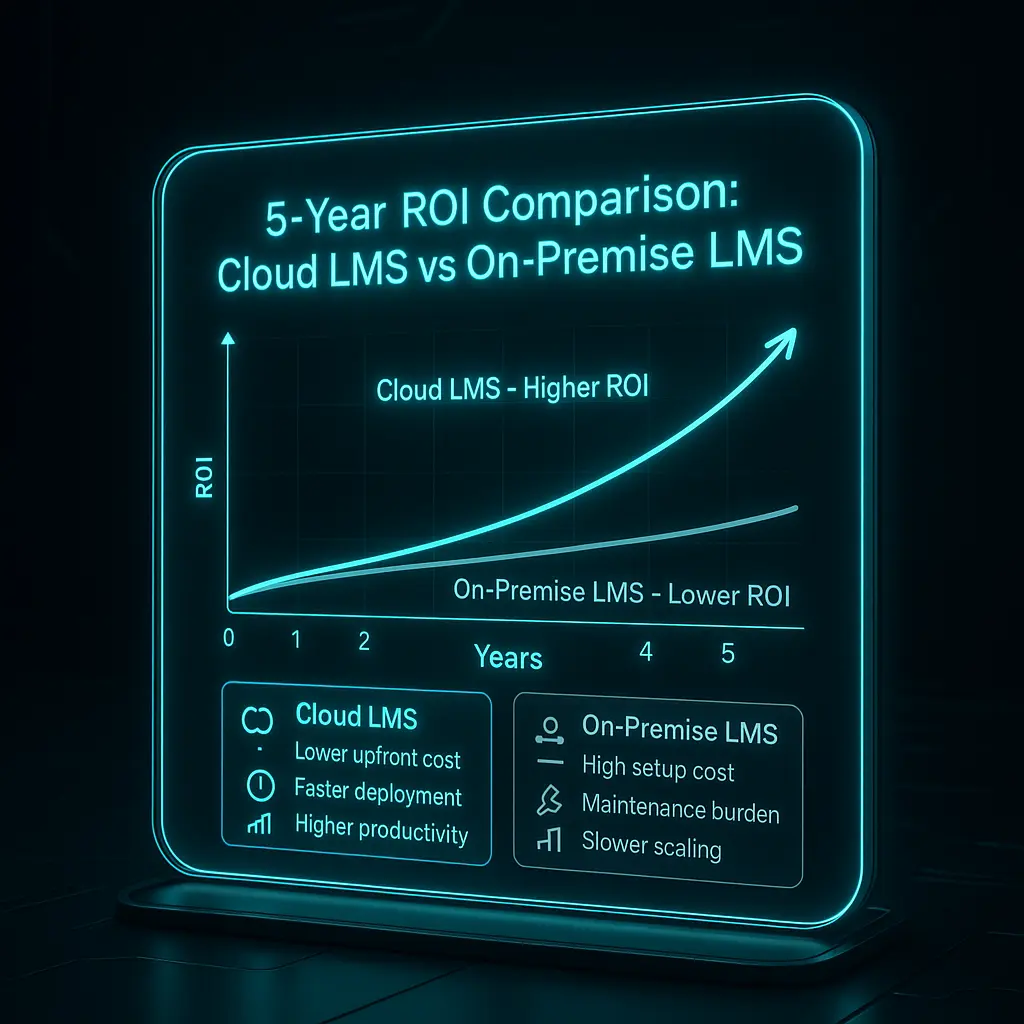
The ROI of an LMS becomes clearer over time, as automation, scalability, and employee engagement benefits compound-making the evaluation of Cloud vs On-Premise LMS for SMEs especially critical for long-term value creation. The table below outlines typical ROI trajectories for SMEs based on deployment model:
| ROI Factor | Cloud-Based LMS | On-Premise LMS |
|---|---|---|
| Initial Investment (Year 1) | Low CapEx, quick deployment | High CapEx, slow setup |
| Cost Recovery Timeline | 12–18 months | 30–36 months |
| Operational Efficiency Gains | High (automated updates, analytics) | Moderate (manual maintenance) |
| Scalability ROI (Year 3–5) | Grows exponentially with user adoption | Linear growth, tied to hardware |
| Overall ROI by Year 5 | 150–200% (typical SME benchmark) | 80–120%, depending on IT resource capacity |
Insight:
Industry research shows that SMEs adopting cloud LMS solutions realize ROI up to 40% faster due to automation, reduced IT workload, and agile deployment. On-premise models, while stable, often incur longer recovery periods as infrastructure and maintenance costs dilute early gains.
4.4 How “Advance the Team” Helps SMEs Achieve Faster ROI
Organizations using “Advance the Team” report measurable ROI acceleration through:
- Zero infrastructure costs-fully cloud-managed architecture reduces CapEx by 70–80%.
- Built-in automation tools-cutting manual admin work and reporting time.
- Actionable analytics dashboards-helping leadership link training outcomes directly to productivity metrics.
These efficiencies compound over time, transforming the LMS from a cost center into a performance multiplier.
5. Real-World Trends and Data Insights (2025–2026 Outlook)
LMS adoption is no longer experimental for SMEs-it’s a strategic capability. The market and practitioner data from 2024–2025 show accelerating investment in cloud-based learning infrastructure, driven by hybrid work, skill shortages, and the need for measurable learning outcomes. Below are the most relevant trends and data-backed insights for IT Heads and CTOs evaluating Cloud vs On-Premise LMS for SMEs.
Market momentum and size
- Global spending on public cloud services continues to grow strongly; industry forecasts place cloud investment expansion as a core driver for enterprise SaaS growth in 2025. This macro shift increases the attractiveness of hosted LMS options for resource-constrained SMEs.
- Market research projects the LMS market expanding at a double-digit CAGR through the mid-2020s, signalling continued vendor innovation and falling entry barriers for SMEs that want cloud deployments. These forecasts suggest more competitive pricing and broader feature sets from cloud LMS providers.
Adoption patterns among SMEs
- Practitioner research (global workplace learning studies) shows an emphasis on scalable, measurable learning solutions as organizations prioritize skills agility-a trend that favours cloud LMS platforms with built-in analytics and quick deployment.
- Many SMEs report moving away from pilot-only experiments toward full implementations in 2025; the shift is toward platforms that can deliver measurable outcomes (completion, skills uplift, time-to-productivity) rather than feature checklists.
Efficiency, cost reduction, and learner engagement-evidence-based insights
- Efficiency gains: Cloud LMS automation (course enrolment, reporting, compliance tracking) materially reduces admin time and accelerates program rollouts -vendor and analyst reports estimate significant reductions in manual effort when automation is adopted.
- Cost dynamics: While precise TCO varies by organization, market analyses show cloud deployments lower upfront CapEx and shift predictable costs to OpEx, enabling SMEs to reallocate capital toward product development or sales. This financial profile often shortens payback windows for training initiatives.
- Learner engagement: Platforms that combine mobile access, microlearning, and analytics see higher completion and recall rates-a key driver for SMEs that need fast, measurable improvements in frontline performance. Industry reports link improved engagement directly to more consistent training outcomes.
The hybrid workforce effect on LMS selection
- The rise of hybrid and distributed teams is a primary reason SMEs prefer cloud LMS options: remote access, cross-location consistency, and centralized reporting are table-stakes features for dispersed workforces. Cloud platforms reduce geographic friction for training and make compliance tracking uniform across locations.
- Hybrid work also elevates the importance of mobile-first learning, asynchronous content, and analytics that surface skills gaps -capabilities most cloud-native LMS vendors prioritize in their product roadmaps.
Practical implications for SME decision-makers
- Expect vendor differentiation to center on analytics, automation, and integration rather than basic hosting. For SMEs, the question in Cloud vs On-Premise LMS for SMEs is increasingly: “Which platform turns learning data into business outcomes fastest?”
- SMEs evaluating platforms should prioritize measurable KPIs (time-to-proficiency, completion rates, cost-per-trained-employee) and validate vendor claims with short pilots that capture baseline metrics.
Bottom line: Market signals and practitioner research from 2024–2025 point toward cloud-first LMS adoption among SMEs—driven by scalability, measurable outcomes, and the realities of hybrid work. That said, the decision around Cloud vs On-Premise LMS for SMEs still hinges on compliance needs and legacy systems; the smartest approach is evidence-based evaluation focused squarely on business metrics, not feature lists.
6. Decision Framework: Choosing the Right Model for Your SME
This section gives a practical, step-by-step framework to help IT Heads and CTOs decide between Cloud vs On-Premise LMS for SMEs. Follow these five actionable steps, then use the decision matrix to map the result to your organization’s size and priorities.
Step 1 -Define clear business objectives
- List 3–5 measurable goals (e.g., reduce onboarding time by X%, improve compliance completion to Y%, cut admin hours by Z).
- Rank priorities: Cost predictability, data control, speed-to-deploy, scalability, integrations.
- Translate objectives into KPIs you will track during a pilot (time-to-proficiency, cost-per-learner, completion rate).
Step 2 -Assess IT maturity and resource capacity
- Inventory internal skills: server administration, security expertise, integration experience.
- Evaluate capacity for ongoing maintenance (patching, backups, disaster recovery).
- If internal IT bandwidth is limited, cloud reduces operational risk and hidden labor costs.
Step 3 -Model TCO and ROI scenarios
- Build 3-year and 5-year financial models including: initial setup, hosting/licenses, staff time, upgrades, and downtime costs.
- Include soft benefits: productivity gains, faster time-to-competency, reduced time managers spend on admin.
- Sensitivity test assumptions (e.g., 20–50% growth in users) to see how each model scales financially.
Step 4 -Evaluate vendors and technical fit
- Must-have checklist: security certifications, SLA uptime, backup/recovery, API ecosystem, mobile support, analytics capabilities.
- Ask for reference SMEs in your industry and measurable outcomes they achieved.
- Evaluate commercial terms: contract length, exit provisions, data portability, and support SLAs.
Step 5 -Pilot, measure, and decide
- Run a 8–12 week pilot with a representative user cohort and key integrations (HRIS, SSO).
- Track the KPIs defined in Step 1 and collect qualitative feedback from learners and managers.
- Use pilot results to update TCO/ROI models and finalize the deployment choice.
Simple Text Decision Matrix (Visual Style)
Use this matrix to quickly map which model typically aligns with common SME profiles. Mark the column that best matches your situation.
| SME Profile / Priority | Cloud-Based LMS – Best Fit When… | On-Premise LMS – Best Fit When… |
|---|---|---|
| Micro / Small (1–50 ppl) | Need quick deployment, low IT headcount, OpEx budgeting, remote teams | Only if strict data residency or legacy systems force on-premise |
| Small–Medium (51–250 ppl) | Rapid growth, hybrid workforce, want analytics & automation, limited IT ops | Strong internal IT, heavy customization needs, regulatory constraints |
| Medium (251–500 ppl) | Faster time-to-value, multi-location rollouts, predictable per-user pricing | When bespoke integrations and full control are non-negotiable |
| Primary Priority: Cost Predictability | Prefer subscription OpEx and pay-as-you-grow | Prefer CapEx ownership and long-term amortization |
| Primary Priority: Data Control / Compliance | Cloud with strict contractual controls & private-cloud options | On-premise for absolute physical control and in-house governance |
(Tip: Most growth-focused SMEs fall into the “Cloud-Based LMS” column when balancing speed, cost, and agility-but test with a pilot.)
Advisory Note -How “Advance the Team” Aligns with Cloud-First SMEs
Advance the Team is designed for SMEs pursuing agile, cloud-first learning strategies: it supports rapid rollouts, built-in analytics, and low operational overhead-helping teams hit KPI targets faster while keeping predictable OpEx. For decision-makers weighing Cloud vs On-Premise LMS for SMEs, Advance the Team often shortens the path from pilot to measurable business impact through managed hosting, automated maintenance, and a modular integration ecosystem.
Follow this framework to convert strategic intent into an evidence-based procurement decision—especially when evaluating Cloud vs On-Premise LMS for SMEs. If you’d like, I can convert the ROI modeling approach (Step 3) into an editable spreadsheet template you can use during vendor evaluations.
7. The Future of SME Learning Infrastructure
The future of SME learning infrastructure is being reshaped by rapid technological evolution and shifting workforce expectations. As digital transformation becomes integral to competitiveness, choosing the right learning management infrastructure—Cloud vs On-Premise LMS for SMEs—is no longer just an IT question, but a strategic business decision that directly impacts scalability, cost efficiency, and workforce performance.
The Strategic Shift Toward Cloud Adoption
In the evolving debate of Cloud vs On-Premise LMS for SMEs, the cloud model is steadily emerging as the preferred choice for forward-looking organizations. Its inherent flexibility, cost efficiency, and ability to support hybrid and remote learning make it a cornerstone of modern training ecosystems. SMEs adopting cloud-based systems benefit from:
- Continuous innovation through automatic updates and new feature rollouts.
- Global accessibility, empowering employees to learn anytime, anywhere.
- Scalable infrastructure that grows in tandem with business expansion.
This agility gives smaller enterprises an edge once reserved for large corporations-transforming training into a strategic enabler rather than an operational burden.
Intelligent, Data-Driven Learning Experiences
The next phase of learning technology is defined by AI-driven personalization, predictive analytics, and learning automation. These advancements enable organizations to:
- Tailor content dynamically to each learner’s pace, role, and performance.
- Predict skill gaps before they impact productivity.
- Automate routine administrative tasks, freeing L&D teams to focus on strategy.
Mobile-first design, gamified experiences, and integrated performance analytics are further enhancing engagement, helping SMEs measure training outcomes with precision.
Future-Proofing SME Investments
To stay competitive, SMEs must invest in learning ecosystems that evolve with their business. This means prioritizing platforms that:
- Offer open APIs for seamless integration with HR and performance tools.
- Support emerging technologies like AR/VR and microlearning.
- Maintain robust cybersecurity and compliance frameworks as regulations tighten.
At Advance the Team, our approach to digital learning infrastructure emphasizes cloud readiness, scalability, and measurable business outcomes. By aligning technology with organizational goals, SMEs can turn their LMS into a growth accelerator—especially when navigating the strategic choice of Cloud vs On-Premise LMS for SMEs, where flexibility, cost, and performance must work in perfect sync with business goals.
In essence, the future of SME learning lies in strategic, data-enabled systems that combine flexibility with foresight. As the debate of Cloud vs On-Premise LMS for SMEs continues to shape decision-making, cloud-based solutions are no longer just modern alternatives—they are the foundation for the next generation of agile, learning-driven enterprises.
Conclusion
Choosing between cloud and on-premise learning systems is no longer just a technical preference-it’s a strategic decision that shapes how an SME scales, learns, and drives digital transformation.
While on-premise LMSs provide greater control and customization, cloud-based platforms deliver superior scalability, cost predictability, and innovation speed-helping SMEs reduce upfront costs, minimize maintenance, and gain actionable insights through automation and analytics.
The most successful organizations today view their LMS not as an expense, but as a growth enabler that improves productivity, agility, and learning outcomes. On-premise models still suit businesses in highly regulated sectors, but for most SMEs aiming for efficiency and flexibility, the cloud offers a faster, more measurable ROI.
At Advance the Team, we help SMEs bridge this strategic gap with agile, secure, and cost-efficient cloud learning ecosystems that align with long-term business goals.
Ultimately, the Cloud vs On-Premise LMS for SMEs decision should be guided by future readiness-choosing the model that best supports sustainable growth, scalability, and a culture of continuous learning.