

Table of Contents
- 1. Introduction: Why Choosing the Right Training System Matters for SMEs
- 2. What Is a Learning Management System (LMS)?
- 3. What Is a Training Management System (TMS)?
- 4. LMS vs TMS: Key Differences Explained
- 5. The Overlap and Integration Advantage
- 6. Measuring ROI: The Metrics That Matter
- 7. Real-World Use Cases by Industry
- 8. How to Choose the Right Training System for Your Business
- 9. Common Pitfalls When Choosing or Implementing a Training System
1. Introduction: Why Choosing the Right Training System Matters for SMEs
Small and midsize enterprises (SMEs), employee training is more than a compliance requirement-it’s a cornerstone of growth, performance, and competitiveness. Yet, the ongoing LMS vs TMS debate often leaves decision-makers uncertain about which platform delivers the best operational and financial outcomes. While both systems contribute to workforce development, their roles, impact areas, and ROI potential differ in critical ways-differences that can directly influence business success or loss.
The Real Cost of Inefficient Training
- $1,200 per employee annually is lost due to poorly managed training programs (Association for Talent Development, ATD).
- 49% of L&D professionals admit struggling to measure training impact, leading to misaligned investments and wasted budgets (LinkedIn Workplace Learning Report).
- Compliance failures from outdated or inconsistent training can cost SMEs up to 4% of annual revenue, especially in heavily regulated industries such as healthcare, construction, and manufacturing.
These numbers underscore one truth-inefficiency in training isn’t just operational; it’s financial.
Why System Choice Is a Strategic Decision
Choosing the right training platform goes far beyond picking a software tool. It’s a strategic investment in organizational capability and long-term scalability. SMEs today must evaluate solutions like LMS vs TMS carefully to ensure they support efficient training delivery, compliance readiness, and measurable workforce performance. Without a clear understanding of LMS vs TMS, businesses risk selecting systems that address only part of their training needs, leading to operational gaps and weak adoption. A well-aligned LMS vs TMS strategy ensures both learning outcomes and administrative efficiency are optimized for sustainable growth.
- Deliver cost-efficient, performance-driven learning experiences.
- Maintain audit-ready compliance and standardized documentation.
- Support rapid skill development to stay competitive in evolving markets.
Modern, technology-driven training systems meet these goals through automation, analytics, and integrated workflows that minimize manual effort while improving visibility and results.
LMS vs TMS-Understanding the Core Difference
Despite their shared goal of enhancing workforce capability, the Learning Management System (LMS) and Training Management System (TMS) serve distinct purposes:
- LMS (Learning Management System)
Focuses on content delivery, learner engagement, and progress tracking – ideal for digital skill development, eLearning modules, and performance analytics. - TMS (Training Management System)
Manages the operational and logistical side of training – including scheduling, instructor coordination, and cost control across departments or sites.
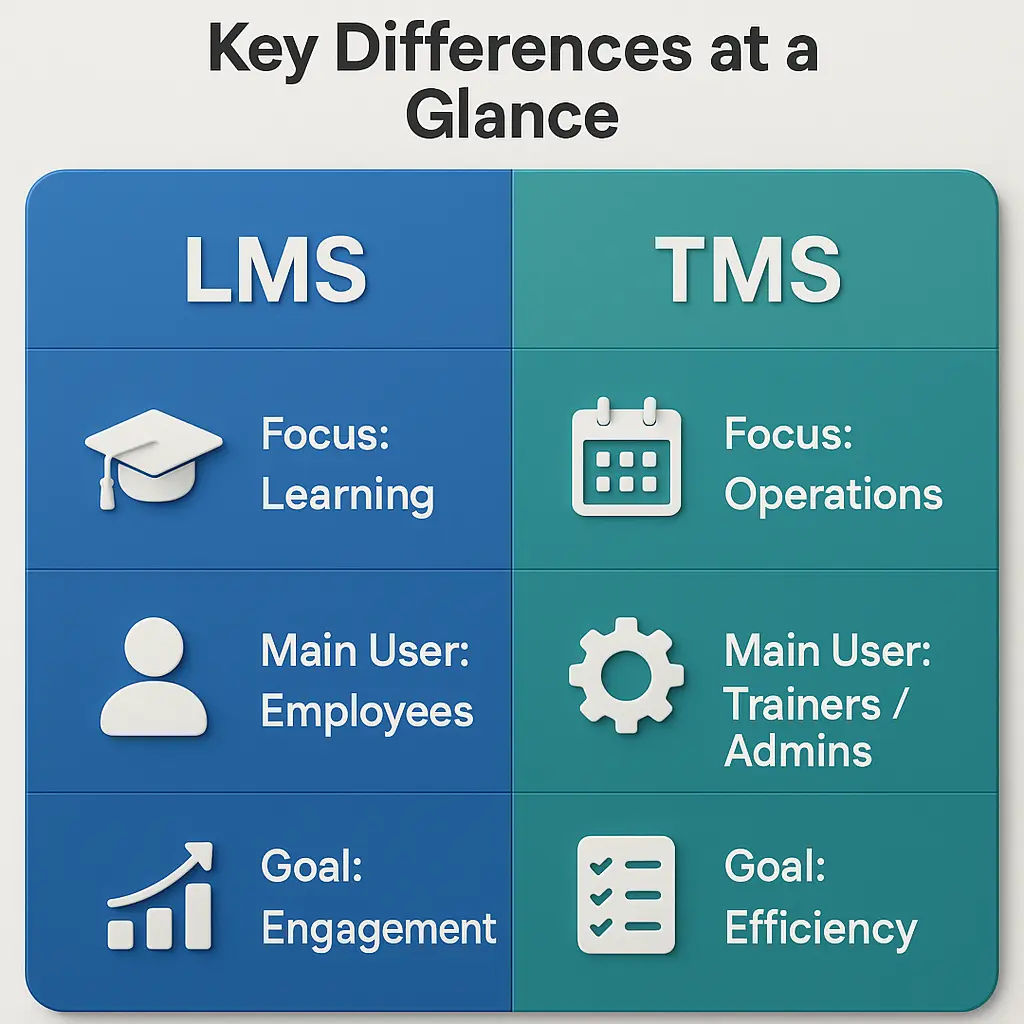
Without understanding this distinction, SMEs risk investing in the wrong platform-one that may support learning delivery but fail to manage logistics, or vice versa, making the LMS vs TMS decision even more critical for long-term training efficiency.
2. What Is a Learning Management System (LMS)?
A Learning Management System is the digital backbone of modern employee development. It helps SMEs centralize, deliver, and measure learning programs – from onboarding to ongoing skill growth. Understanding its role is key to making the right LMS vs TMS decision.
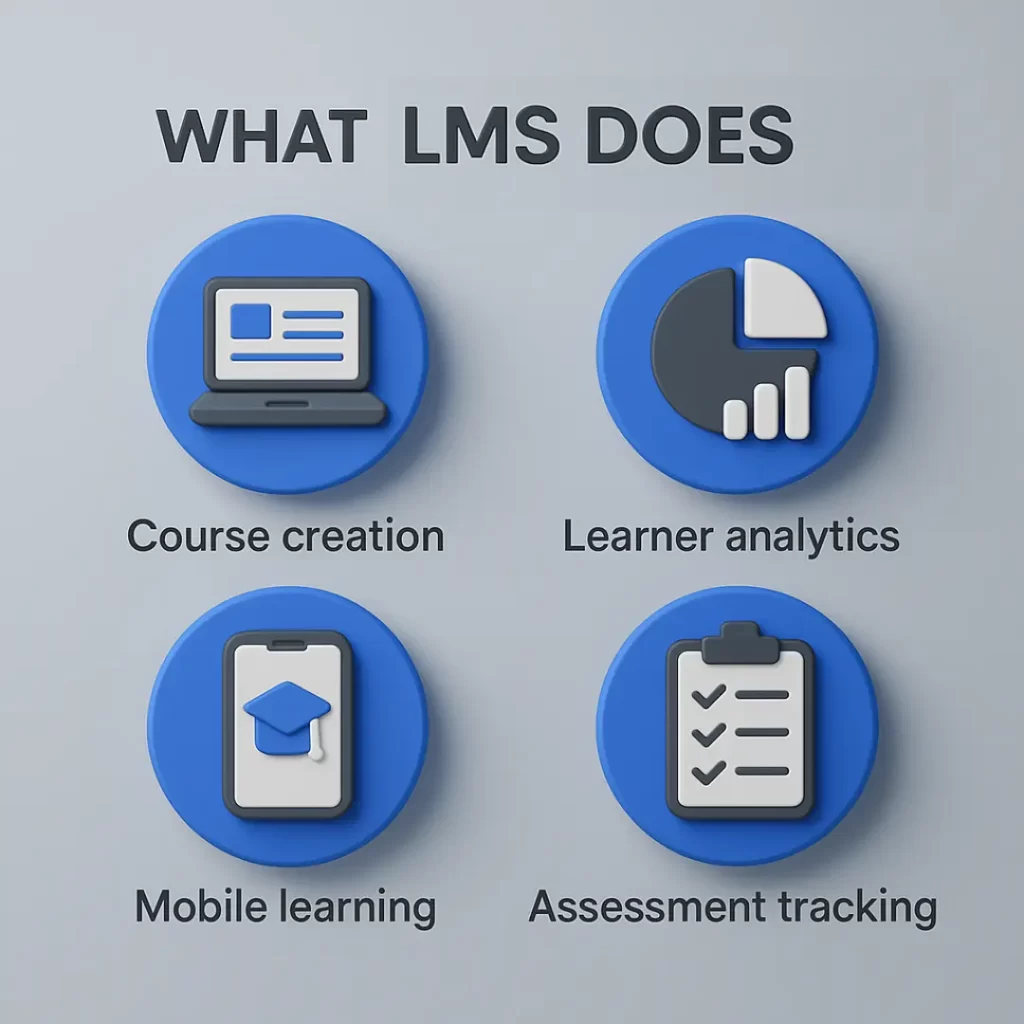
What an LMS Does
- Delivers online courses, videos, and assessments to employees anytime, anywhere.
- Tracks learner progress, completion rates, and skill outcomes.
- Enables self-paced, blended, or instructor-led learning within one unified platform.
- Provides analytics dashboards for HR and managers to measure learning effectiveness.
Key Features
- Content Management: Upload, organize, and update training materials in one place.
- User Management: Assign courses by role, department, or skill level.
- Progress Tracking: View completion rates, assessment scores, and learning paths.
- Reporting & Analytics: Generate insights into training effectiveness and compliance readiness.
- Gamification & Engagement Tools: Boost learner motivation through badges, points, and leaderboards.
- Integrations: Connect seamlessly with HRIS, CRM, and performance management systems.
Technical Setup Options
- Cloud-Based LMS:
- Hosted by the vendor; accessible from any device.
- Lower upfront costs and faster deployment.
- Ideal for SMEs needing scalability and minimal IT management.
- On-Premise LMS:
- Installed on company servers; offers deeper customization.
- Requires in-house IT support and maintenance.
- Suitable for industries with strict data security or regulatory needs.
Business Value (with Measurable Impact)
- 30–40% reduction in training administration time through automation.
- 25% faster onboarding for new hires with digital, trackable learning paths.
- 20% increase in employee retention when learning is accessible and engaging.
- Consistent compliance reporting – eliminating manual tracking errors.
Mini-Case: Healthcare SME Example
A mid-sized healthcare firm adopted a cloud-based LMS to manage staff certification renewals. Within six months, they:
- Cut compliance-related penalties by 70%.
- Reduced manual tracking time from 12 hours/week to 3 hours/week.
- Improved completion rates for mandatory courses from 58% to 93%.
The result: measurable ROI and a scalable learning structure – proving how a well-implemented LMS directly supports operational efficiency and regulatory readiness.
3. What Is a Training Management System (TMS)?
A Training Management System focuses on the operational side of corporate learning – the logistics, scheduling, and cost control behind every training session. While an LMS manages learning delivery, a TMS manages training administration. Understanding this distinction in LMS vs TMS is critical for SMEs aiming to improve efficiency and reduce training overhead.
What a TMS Manages
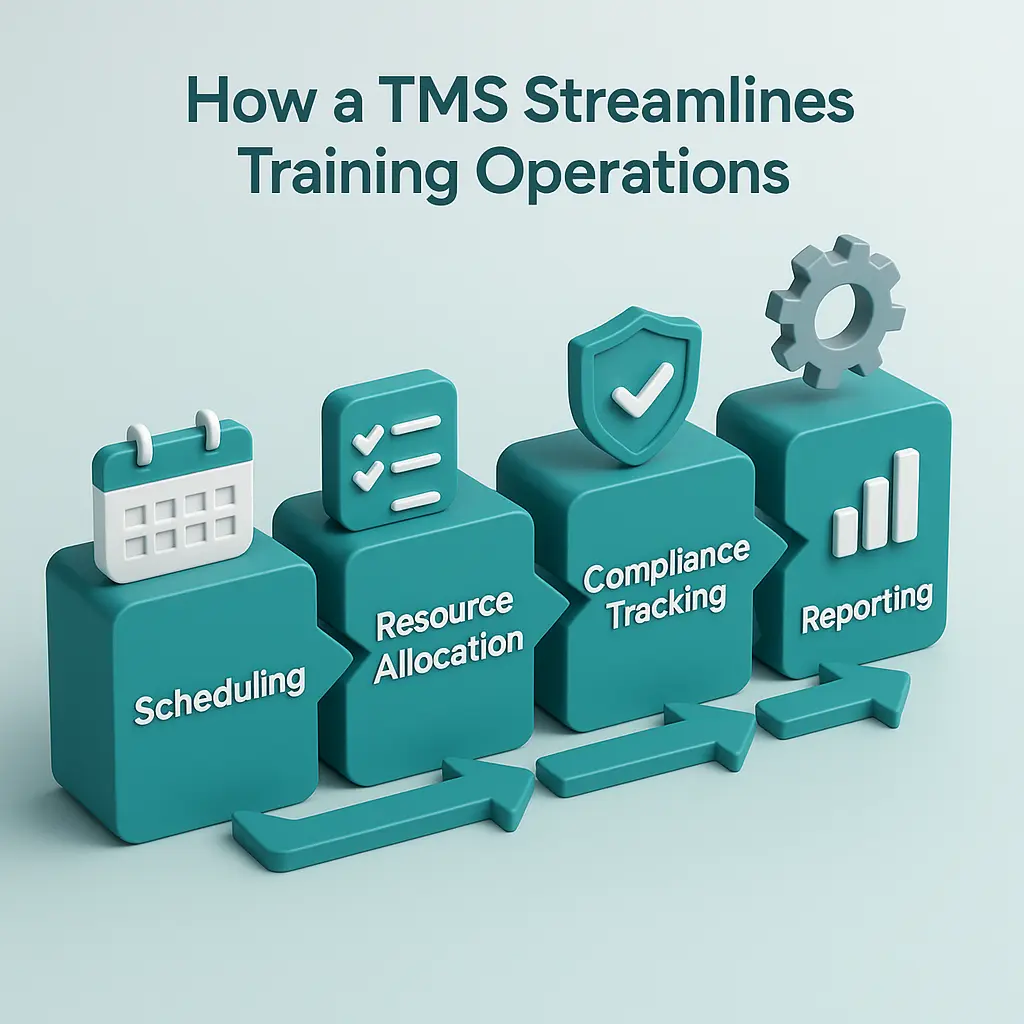
- Scheduling: Automates course calendars, trainer availability, and room bookings.
- Resource Allocation: Assigns trainers, venues, and materials efficiently across programs.
- Cost Tracking: Monitors budgets, per-session costs, and resource utilization.
- Attendance & Certification: Tracks participation and ensures records align with compliance needs.
- Reporting: Centralizes operational data for finance and HR teams to measure ROI.
Operational Efficiency Metrics
- 40–50% reduction in manual scheduling time through automation.
- 25% lower training delivery costs via optimized resource allocation.
- 100% visibility into training attendance and compliance readiness.
- Real-time analytics help managers forecast demand and plan future sessions more effectively.
Training Logistics & Compliance Automation
- Automatically send reminders for upcoming sessions and recertifications.
- Manage multiple locations or departments from one central dashboard.
- Sync data with HR or ERP systems to ensure employee records stay audit-ready.
- Maintain consistent documentation-reducing the risk of failed audits or expired certifications.
Mini Case: Manufacturing SME Success
A mid-sized manufacturing company with 400 employees struggled with inconsistent safety training records and frequent scheduling conflicts. After evaluating the LMS vs TMS approach and implementing a TMS, the company streamlined scheduling, improved compliance tracking, and gained real-time visibility into training operations.
- Administrative time for training coordination dropped by 45%.
- Compliance audit preparation time was reduced from 3 weeks to 4 days.
- Overtime costs related to last-minute rescheduling decreased by 30%.
- The operations team gained real-time visibility into every worker’s certification status.
The outcome: streamlined logistics, better compliance control, and tangible cost savings-showing how a TMS directly enhances training efficiency and operational performance.
4. LMS vs TMS: Key Differences Explained
While both systems improve workforce development, their functions, users, and ROI drivers differ sharply. Understanding these distinctions helps SMEs choose the right technology for measurable performance gains. The LMS vs TMS comparison below clarifies where each system delivers the most business value.
Key Differences at a Glance
- Core Focus: LMS enhances learning experience; TMS optimizes training operations.
- Primary Users: LMS serves employees and L&D teams; TMS supports HR, admins, and training coordinators.
- Data Insights: LMS tracks engagement, completion, and skill growth; TMS tracks cost, resources, and scheduling efficiency.
- ROI Impact: LMS drives productivity and retention; TMS delivers cost control and operational accuracy.
- Integration Potential: Together, they provide end-to-end visibility-from learning outcomes to logistics performance.
- In short, the LMS vs TMS decision isn’t about which is better-it’s about aligning the system with your business priorities.
LMS vs TMS Comparison Table
| Criteria | Learning Management System (LMS) | Training Management System (TMS) |
|---|---|---|
| Core Purpose | Deliver and track digital learning programs | Manage and automate training logistics |
| Primary Users | Employees, learners, L&D managers | HR teams, training administrators, operations staff |
| Key Features | eLearning delivery, content tracking, performance analytics | Scheduling, cost tracking, compliance automation |
| Business Focus | Skill development and learner engagement | Operational efficiency and cost optimization |
| Data & Reporting | Progress, completion rates, learning performance | Session costs, trainer utilization, resource forecasting |
| Best Use Case | Continuous eLearning, onboarding, compliance training | Instructor-led training & certification management |
Bottom Line:
An LMS empowers teams to learn, grow, and perform, while a TMS enables organizations to plan, track, and manage training efficiently. Understanding the LMS vs TMS distinction ensures businesses choose the right system-or combine both-to build a complete ecosystem for scalable, ROI-driven workforce development.
5. The Overlap and Integration Advantage
While each system serves a distinct purpose, combining the strengths of an LMS vs TMS unlocks the full potential of a data-driven training ecosystem. Integration bridges the gap between learning outcomes and operational efficiency-creating a unified, scalable framework for SMEs.
Why Both Systems Work Better Together
- Eliminate silos: Learner progress, instructor schedules, and cost data flow seamlessly between systems.
- Centralized visibility: HR and L&D teams can track both training outcomes and resource utilization in one dashboard.
- End-to-end automation: From course delivery to certification tracking-everything syncs in real time.
- Improved decision-making: Managers gain insights into which programs drive the best ROI, not just participation rates.
Proven Efficiency Gains
- SMEs that integrate their learning and training systems report 20–30% reduction in administrative time.
- Real-time scheduling, automated updates, and shared reporting eliminate redundant data entry.
- Compliance tracking becomes proactive, with auto-reminders for expiring certifications or mandatory sessions.
Unified Analytics Benefit
- Combined LMS + TMS data delivers a 360° view of workforce performance.
- Correlate training investment with productivity, retention, and compliance outcomes.
- Identify gaps early-enabling faster, smarter learning interventions.
Advance the Team: A Practical Integration Example
- Advance the Team integrates LMS learning delivery with TMS-style logistics management for SMEs.
- Delivers automated course scheduling, attendance tracking, and certification reporting-all in one platform.
- Enables leaders to measure learning ROI while cutting manual work by up to 30%.
- Scalable for growing businesses-whether training 50 or 500 employees.
Result: Unified systems turn training from an administrative task into a measurable business advantage
6. Measuring ROI: The Metrics That Matter
When evaluating LMS vs TMS, SMEs must look beyond features-and focus on measurable business outcomes. The true value lies in quantifiable improvements across cost, productivity, and compliance.
Cost Savings
- 25–40% reduction in training administration expenses through automation and centralized scheduling.
- Elimination of redundant manual data entry and paper-based tracking.
- Fewer missed sessions and rescheduled training reduce hidden overtime costs.
Productivity Gains
- Employees spend 20% less time away from core work due to streamlined learning delivery.
- Automated reminders and digital access improve course completion rates by 30–50%.
- Managers and HR teams reclaim up to 8–10 hours per week from manual coordination tasks.
Time-to-Competence
- New hires reach performance readiness 25% faster through structured onboarding paths.
- Skill gaps close sooner as analytics pinpoint learning needs in real time.
- SMEs experience smoother workforce scaling during rapid growth or seasonal hiring.
Compliance Accuracy
- Real-time tracking ensures 100% visibility into certifications and renewals.
- Automated alerts reduce compliance-related risks and penalties by up to 70%.
- Digital audit trails simplify verification for internal and external inspections.
Bottom Line:
A well-aligned LMS vs TMS strategy delivers measurable ROI-lower training costs, faster skill development, and stronger compliance outcomes-turning training technology into a true performance multiplier for SMEs.
7. Real-World Use Cases by Industry
Different industries apply training technology in unique ways-but all share the same goal: improving workforce capability, compliance, and efficiency. The right mix of LMS vs TMS capabilities helps SMEs achieve measurable, industry-specific ROI.
Key Industry Applications
- Manufacturing: Safety, compliance, and skill certification management.
- Healthcare: Continuous credentialing, policy training, and patient-safety updates.
- Professional Services: Soft-skill development, client onboarding, and project compliance.
LMS vs TMS in Action — Industry Comparison Table
| Industry | Training Challenges | LMS Solution Focus | TMS Solution Focus | Measured Results |
|---|---|---|---|---|
| Manufacturing | Frequent safety updates, high turnover, multi-location training | Digital compliance courses and automated refresher learning | Scheduling trainers, tracking equipment and venue use | 45% reduction in admin time, 30% fewer missed certifications |
| Healthcare | Strict compliance, certification tracking, continuous learning | Centralized eLearning for HIPAA & clinical modules | Automated renewal reminders, shift-based scheduling | 70% improvement in compliance readiness, 25% lower training costs |
| Professional Services | Rapid upskilling, client compliance, dispersed teams | On-demand courses for soft skills and service quality | Coordinated instructor sessions and client-specific workshops | 35% faster onboarding, 20% higher engagement across teams |
Advance the Team: Industry-Proven Impact
- Advance the Team combines LMS learning power with TMS-style operational automation.
- Manufacturing clients reduced training coordination time by 40%.
- Healthcare SMEs achieved 95% certification completion across multiple locations.
- Professional services firms boosted new-hire productivity within 30 days of implementation.
Outcome: Across industries, integrating LMS vs TMS capabilities-as Advance the Team enables-drives measurable gains in compliance, workforce performance, and overall cost efficiency.
8. How to Choose the Right Training System for Your Business
Selecting between an LMS vs TMS isn’t about picking a tool-it’s about aligning technology with your business priorities, workforce size, and training complexity. SMEs should focus on outcomes, not features.
Step 1: Define Your Core Priorities
- Learner Engagement: Choose an LMS if your goal is to improve skill development, onboarding, and knowledge retention.
- Compliance Management: Consider a TMS or integrated system to track certifications, audits, and renewals automatically.
- Training Logistics: A TMS adds value when scheduling, budgeting, and instructor coordination become time-consuming.
Step 2: Evaluate Scalability & Integration
- Can the system scale from 50 to 500+ users without performance issues?
- Does it integrate with your HR, payroll, or CRM platforms for unified reporting?
- Can administrators easily add courses, sessions, or new roles without IT support?
- Is there API or single sign-on (SSO) support for seamless access?
Step 3: Assess Analytics & ROI Capabilities
- Look for dashboards that link learning outcomes to business metrics (productivity, compliance, cost per learner).
- Ensure real-time analytics for tracking progress and forecasting future training needs.
- Prefer solutions that provide audit-ready data exports for easier compliance management.
Step 4: Use This Decision Checklist
Define your top training objective-learning, logistics, or both.
Identify who will use the platform-learners, admins, or both teams.
Assess integration needs with existing HR or performance systems.
Confirm scalability and support model.
Evaluate reporting depth and data accuracy.
Calculate potential ROI (time saved, costs reduced, compliance improved).
Advance the Team: Designed for SME Agility
- Advance the Team helps SMEs streamline both digital learning and training operations in one unified platform.
- Combines the engagement power of an LMS with the scheduling and compliance control of a TMS.
- Scales effortlessly as your workforce grows-without adding administrative load.
- Provides actionable analytics for smarter, faster business decisions.
Result: By aligning the LMS vs TMS approach correctly, SMEs gain a balanced, scalable system-one that drives learning, reduces costs, and delivers measurable business performance.
9. Common Pitfalls When Choosing or Implementing a Training System
Even the best solutions can fail to deliver ROI if implemented without a clear strategy. Many SMEs make predictable mistakes when comparing or deploying LMS vs TMS platforms-leading to wasted investment, poor user adoption, and misaligned training goals. Without a clear understanding of the LMS vs TMS difference, businesses often choose tools that solve only part of the problem, resulting in fragmented learning experiences and inefficient training operations.
Top Mistakes to Avoid
- Focusing on features, not business outcomes-selecting a system for its tools, not its measurable impact.
- Ignoring integration needs-failing to connect the platform with HR or performance systems, causing data silos.
- Overlooking user experience-complex interfaces discourage learner engagement and admin adoption.
- Underestimating post-launch support-lack of training and vendor assistance slows down ROI realization.
- Skipping change management-employees resist new systems if benefits aren’t clearly communicated.
- Choosing without scalability in mind-the platform struggles as your team or compliance needs grow.
Prevention Checklist
- Start with a clear training strategy tied to business KPIs.
- Map functional requirements — who uses it, how, and why.
- Test integration capabilities before signing a contract.
- Ensure mobile accessibility for distributed or field teams.
- Request pilot access or demo with real users.
- Confirm data analytics and reporting depth.
- Align with a vendor offering strong onboarding and continuous support.
Pro Tip
Treat your training system as a long-term business asset — not a one-time software purchase.
With the right planning and implementation discipline, SMEs can achieve faster adoption, stronger compliance, and sustained ROI.
Conclusion
In conclusion, understanding the distinction between LMS vs TMS is essential for SMEs aiming to transform training from a cost center into a strategic performance driver.
While an LMS focuses on improving learning outcomes and employee engagement, a TMS delivers administrative efficiency through automation, compliance tracking, and resource optimization.
When integrated, both systems create a unified, data-driven training ecosystem that enhances productivity, reduces operational costs, and strengthens compliance readiness.
For SMEs seeking a scalable, ROI-focused solution, Advance the Team offers the best of both — combining smart learning delivery with streamlined training management to maximize workforce performance and business growth.