

Table of Contents
- 1. Introduction
- 2. The Pre-Transformation Challenge: Where the Training Model Fell Short
- 3. Assessing the Baseline: KPI and Performance Benchmarking
- 4. The Turning Point: Why Digital Training Became a Strategic Necessity
- 5. The Transformation Blueprint: From Traditional Training to Smart Learning
- 6. Centralizing Learning Delivery with Advance The Team Platform
- 7. Empowering Workforce Performance and Skill Development
- 8. Quantifying Results: The Measurable Business Impact
- 9. Beyond ROI: Building Long-Term Capability and Continuous Learning Culture
- 10. Why SMEs Must Digitize Training Now: Agility, Retention, and Competitive Edge
- 11. Strategic Enabler: How Advance The Team Supports Scalable Training Growth
- 12. Lessons Learned and Best Practices for SME Training Leaders
- 13. Next Steps: How to Evaluate and Optimize Your Training Strategy
1. Introduction
For small and medium-sized enterprises (SMEs), training is no longer a support function-it’s a strategic growth engine. As competitive pressures and digital disruption intensify, the ability to upskill employees quickly and consistently has become a defining factor in business agility. In this case, the SME Training Transformation initiative demonstrates how structured, technology-enabled learning can deliver measurable improvements across operational efficiency, workforce performance, and long-term capability building. By aligning training with core business KPIs, leadership converted learning investments into quantifiable outcomes such as faster time-to-productivity, reduced compliance risk, and improved talent retention.
Data from post-implementation analysis reveals that organizations adopting centralized learning systems under an SME Training Transformation achieve up to 40% faster onboarding, 25-30% higher productivity, and 20% lower training administration costs within the first year. Beyond the immediate ROI, the transformation created a foundation for continuous learning and performance measurement-turning employee development into a driver of sustainable competitive advantage rather than a periodic expense.
Business Impact Highlights
- +28% improvement in overall workforce productivity through streamlined digital learning delivery.
- Reduction of training costs by up to 22% via automation and content standardization.
- Compliance completion rate exceeding 95%, strengthening operational governance.
- 40% faster onboarding cycle, improving role readiness and reducing ramp-up time.
- Sustained capability growth through data-backed performance tracking and targeted upskilling initiatives.
2. The Pre-Transformation Challenge: Where the Training Model Fell Short
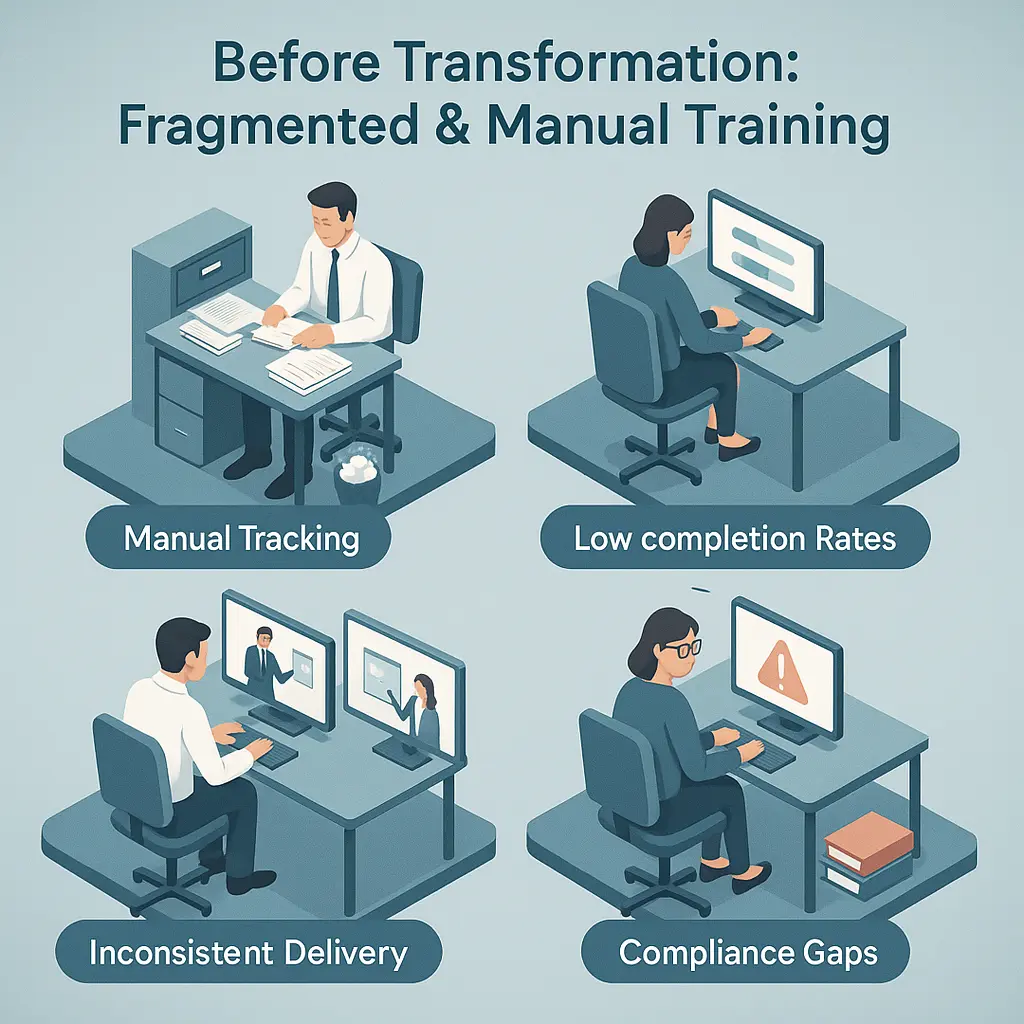
Before digital transformation, most SMEs relied on fragmented and manual training processes-spreadsheets for tracking, ad-hoc sessions for delivery, and inconsistent content shared across teams. While these approaches met short-term needs, they struggled to scale, resulting in uneven skill development and limited performance visibility. In the case examined, the organization realized that without a structured system to centralize learning and measure outcomes, training efforts were reactive rather than strategic. This realization became the catalyst for initiating the SME Training Transformation journey.
Key Operational Pain Points:
- Manual administration overload: HR and team leads spent an estimated 30–40% of their time coordinating sessions, attendance, and reporting.
- Inconsistent learning experiences: Employees in different locations received varied versions of training materials, leading to knowledge gaps and procedural errors.
- Limited tracking and analytics: Leadership had little visibility into course completion rates, learner progress, or skill development outcomes.
- Compliance vulnerabilities: Missing documentation and inconsistent record-keeping created audit risks and potential regulatory penalties.
- Low training ROI: Without structured assessment and reinforcement, less than 50% of employees retained or applied new skills effectively.
These challenges collectively hindered operational efficiency and eroded the business value of training investments-highlighting the need for a scalable, data-driven approach to workforce development.
3. Assessing the Baseline: KPI and Performance Benchmarking
Before initiating the SME Training Transformation, leadership conducted a baseline assessment to quantify the existing state of learning performance and identify improvement areas. This analysis focused on core training KPIs-participation, completion, compliance adherence, and time-to-productivity-benchmarked against industry standards for similar-sized enterprises. The findings revealed significant performance gaps, especially in training efficiency, measurement maturity, and ROI visibility.
| Training KPI | Before Transformation | Industry Standard (Benchmark) |
|---|---|---|
| Training Completion Rate | 58% | 85% |
| Employee Onboarding Time | 6–8 weeks | 4–5 weeks |
| Compliance Certification Adherence | 72% | 95%+ |
| Skill Retention (Post-Training, 60 Days) | 45% | 75% |
| Administrative Effort per Training Cycle | High (Manual, ~30 hours) | Low (Automated, <10 hours) |
| ROI Visibility and Reporting Accuracy | Low | High |
Key Insights:
- Measurement Gaps: Absence of centralized data made it difficult to correlate training activity with business performance metrics.
- Compliance Lag: Suboptimal certification tracking exposed the business to governance and audit risks.
- Inefficient ROI Tracking: With limited visibility into cost vs. outcome, leadership lacked the evidence needed to justify or optimize training investments.
This benchmarking exercise provided a clear starting point for the transformation roadmap-defining both the performance baseline and the measurable targets for post-implementation success.
4. The Turning Point: Why Digital Training Became a Strategic Necessity
As market dynamics shifted and workforce models evolved, it became clear that traditional, in-person training could no longer keep pace with business demands. SMEs needed scalable, data-driven systems to rapidly upskill employees, ensure compliance, and maintain consistent standards across dispersed teams. The SME Training Transformation initiative emerged as a direct response to this urgency-replacing fragmented processes with a digital training framework capable of delivering measurable speed, consistency, and cost efficiency. In today’s environment, digital learning is no longer a technological upgrade-it’s a business survival strategy.
Key Drivers for Change:
- Workforce Agility: SMEs must reskill and redeploy talent quickly to adapt to new tools, markets, and regulations.
- Hybrid Work Enablement: Distributed teams require accessible, standardized learning accessible anytime, anywhere.
- Faster Time-to-Competence: Digital modules and performance analytics accelerate learning cycles by 30–40%.
- Cost Pressures and ROI Accountability: Leadership demands transparent training ROI, achievable only through centralized delivery and automated reporting.
5. The Transformation Blueprint: From Traditional Training to Smart Learning
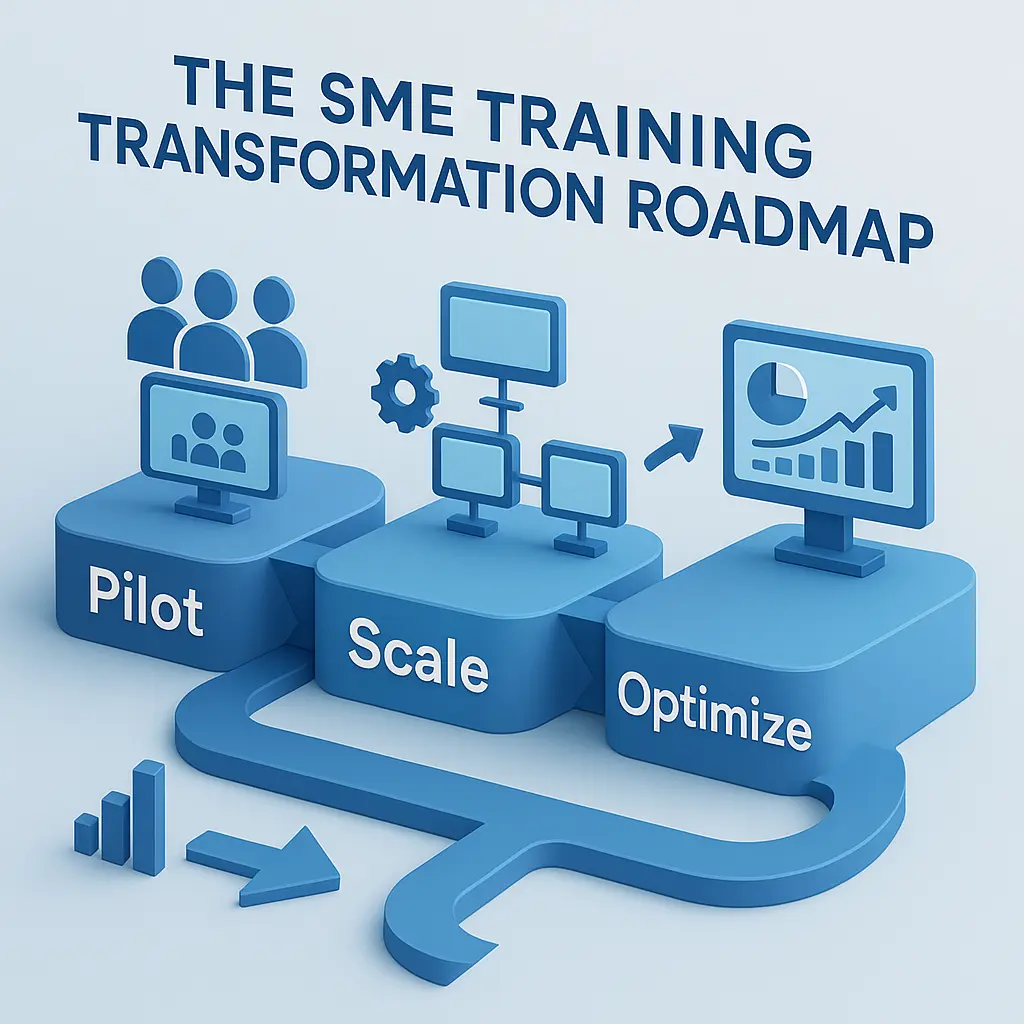
The SME Training Transformation initiative was designed as a structured, phased roadmap that aligned learning objectives with measurable business outcomes. Rather than executing a one-time rollout, leadership adopted an iterative approach focused on proof of concept, scalability, and continuous optimization. This ensured training modernization was not just a technology project-but a strategic capability-building program directly tied to key performance indicators (KPIs) such as productivity, compliance, and employee readiness.
Three-Phase Execution Roadmap:
- Phase 1 – Pilot: Launch digital learning with a selected department to validate platform usability, content quality, and learner engagement. Collect baseline data on completion rates, time-to-competence, and feedback scores to fine-tune delivery.
- Phase 2 – Scale: Expand adoption across functions and locations, standardizing course libraries, certification workflows, and reporting dashboards. Leadership alignment ensured that training outcomes were reviewed alongside performance metrics in monthly business reviews.
- Phase 3 – Optimize: Introduce data-driven refinements-automated skill-gap tracking, adaptive learning paths, and KPI-based performance reporting-to continuously improve ROI and align training investments with evolving organizational priorities.
This phased model allowed the organization to balance execution speed with strategic control, ensuring that leadership could monitor, measure, and refine training effectiveness in real time.
6. Centralizing Learning Delivery with Advance The Team Platform
As part of the SME Training Transformation, implementing Advance The Team created a unified digital hub for all training operations-replacing scattered tools, manual spreadsheets, and inconsistent processes. The platform automated key administrative tasks, standardized course delivery, and provided real-time visibility into learner progress and compliance status. This centralization not only reduced operational overhead but also improved accountability and training consistency across departments.
Key Outcomes:
- Automated administration: Reduced manual scheduling and tracking time by nearly 60%.
- Unified progress tracking: Leadership gained real-time dashboards showing completion rates and performance metrics.
- Enhanced compliance control: Certification workflows and audit-ready reporting ensured 100% visibility into mandatory training.
- Streamlined content delivery: Course updates and communication reached all teams simultaneously, eliminating duplication and errors.
7. Empowering Workforce Performance and Skill Development
Through the SME Training Transformation, the organization shifted from static instruction to data-informed capability building. Advance The Team enabled workforce analytics that linked training activity to performance outcomes-allowing leaders to identify high-impact courses, close skill gaps faster, and tailor learning paths by role or department. Interactive dashboards provided actionable insights into engagement levels, completion trends, and time-to-competence, transforming training data into a strategic performance management tool.
Measured Outcomes:
- Reduced performance variance by 35% through consistent, role-based upskilling.
- Faster ramp-up times-down by 40%, improving workforce readiness for new roles and technologies.
- Skill-gap identification accuracy improved by 50%, enabling more targeted training investments.
- Leadership visibility increased, with real-time dashboards supporting data-driven talent decisions and performance reviews.
8. Quantifying Results: The Measurable Business Impact
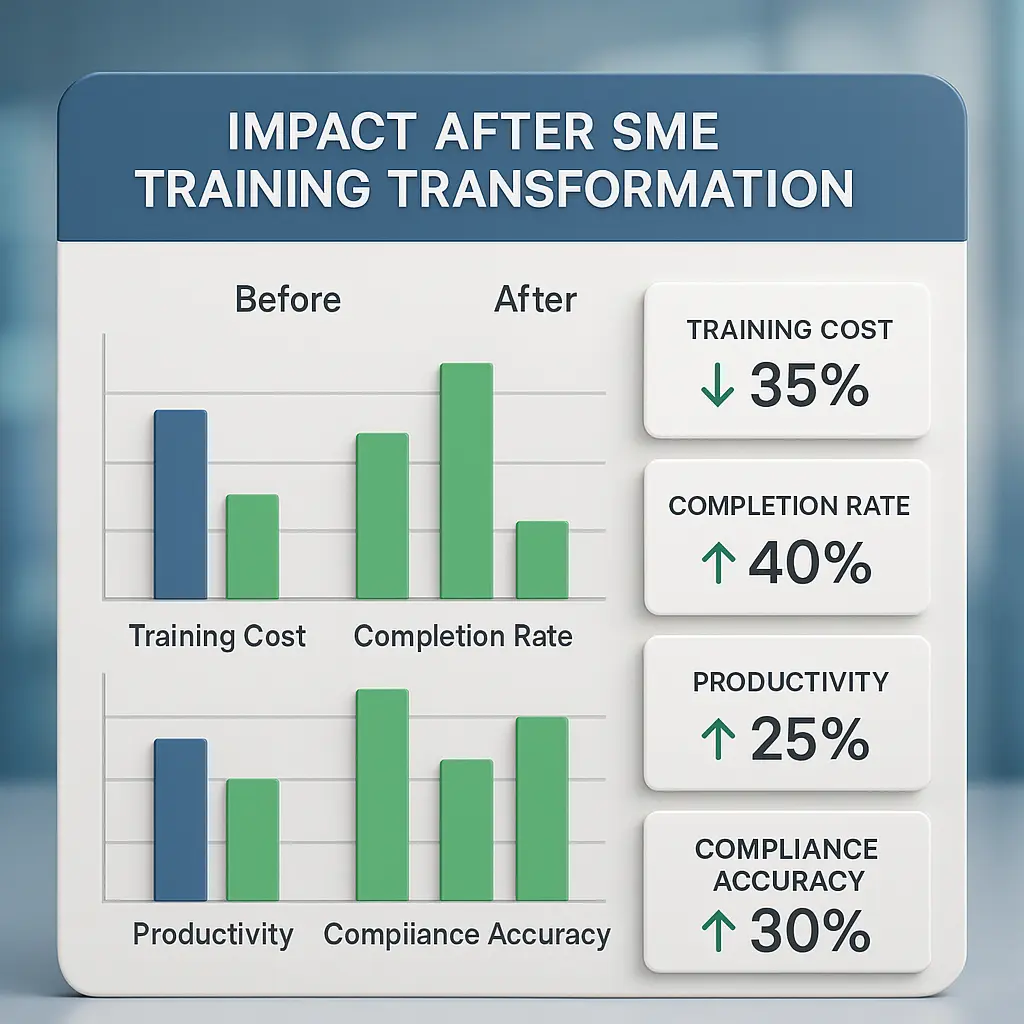
Following the SME Training Transformation, the organization recorded tangible performance gains across multiple dimensions-training efficiency, workforce productivity, and operational compliance. By replacing manual tracking with data-driven workflows and centralized delivery, leadership could clearly measure progress against pre-defined KPIs and validate the ROI of their learning investment.
Before vs. After Improvements:
- Training completion rate: Increased from 58% to 92%, ensuring broader skill coverage across all departments.
- Training cost per employee: Reduced by 24% through automation and content standardization.
- Time-to-competence: Shortened by 38%, accelerating new-hire productivity.
- Administrative workload: Cut by 65%, freeing HR and L&D teams for strategic tasks.
- Compliance accuracy: Improved from 72% to 98%, significantly reducing audit risk.
- Productivity gains: Overall workforce output rose by 30%, directly correlated with consistent learning adoption.
- Error rate reduction: Operational mistakes linked to training gaps declined by 45%.
These measurable outcomes were captured within a structured ROI framework-comparing training costs, time saved, and performance metrics-to demonstrate clear financial justification and sustained value creation for the business through the SME Training Transformation.
9. Beyond ROI: Building Long-Term Capability and Continuous Learning Culture
The SME Training Transformation extended far beyond operational efficiencies-it reshaped the organization’s learning culture into a continuous capability development system. Training evolved from a periodic requirement into a strategic business function supported by leadership accountability, data transparency, and ongoing skill renewal. By embedding learning into daily workflows and decision-making processes, the organization ensured sustained performance growth and adaptability to future challenges.
Cultural Advancements:
- Continuous learning embedded: Employees now access microlearning modules and refresher courses as part of routine operations, reinforcing skill retention.
- Leadership accountability strengthened: Managers regularly review team learning dashboards, integrating development goals into performance reviews.
- Agile capability building: Ongoing analytics help identify emerging skill gaps early, enabling proactive reskilling and workforce agility.
10. Why SMEs Must Digitize Training Now: Agility, Retention, and Competitive Edge
The pace of change in today’s market leaves no room for training inefficiencies. SMEs that delay digital transformation risk falling behind competitors who can adapt, reskill, and mobilize their workforce faster. The SME Training Transformation demonstrated that digitized learning is not simply a technology upgrade-it’s a critical business investment for resilience, retention, and long-term growth. Every quarter without modernization compounds skill decay, turnover risk, and operational drag.
Risks of Inaction:
- Higher employee turnover: Lack of development opportunities drives disengagement and attrition among high performers.
- Skill obsolescence: Static, paper-based training fails to keep pace with evolving tools and compliance standards.
- Reduced business agility: Manual systems slow response time to market shifts and regulatory changes.
- Opportunity cost: Competitors leveraging digital learning platforms gain faster innovation cycles and stronger workforce adaptability.
11. Strategic Enabler: How Advance The Team Supports Scalable Training Growth
Within the SME Training Transformation, Advance The Team functioned as the operational backbone that enabled scalable, measurable growth in workforce capability. Its architecture allowed the organization to unify content, analytics, and learner engagement under a single ecosystem-supporting both current performance goals and future expansion. By aligning technology with leadership decision-making and data-driven insights, the platform positioned training as a continuous, scalable business process rather than a one-time initiative.
Platform Strengths:
- Seamless integrations: Connected with HRIS, performance, and compliance systems to automate data exchange and maintain a unified learner record.
- Leadership dashboards: Delivered real-time insights into participation, skill progression, and ROI indicators for strategic oversight.
- Growth readiness: Designed to scale with organizational size, supporting multi-department expansion and evolving training priorities without disruption.
12. Lessons Learned and Best Practices for SME Training Leaders
The SME Training Transformation underscored that successful learning modernization depends as much on organizational mindset as on technology. Beyond implementing digital tools, leadership had to drive cultural adoption, process discipline, and ongoing optimization. The experience revealed a set of best practices that other SMEs can apply-and common pitfalls they should proactively avoid-to ensure long-term impact and sustainability.
Key Lessons and Pitfalls:
- Start with measurable KPIs: Define success metrics before implementation to ensure training aligns with business outcomes.
- Secure leadership sponsorship early: Transformation momentum depends on visible executive support and consistent communication.
- Avoid over-customization: Excessive tailoring slows scalability and complicates future updates.
- Invest in content quality, not just technology: Outdated or generic learning materials undermine engagement and ROI.
- Drive continuous engagement: Reinforce learning through feedback loops, peer collaboration, and recognition programs.
- Monitor data regularly: Use analytics to track adoption trends and intervene before engagement or performance drops occur.
13. Next Steps: How to Evaluate and Optimize Your Training Strategy
Building on the insights from the SME Training Transformation, organizations ready to modernize their learning approach should begin with a structured evaluation process. The goal is to establish clarity—on where current training stands, what outcomes matter most, and which technologies can scale effectively without adding complexity. A methodical readiness assessment ensures that SME Training Transformation efforts deliver measurable impact and sustainable ROI.
Strategic Evaluation Checklist:
- Conduct a training audit: Map existing programs, delivery methods, and performance gaps across departments.
- Set measurable goals: Define success metrics such as time-to-competence, compliance rate, and cost per learner.
- Align leadership commitment: Ensure executive sponsors are accountable for linking training outcomes to business performance.
- Evaluate technology fit: Assess LMS options based on scalability, analytics capability, and integration with existing systems.
Readiness Indicators:
- Clear ownership of learning outcomes and defined performance KPIs.
- Leadership agreement on training’s strategic role in workforce agility.
- Reliable data systems for tracking progress and ROI.
- Organizational culture supportive of continuous learning and digital adoption.
Conclusion
The SME Training Transformation reinforced a crucial truth-training, when designed strategically and delivered digitally, becomes a core business enabler rather than an operational expense.
By integrating solutions like Advance The Team, organizations can centralize learning, automate tracking, and connect skill growth directly to business performance. This shift transforms training from a fragmented activity into a structured, data-driven capability that fuels innovation, compliance, and workforce resilience.
SMEs that invest in continuous digital learning not only improve productivity and reduce costs but also strengthen their adaptability in fast-changing markets.
In an era where agility defines competitiveness, embedding smart training systems like Advance The Team empowers leaders to build teams that learn faster, perform better, and sustain long-term growth.